Scale the workforce to the work.
As analytical demand changes, scale AI agents around the tasks and functions you need. Start with one bounded workflow and expand its scope under your policies.
Explore AI agents →StromaOS gives life sciences organizations an elastic analytical workforce that performs regulated work under policy, records the evidence of execution, and preserves human authority.
Specialist AI agents are organized into teams called Fleets. They perform analytical work across biostatistics, medical writing, regulatory, safety, HEOR and many more, within the scope your organization authorizes.
As analytical demand changes, scale AI agents around the tasks and functions you need. Start with one bounded workflow and expand its scope under your policies.
Explore AI agents →Approved methods, data permissions and worker clearance determine what can run. Work that exceeds the authorized scope is blocked or routed for human review.
Explore policy controls →The Evidence Data Trace records inputs, methods, controls, actions and exceptions as work runs, giving reviewers evidence of how an output was produced.
Read an example record →Named people hold approval and sign-off authority. AI agents prepare analyses and outputs; accountable reviewers decide whether to accept them for their intended use.
See the human sign-off →Evidence work runs on people: statisticians and medical writers you hire, safety reviewers you recruit, the functional team you contract for a program. Capacity arrives slowly, leaves completely, and every additional question is a change order.
A filing needs three times the team for four months. Hiring takes two quarters. The contract takes six weeks. The work waits.
The people who learned your compounds, endpoints and reviewer standards move on at the end of the engagement. The next program starts from zero.
Every extra analysis is billable. So the sensitivity analysis, the extra subgroup, the second look - quietly don’t happen.
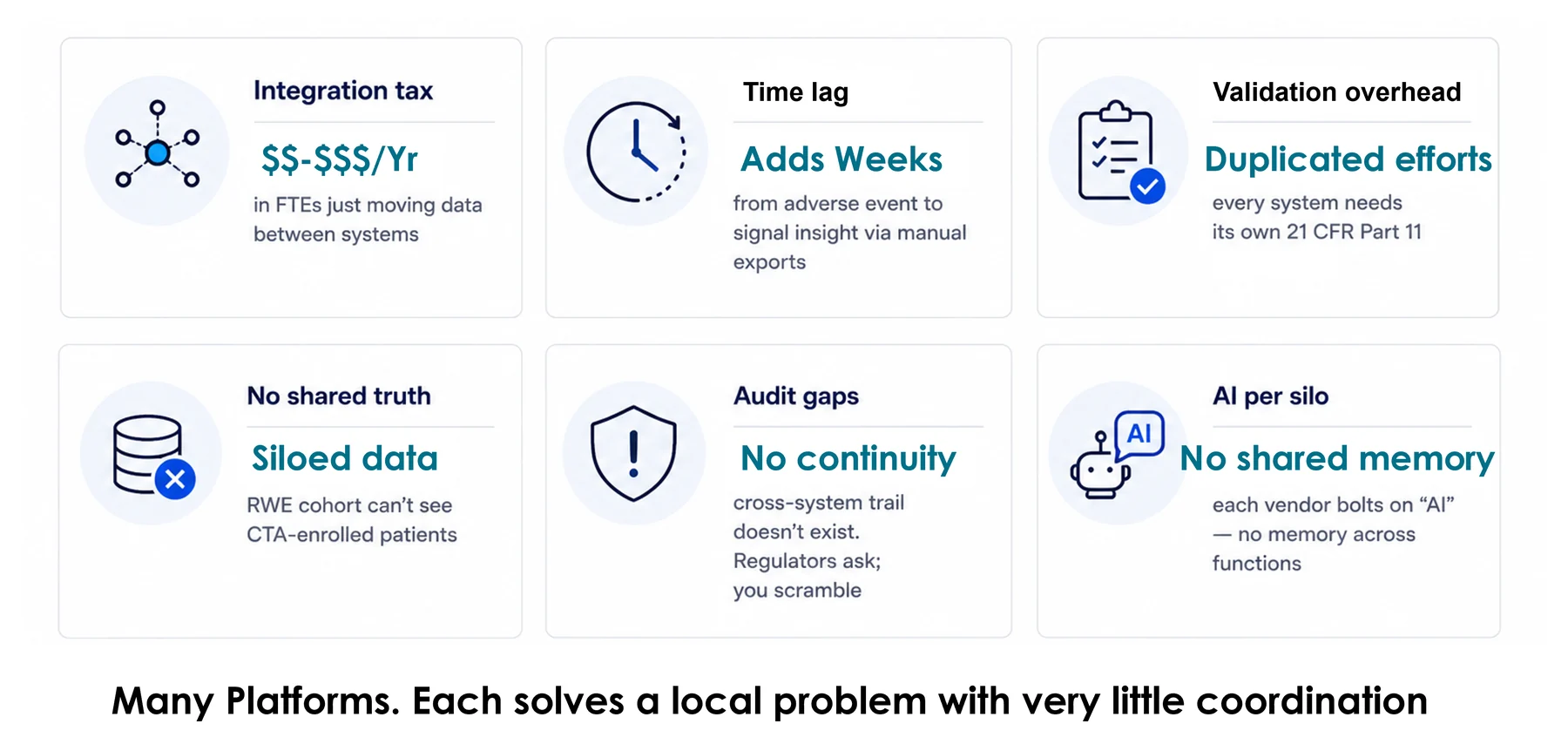
Each platform solves its own problem well. The cost lands in the space between them - and it is paid in people, lag and audit exposure rather than licence fees.
A Fleet coordinates the work, performs authorized tasks and checks execution against policy. Named people retain authority over the decisions and approvals.
| The team you’d staff today | A StromaOS Fleet | What it does |
|---|---|---|
| Project lead who scopes and assigns | Lead Agent | Frames the objective, plans execution, assigns work, reconciles outputs and prepares the decision. |
| Statisticians, programmers, medical writers | Worker Agents | Perform bounded domain tasks using approved skills, tools, methods, models and source evidence. |
| QA reviewer and the compliance function | Sentry Agent | Quality gates, policy enforcement, authority routing and Evidence Data Trace - applied before the action, not after. |
| Contracted, then moves on | Institutional memory | It stays. Your compounds, endpoints, SOPs and reviewer standards retained as a governed asset you own. |
Reproducible methods, controlled data access and traceable work products support the workforce. Review the execution architecture against your intended use.
Survival and Cox models, propensity matching, causal inference and probabilistic sensitivity analysis execute under a pinned engine with a required seed - version-controlled and reproducible, with the validation evidence needed to qualify a method for your intended use.
Patient-level reasoning executes where the data already sits, so the data classification does not have to change to get the analysis done. Achievable elsewhere only with substantial customer engineering.
Generate SDTM, ADaM, define.xml and conformance artifacts through a governed, reproducible execution chain - not exported for someone else to assemble.
Clone a definition from the library and change what doesn’t fit - dragging steps on a canvas, describing the change in plain language, or editing the DSL underneath. The statistician who wants the extra covariate makes that change and runs it. Every edit is a new version with its own approval gate and evidence record, so the work doesn’t route through IT and the understanding doesn’t leave with a consultant.
The actual screen
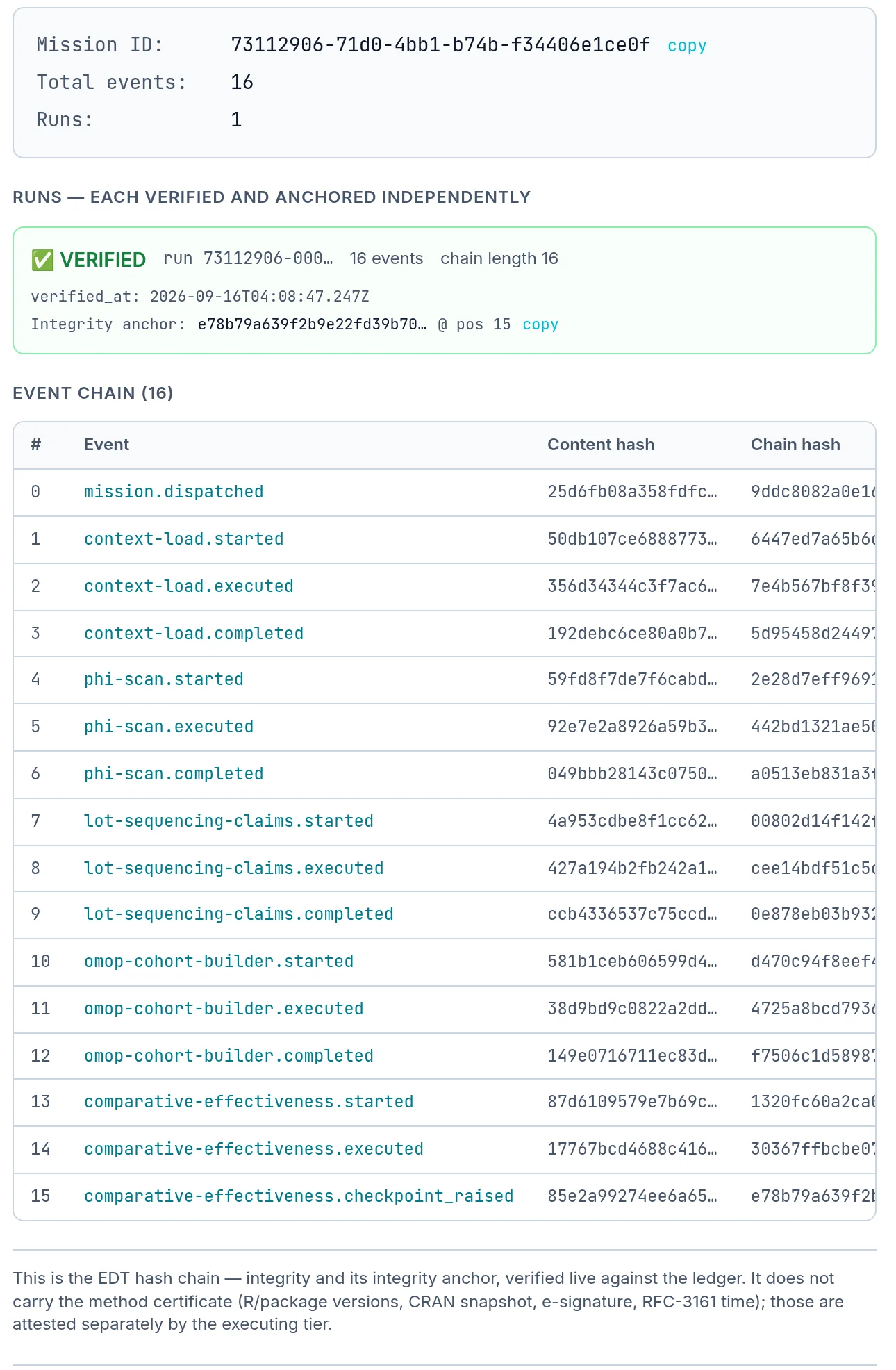
Before the record below, the screen that produces it. Sixteen events, each hashed into the next, verified against the ledger on demand. The record in the section that follows is one of these reproduced in full, field by field, so you can read what an inspector would read.
Captured from a running instance. Demo tenant on synthetic and public test data.
This illustrative record connects a completed analysis to its inputs, method, policy checks and the named person who accepted it for use.
| Analysis authorityCTL-RWE-014 | Method approved for use and within worker clearance | Pass |
| Data residencyCTL-GOV-002 | Execution confined to the sponsor perimeter | Pass |
| License entitlementCTL-DAT-009 | Entitlement valid for every licensed asset resolved | Pass |
AI agents performed the analysis under policy and recorded the execution evidence. The named reviewer retained authority to approve its use. Refused actions and exceptions are recorded too.
A single task executed under policy, with the evidence record opened line by line - inputs, method, controls evaluated, the exception raised and the named human who signed. No deck, and nothing gated.
Most engagements begin with one constrained function and a Fleet built around it. If you’d rather shape the product while you deploy it, the design partner program is open.
A ninety-minute working session. We map one function you’re constrained on, show the Fleet that would run it against your existing stack, and scope a first deployment - including the parts where the answer is no.
Book a working sessionThe platform and its governance architecture are built. We are selecting a small number of sponsors and CROs to co-design additional production Fleet configurations by function - direct influence on the roadmap, an architecture review, and commercial terms that reflect the contribution.
Enquire about design partnershipDeploy in your VPC, embedded in your data platform, or fully air-gapped - or run it managed by us. The governance envelope is the same in every posture; where the data sits is your choice.