Approved and emerging evidence live in separate channels.
Publications, trial updates, congresses, internal analyses, approved content, field insights, and medical questions are monitored and reviewed in different systems.
StromaOS connects scientific monitoring, field insight, medical information, evidence response, scientific communications, review, approval, and reuse in one governed execution environment.
Medical affairs and medical information operate at the intersection of changing evidence, external scientific exchange, field insight, approved response, compliance, and local execution. The work is often split across monitoring tools, insight systems, repositories, documents, email, vendors, and manual review.
Publications, trial updates, congresses, internal analyses, approved content, field insights, and medical questions are monitored and reviewed in different systems.
Medical information staff repeatedly retrieve, verify, cite, draft, and review content that the organization has already approved or closely related evidence it has already assessed.
Field notes, stakeholder questions, patterns, hypotheses, recommendations, and decisions are often compressed into the same record, weakening the ability to distinguish evidence from inference.
AI can classify, retrieve, summarize, and draft, but it cannot be allowed to select unapproved evidence, infer beyond the record, bypass medical review, or communicate without explicit authority.
StromaOS coordinates scientific monitoring, question classification, approved evidence retrieval, insight analysis, drafting, citations, review, approval, engagement, follow-up, and reuse in one execution model.
Publication, congress update, field insight, unsolicited question, competitor event, guideline, or evidence change.
Question type, audience, jurisdiction, channel, approved evidence scope, urgency, and required review.
Approved content, source evidence, citations, limitations, emerging evidence, prior responses, and unresolved gaps.
Source-linked synthesis, approved language, exceptions, medical review, compliance review, and revision.
Authorized response, scientific exchange, channel controls, local adaptation, follow-up, and escalation.
Sources, versions, rationale, approval, audience, response, insight, outcome, and reusable medical memory.
StromaOS treats medical response as a governed execution chain rather than a document-generation task. Evidence eligibility, question context, approved content, citations, review requirements, local adaptation, and release authority are evaluated before communication.
The result is faster response without weakening scientific or compliance control.
Model a medical response workflow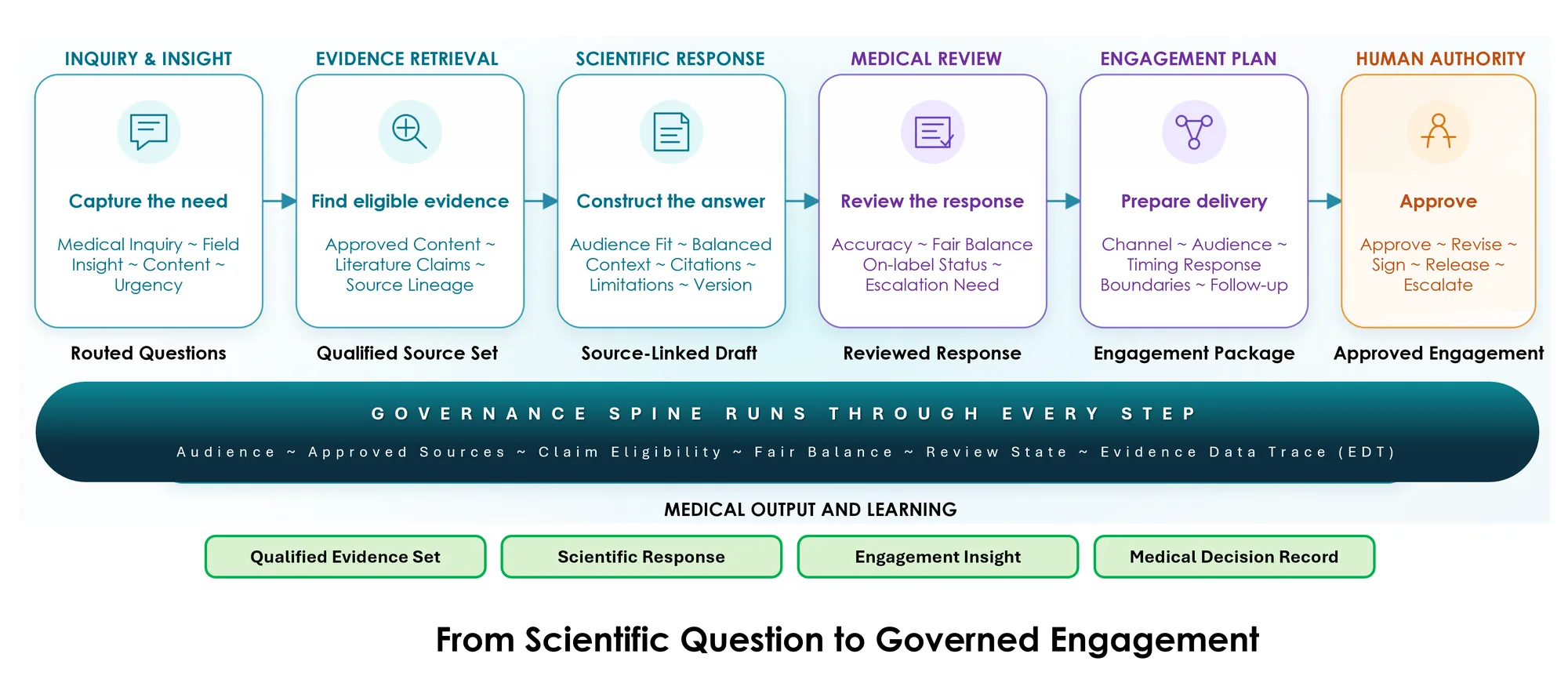
Responses are assembled from approved evidence and stay linked to it. What was said, on what basis, and who released it remain answerable long after the inquiry closed.
StromaOS separates monitoring, classification, retrieval, synthesis, drafting, interpretation, recommendation, review, approval, local adaptation, release, and engagement.
Explore the Governance SpinePolicy determines which approved and emerging evidence may be used for a specific question, audience, jurisdiction, channel, purpose, and response type.
Field observations, stakeholder questions, patterns, interpretations, hypotheses, recommendations, and decisions remain distinct in the record.
AI may classify, retrieve, summarize, compare, and draft without receiving authority to approve, adapt, send, publish, or communicate.
Medical, compliance, legal, local, channel, audience, and jurisdiction reviews are applied according to the content and communication context.
Sources, claims, prompts, versions, citations, comments, decisions, approvals, audience, channel, response, follow-up, and outcome remain reconstructable.
Connect the evidence sources and specialist systems already in use. Define approved evidence, audience, jurisdiction, review, release authority, and reuse boundaries. Then run the work as one governed medical operation.