What we have to offer
Three parts. None of them is the product on its own - a workforce without governed execution is a generic agent platform, and governed execution without your data and your authority is somebody else’s system.
One - the work
Performed, not tooled.
Biostatistics, medical writing, regulatory, safety and HEOR executed end to end by governed specialists you scale without hiring, built for pharmaceutical work rather than adapted to it.
Two - the proof
Proven while it runs.
Policy is evaluated before a task is dispatched, not reviewed after it lands, and every result arrives with the evidence record that defends it.
Three - the authority
Under your authority.
Your data and your models, deployed where you choose - managed, in your VPC, embedded, or air-gapped - with every decision right resolved to a named person in your organization, never to the platform.
Implemented framework
Governance depth that can be executed, measured, and audited.
The control catalog spans scientific integrity, data integrity, validation, GCP, GVP, quality, security, privacy, risk, audit, electronic signatures, CAPA, change control, provenance, model governance, agent governance, and more.
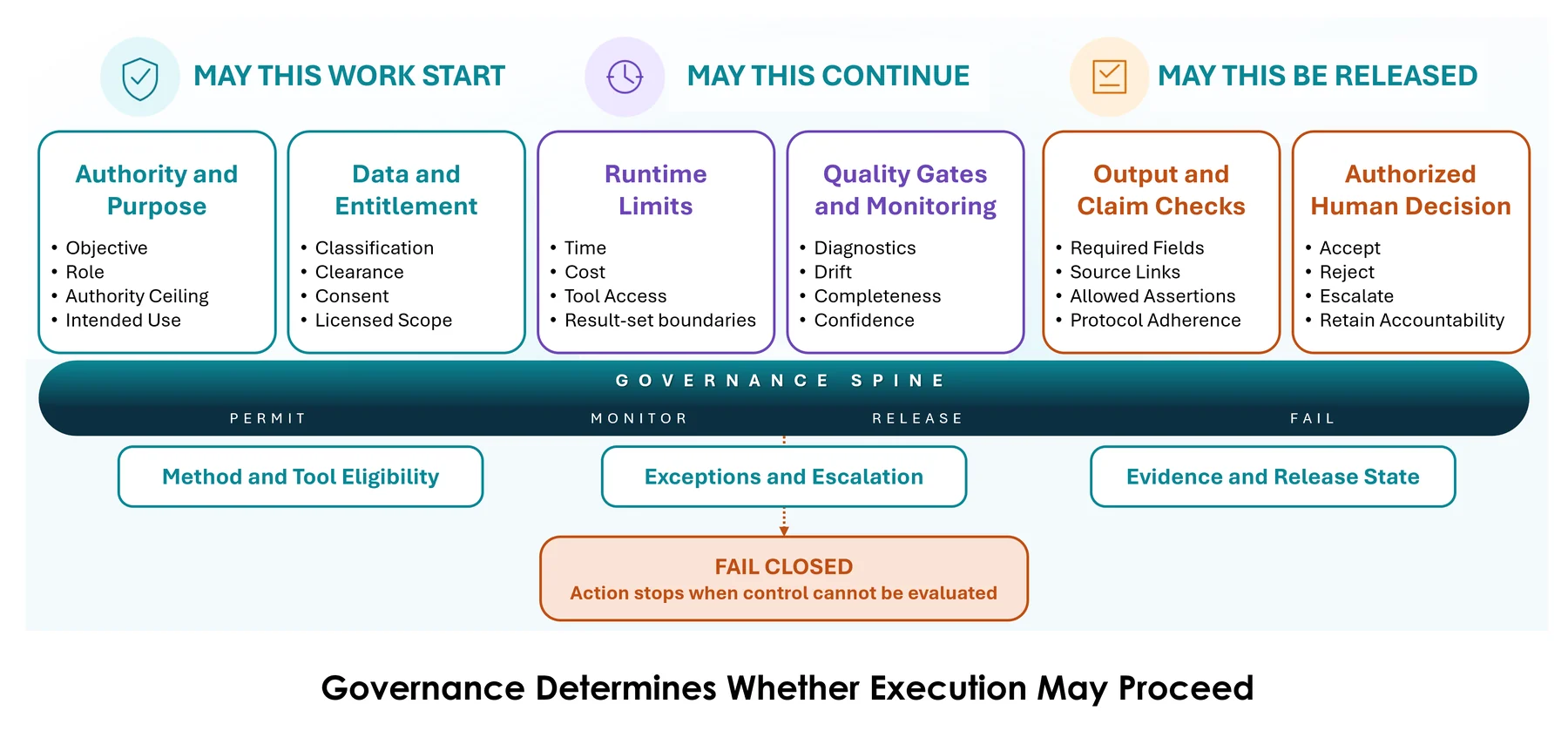
Three questions, asked continuously rather than at the end. When a control cannot be evaluated the action stops - the failure mode is refusal, not a best-effort result nobody flagged.
Five execution archetypes
Every control is implemented through one or more runtime mechanisms.
This architecture prevents governance from becoming a checklist detached from execution.
Metric
Measures operating state, risk, quality, completeness, timeliness, drift, or performance against a defined threshold.
- Continuous or scheduled evaluation
- Threshold and trend monitoring
- Evidence-linked scorecards
- Escalation on breach
Gate
Blocks progression until specified evidence, approvals, signatures, quality conditions, or authority requirements are satisfied.
- Preflight and release gates
- Human approval requirements
- Mandatory evidence checks
- Exception routing
Ruleset
Executes deterministic policy logic using structured facts, conditions, thresholds, classifications, and outcomes.
- Policy-as-code
- Versioned deterministic logic
- Explainable rule outcomes
- Reusable domain policies
Process
Coordinates multi-step governed work involving systems, agents, human tasks, reviews, escalations, deadlines, and evidence capture.
- Workflow orchestration
- Human tasks and SLAs
- Escalation and remediation
- End-to-end auditability
Quality Agent
Performs contextual review, challenge, anomaly detection, completeness assessment, consistency checking, and evidence reconciliation.
- Context-aware review
- Cross-document consistency
- Quality and risk challenge
- Human escalation for ambiguity
Control domains
One framework across scientific, regulated, operational, and technical risk.
Controls are grouped by domain but executed through the same Sentry architecture.
Integrity, provenance, and knowledge
ALCOA+, lineage, source eligibility, versioning, traceability, evidence strength, retention, and permissible use.
CSV, AI validation, and scientific integrity
Qualification, intended use, model validation, method validation, reproducibility, reference datasets, and controlled change.
GCP, GVP, medical, and patient protection
Protocol compliance, case handling, signal governance, benefit-risk review, medical authority, and escalation.
CAPA, change, deviation, and release
Investigation quality, root cause, action ownership, effectiveness, change impact, batch and product disposition.
Access, purpose, confidentiality, and resilience
Identity, least privilege, data minimization, residency, encryption, segregation, incident response, and availability.
Risk, audit, signatures, and accountability
Authority separation, e-signatures, approvals, audit evidence, policy exceptions, monitoring, and executive oversight.
Control lifecycle
Controls evolve through governed design, deployment, execution, and improvement.
STEP 01
Define the obligation
Source, rationale, scope, risk, owner, evidence, and intended control outcome.
STEP 02
Select archetypes
Metric, Gate, Ruleset, Process, Quality Agent, or a combined implementation.
STEP 03
Configure the profile
Product, module, market, lifecycle stage, deployment, risk class, and authority.
STEP 04
Execute in the Sentry
Preflight, runtime checks, evidence capture, blocking, escalation, and remediation.
STEP 05
Review effectiveness
Breaches, false positives, exceptions, delays, residual risk, and control performance.
STEP 06
Version and preserve
Approval, deployment, supersession, lineage, Evidence Data Trace, and audit.
Sentry execution
The Sentry Agent turns governance into operational behavior.
The Sentry Agent evaluates the applicable control profile before work begins, monitors execution while it proceeds, and determines whether outputs may advance, require remediation, need human review, or must be blocked.
Because controls are encapsulated in the Fleet, governance cannot be bypassed by a Worker Agent or treated as an external reporting function.
Model a Sentry control profileGovernance profiles
Apply the right controls to the right work.
Organizations can define profiles by domain, product, process, lifecycle stage, market, deployment posture, risk level, and intended use.
Scientific and functional governance
Clinical, safety, regulatory, CMC, quality, HEOR, medical, security, privacy, and enterprise profiles.
Control intensity by consequence
Higher-risk work can require stronger evidence, additional quality agents, independent verification, or expert-panel review.
Cloud, VPC, and air-gapped controls
Control requirements adapt to data movement, model access, network boundaries, hosting, and operational responsibility.
Controls that evolve with product maturity
Discovery, clinical development, submission, launch, and post-market work apply different authority, evidence, and monitoring requirements.
Framework outcomes
Governance becomes measurable operating capability.
Apply policy the same way across every Fleet.
Common archetypes, profiles, evidence standards, and Sentry execution reduce local interpretation drift.
Resolve control requirements before review deadlines.
Automated metrics, gates, and rulesets expose gaps early and reduce manual governance reconstruction.
Make authority and exception ownership explicit.
Every override, escalation, approval, remediation, and residual-risk decision remains named and traceable.
Preserve evidence of control execution.
Show which control applied, how it executed, what evidence was used, who decided, and what happened next.
What it looks like in practice
Controls executing, and the record they leave.
A governed run against a real control profile - including the actions the Sentry Agent refuses before dispatch, which is the part worth watching.
Start with one high-risk workflow where policy is still enforced manually.
Map the obligation, choose the control archetypes, configure the Sentry profile, define authority, and capture the evidence record. Then operate governance as runtime execution.