Specialist AI agents
Deploy governed specialists that execute regulated work.
StromaOS provides 90+ role-based AI agents and 350+ executable skills across the pharmaceutical lifecycle. AI agents operate inside Fleets with explicit responsibilities, approved tools, evidence scope, intelligence tiers, quality requirements, authority ceilings, and Sentry-enforced governance.
90+ governed agents350+ executable skills16+ packaged Fleets16+ intelligence modulesLead + Worker + Sentry
What we have to offer
Three parts. None of them is the product on its own - a workforce without governed execution is a generic agent platform, and governed execution without your data and your authority is somebody else’s system.
One - the work
Performed, not tooled.
Biostatistics, medical writing, regulatory, safety and HEOR executed end to end by governed specialists you scale without hiring, built for pharmaceutical work rather than adapted to it.
Two - the proof
Proven while it runs.
Policy is evaluated before a task is dispatched, not reviewed after it lands, and every result arrives with the evidence record that defends it.
Three - the authority
Under your authority.
Your data and your models, deployed where you choose - managed, in your VPC, embedded, or air-gapped - with every decision right resolved to a named person in your organization, never to the platform.
Implemented workforce
A governed operating workforce, not a directory of generic chatbots.
Specialist AI agents combine executable skills, processes, scientific methods, governance controls, ontologies, and approved models. Each agent is defined by the work it can perform and the boundaries it cannot cross.
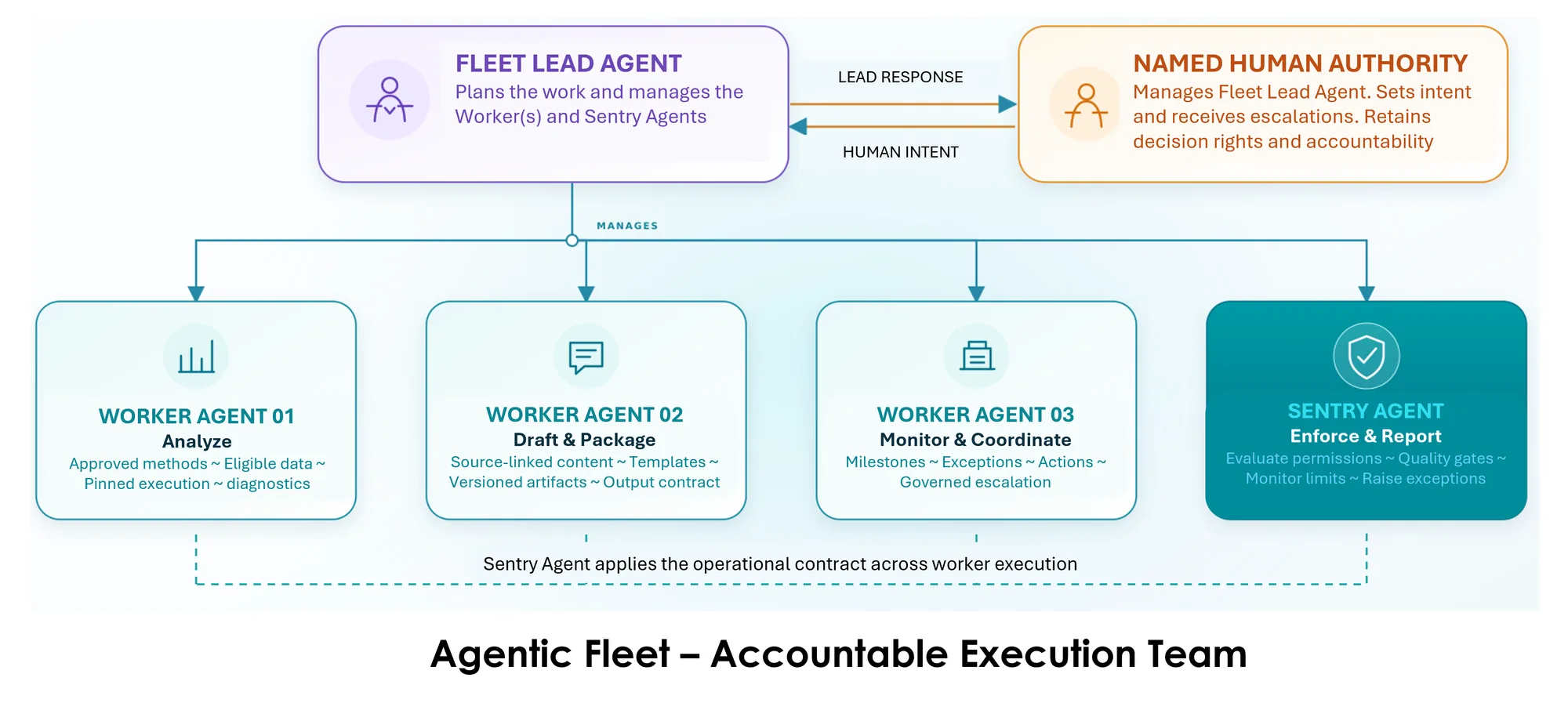
The Lead plans, the Workers execute, the Sentry enforces. None of them decides - decision rights resolve to a named person in your organization, and the Sentry's exceptions return to the Lead rather than being resolved quietly.
Agent roles
Each agent is a bounded specialist with a defined operational contract.
An AI agent is more than a persona. Its contract defines purpose, inputs, outputs, allowed skills, approved data, permitted tools, available intelligence tiers, quality thresholds, escalation conditions, and maximum authority.
Scientific intelligence agents
Connect biological, chemical, translational, portfolio, and external evidence to research decisions.
- Target and mechanism intelligence
- Literature and evidence synthesis
- Biomarker and translational review
- Portfolio scenario support
Trial and development agents
Coordinate design, feasibility, operations, analytics, pharmacology, risk, and evidence readiness.
- Protocol and endpoint support
- Site and enrollment intelligence
- Clinical analytics and forecasting
- Study-risk and milestone monitoring
Regulated evidence agents
Assemble safety, regulatory, submission, commitment, and authority-interaction evidence.
- Case and signal support
- Regulatory intelligence
- Submission readiness
- Commitment and response tracking
CMC and quality agents
Connect process, method, deviation, investigation, CAPA, change, release, and supply evidence.
- Deviation and root-cause support
- Method and specification intelligence
- Change-impact assessment
- Release and supply readiness
RWE, HEOR, and payer agents
Build governed real-world, economic, comparative, burden, value, and access evidence.
- Cohort and causal analysis
- Economic-model support
- Payer and HTA intelligence
- Access scenario and barrier analysis
Medical affairs and information agents
Turn external insight, approved evidence, inquiries, publications, and engagement into controlled medical action.
- Insight synthesis
- Expert and publication intelligence
- Scientific response support
- Evidence-gap and education planning
Executable skills
Skills are governed capabilities that can be assigned, reused, tested, and audited.
Skills package business logic, data access, scientific methods, tools, models, output contracts, and governance requirements. Workers receive only the skills necessary for their defined role.
Retrieve, qualify, and synthesize
Find and connect eligible evidence without treating every source as equally trustworthy.
- Semantic and source-aware retrieval
- Literature and document synthesis
- Claim-to-evidence mapping
- Contradiction and gap detection
Calculate, model, and simulate
Invoke governed analytical, statistical, machine-learning, and scientific compute services.
- SQL and deterministic analysis
- R and version-controlled statistical methods
- Machine-learning executors
- Scenario and simulation workflows
Plan, route, monitor, and reconcile
Operate work across systems, people, tools, models, milestones, and dependencies.
- Workflow and task orchestration
- Cross-system action execution
- Exception and escalation handling
- Output reconciliation
Draft, adapt, and package
Create source-linked regulated content while preserving review and release authority.
- Medical and regulatory drafting
- Audience and market adaptation
- Evidence package assembly
- Version and content consistency
Check, challenge, and verify
Test inputs, methods, outputs, assumptions, completeness, consistency, and required review.
- Quality-agent review
- Ruleset and metric execution
- Independent verification
- Readiness and release checks
Capture outcomes and improve execution
Preserve what worked, what failed, why humans intervened, and what should be reused.
- Decision and outcome linkage
- Reusable execution patterns
- Skill-performance monitoring
- Knowledge promotion and expiry
Lifecycle coverage
AI agents span the full pharmaceutical operating model.
Agents can be deployed within a single module or coordinated across multiple modules when the work crosses scientific and functional boundaries.
From target question to translational evidence.
Coordinate target, mechanism, portfolio, safety, translational, pharmacology, and IND-enabling activities.
From protocol intent to study decision.
Connect design, operations, analytics, pharmacology, safety, evidence, milestones, and regulatory readiness.
From requirement to approved action.
Coordinate strategy, evidence readiness, medical writing, submissions, CMC, quality, commitments, and authority interactions.
From value evidence to sustained patient impact.
Connect HEOR, market access, medical affairs, medical information, RWE, pharmacovigilance, and lifecycle adaptation.
Governed execution lifecycle
AI agents execute through a controlled, reviewable sequence.
Every task remains connected to its objective, evidence, assigned agent, skill, tool, policy, quality state, human authority, and outcome.
STEP 01
Receive governed intent
Objective, scope, evidence need, policies, risk, decision purpose, success criteria, and authority.
STEP 02
Plan the Fleet
Lead Agent selects agents, skills, methods, tools, data, dependencies, milestones, and escalation paths.
STEP 03
Sentry preflight
Validate permissions, source eligibility, quality thresholds, models, tools, controls, cost, and allowed execution.
STEP 04
Execute bounded work
Worker Agents retrieve, analyze, model, draft, monitor, act, and produce source-linked artifacts.
STEP 05
Verify and authorize
Sentry quality gates, Lead reconciliation, human review, approval, signature, escalation, or rejection.
STEP 06
Preserve and learn
Evidence Data Trace, outcomes, intervention, performance, reusable skills, and institutional memory.
Sentry Agent control plane
Governance controls are encapsulated inside the Fleet.
The Sentry Agent is the Fleet's governance carrier. It selects and executes the applicable controls for the work, including metrics, gates, rulesets, processes, and quality-agent checks.
This keeps governance inseparable from execution. A Worker Agent cannot bypass the Sentry, and a Lead Agent cannot release regulated output until required controls and human authority are satisfied.
Design a governed FleetExecution hierarchy
Scale from one specialist to coordinated enterprise execution.
The same governed AI agent can operate inside progressively larger execution structures without losing its role, permissions, lineage, or authority boundaries.
Agent
One bounded specialist with approved skills, tools, evidence access, method routing, and Sentry-controlled execution.
Fleet
A Lead, multiple Workers, and a Sentry Agent delivering a complete governed business capability. This is what you stand up first, and what most programs run on.
Beyond a single Fleet, the same governance model extends two further steps - a shared memory boundary in which Fleets learn from each other’s work without that knowledge leaving the boundary, and sovereign federation across entities, regions and classification levels that exchanges signed evidence records rather than centralizing data. Neither changes how a Fleet is governed, and neither is something you need to decide about to start.
Packaged Fleets
Start from a Fleet that already exists, not a blank configuration.
Standing up a governed Fleet from nothing means deciding the roles, the skills each may call, the approval gates and the evidence contract before any work runs. The catalog ships 16+ packaged Fleet units with those decisions already made, so the first conversation is which one fits rather than how to assemble one.
Safety Signal Triage · PV Case Ops
Case intake, triage and signal work running as a governed unit, with the clinical assessment routed to a named safety authority rather than concluded by the Fleet.
Regulatory Ops · Study Ops
Submission and study execution work, each step producing the artifact the next one consumes and an Evidence Data Trace a reviewer can open.
Incident Triage · Contract Ops · Release Comms
The functions a scientific program depends on but rarely staffs well. Governed the same way, on the same Governance Spine, with the same evidence record.
A packaged Fleet is a starting configuration, not a fixed one. Roles, skills, approval gates and decision rights are yours to change on day one, and the catalog grows as new units are published - your deployment picks them up without a migration.
Platform outcomes
AI agents increase execution capacity without transferring accountability to AI.
Organizations gain reusable, continuously available operating capability while preserving scientific rigor, policy control, human authority, and complete reconstructability.
Scale specialist work beyond available headcount.
Run repeatable evidence, analysis, monitoring, drafting, coordination, and review tasks continuously across programs and time zones.
Apply the same methods and controls every time.
Workers reuse approved skills, processes, methods, ontologies, policies, quality gates, and output contracts.
Retain the knowledge of how work is performed.
Preserve execution patterns, interventions, exceptions, decisions, outcomes, and qualified expertise inside the operating system.
Increase automation without creating uncontrolled agents.
The Sentry Agent enforces governance inside every Fleet while qualified humans retain final authority over consequential decisions.
Fleet governance
Every Fleet operates inside the Governance Spine.
Coordination is where most multi-agent systems lose their audit trail. These four properties are what keep a Fleet accountable as it scales.
Policy-aware
Every agent in the Fleet operates under its own clearance. Authority is never borrowed from a peer and never temporarily widened to get a task through.
Shared semantic context
Agents work from one vocabulary, so a result produced by one is interpretable by the next without reconciliation.
Evidence Data Trace
Coordination is recorded, not just execution - formation, each routed request and dissolution, with both the requesting and executing agent named.
Dynamic scaling
Fleets scale to the work in front of them and release when it is done. Capacity is not a hiring plan and not a contract negotiation.
From coordinated agents to an accountable decision. Coordination without a named human at the boundary is just faster unaccountability.
Start with one recurring role where expert time is consumed by repeatable, evidence-intensive work.
Define the worker contract, required skills, source boundaries, intelligence tiers, Sentry controls, escalation paths, human authority, and measurable outcomes. Then deploy it as a governed AI agent inside a Fleet.