Claims arrive without the full decision context.
Source evidence, analysis methods, assumptions, limitations, versions, reviewers, and decision rationale are frequently separated from the statement that enters the submission.
StromaOS connects regulatory strategy, health authority questions, claims, source evidence, analyses, medical writing, review, commitments, approvals, and submission execution in one traceable operating environment.
Regulatory teams often receive analyses, conclusions, tables, narratives, and proposed claims after the operating context that produced them has been separated across functions, vendors, documents, systems, and review cycles.
Source evidence, analysis methods, assumptions, limitations, versions, reviewers, and decision rationale are frequently separated from the statement that enters the submission.
Writers, reviewers, affiliates, and vendors copy and adapt content across documents without a shared governed evidence object or explicit reuse boundary.
Review cycles capture edits but often lose the underlying issue, evidence conflict, decision authority, rationale, and downstream effect of the resolution.
AI can summarize, compare, draft, and reuse content, but it cannot be allowed to collapse evidence selection, scientific interpretation, regulatory judgment, approval, and release into one step.
StromaOS coordinates requirements, evidence, claims, authoring, review, approval, commitments, health authority response, and submission records in one execution model.
Strategy, meeting, question, submission, variation, response, label, commitment, or market requirement.
Clinical, safety, CMC, MIDD, RWE, HEOR, literature, precedents, guidance, and prior decisions.
Approved analyses, conclusions, limitations, confidence, jurisdiction, permitted use, and evidence status.
Draft from approved evidence, reuse governed content, preserve citations, route comments, conflicts, and decisions.
Technical, medical, regulatory, quality, publishing, submission, and market-specific authorization.
Versions, evidence, rationale, approvals, commitments, authority questions, responses, outcomes, and lessons.
StromaOS treats claims as governed evidence objects rather than sentences copied between documents. Each claim retains the approved evidence, analysis, limitations, confidence, jurisdiction, audience, permitted use, owner, status, and required approval.
Content can be reused faster because the boundaries of reuse are explicit.
Model a claim workflow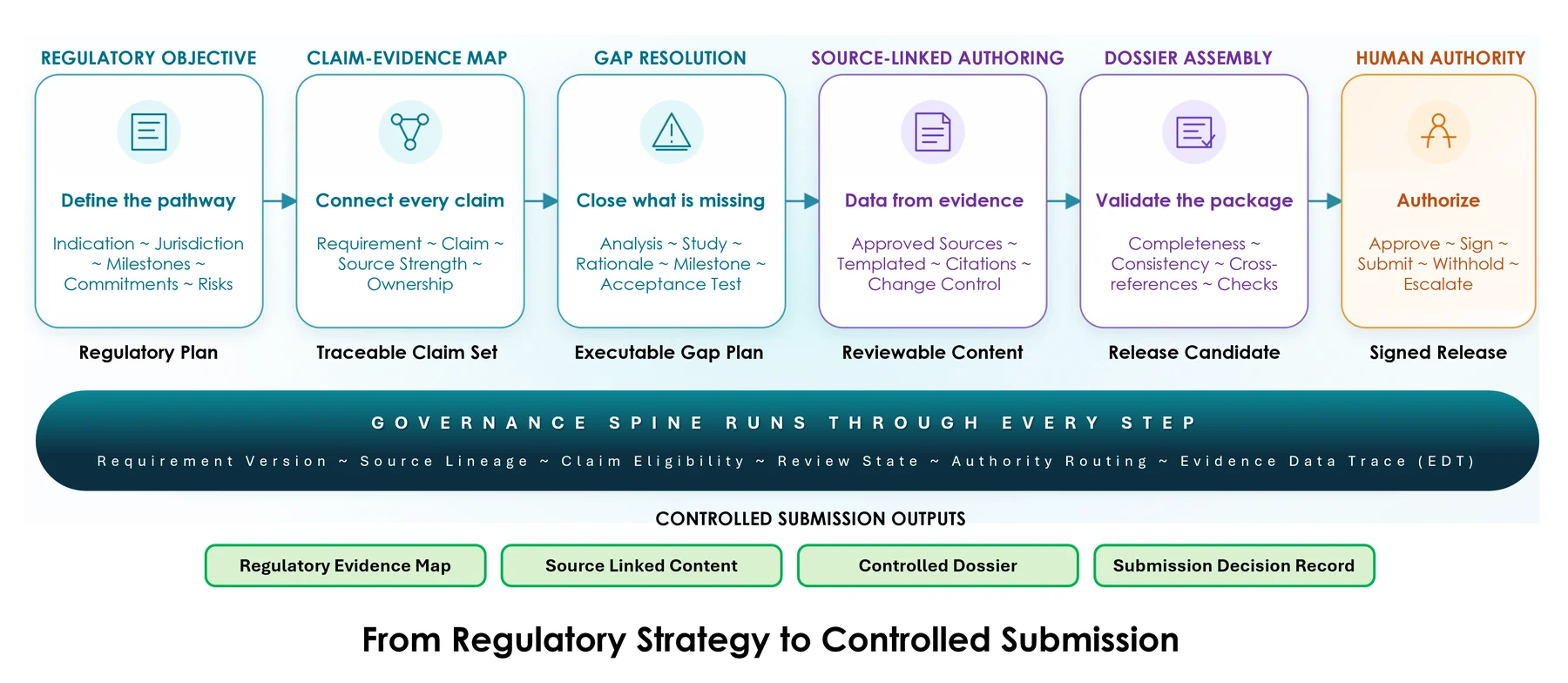
Claims stay tied to the evidence that supports them. The lineage from source to submitted statement is the deliverable, not a document produced alongside it.
StromaOS separates retrieval, analysis, interpretation, claim formation, drafting, technical review, medical review, regulatory review, approval, publishing, submission, and release.
Explore the Governance SpineEvery regulated statement remains connected to approved evidence, analyses, limitations, confidence, jurisdiction, permitted use, owner, review state, and version.
Approved components can be reused within explicit boundaries. Local adaptation, audience, market, document type, and required re-review are governed.
Drafting, scientific review, regulatory review, quality approval, publishing, submission, and release remain distinct permissions assigned to accountable roles.
Comments, evidence conflicts, proposed changes, rationale, decisions, owners, and downstream effects remain part of the execution record.
Sources, transformations, analyses, prompts, methods, versions, comments, decisions, approvals, commitments, submissions, and responses remain reconstructable.
Connect the evidence sources and specialist systems already in use. Define the claim standard, review sequence, approval authority, quality gates, content reuse boundaries, and release controls. Then run the work as one governed regulatory operation.