Evidence is fragmented
Assay results, literature, translational models and competitive intelligence live in different systems owned by different functions, and are assembled by hand for each decision.
Early decisions are the most expensive ones to get wrong and the least well evidenced. The data exists - in assays, literature, translational models, competitor filings and the last program’s post-mortem - but it is scattered across functions that never assemble it into one argument.
None of these are analytical problems. They are operating problems, which is why buying another analytics tool has not fixed them.
Assay results, literature, translational models and competitive intelligence live in different systems owned by different functions, and are assembled by hand for each decision.
Six months later nobody can reconstruct why a target was prioritized or a program deprioritized - only that it was.
Literature triage and target scoring are exactly where generative tools get used first and governed least, which is a problem when the output informs capital allocation.
Each new program rebuilds the understanding the last one produced, because the understanding lived in people rather than in the platform.
The same Fleet structure that runs a clinical analysis runs a target assessment - a Lead Agent that scopes, Worker Agents that execute under their own clearance, and a Sentry Agent that enforces the boundary before an action happens.
Target, indication, portfolio decision or capital-allocation review, with its scope and evidence standard.
Internal assay and translational data, literature, precedent and competitive position, connected rather than collected.
Data classification, method approval and entitlement verified before any analysis is dispatched.
Deterministic and statistical methods first; AI where the task genuinely requires it, never as the default.
The recommendation and its uncertainty go to a named authority who accepts it and records what the acceptance meant.
The evidence, the method and the decision are retained together, so the next program starts from context.
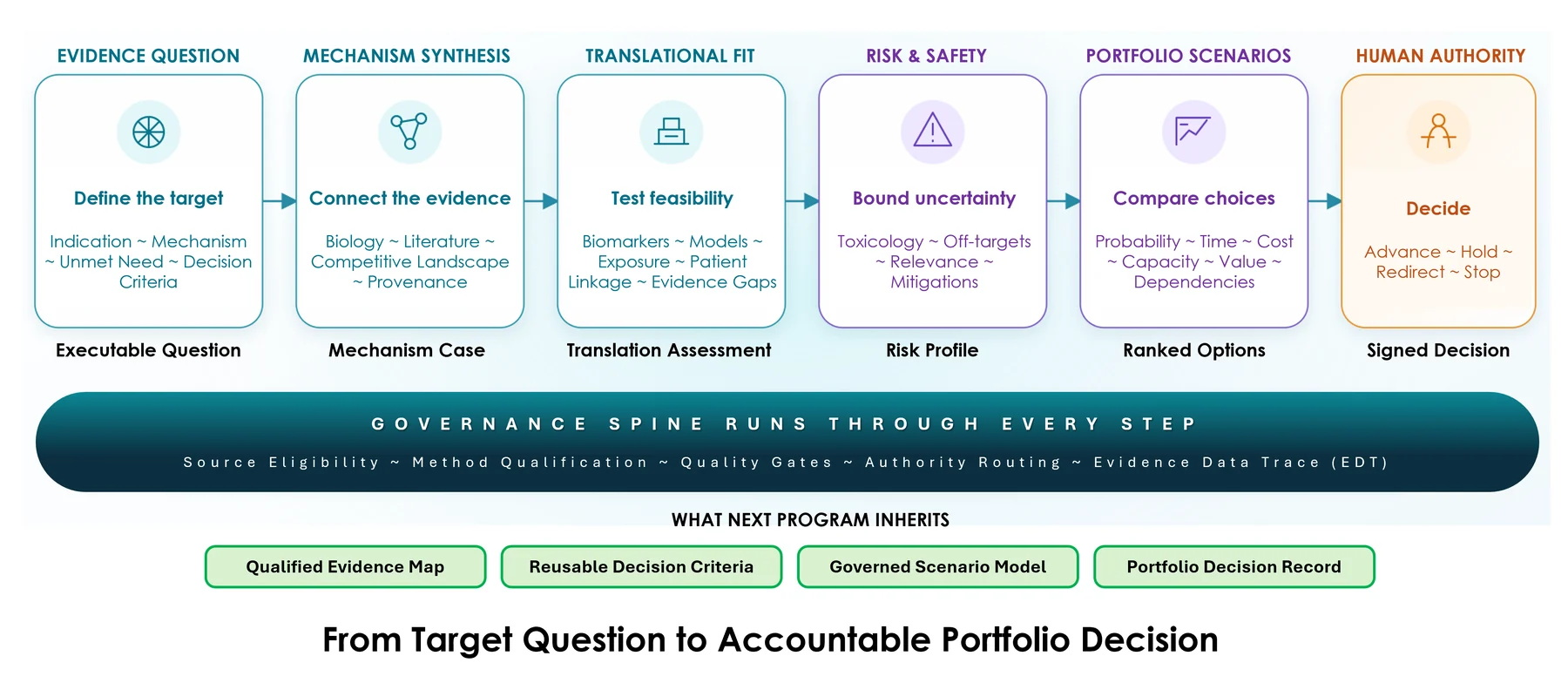
Every stage hands the next one evidence rather than a conclusion. The decision at the end is signed by a named human, and the route that produced it is part of the record.
Discovery is where AI is applied first and governed least. It is also where an ungoverned conclusion is cheapest to produce and most expensive to act on.
A target ranking is a capital-allocation recommendation. If it cannot be reconstructed - which evidence, which method, which assumptions, which human accepted it - then the organization has made an expensive decision it cannot explain or defend.
Governing early work is not slower. It is the difference between a decision and a guess with a chart attached.
Source, license entitlement and classification checked before an asset resolves.
Method approved for the task, run under a pinned engine, recorded with its inputs.
Authority evaluated before dispatch, and escalation where confidence is below threshold.
A named human accepts the recommendation, with the meaning of that acceptance recorded.
Stand up a Fleet where the backlog is worst. What it learns about your targets, endpoints and standards makes the next decision cheaper to reach.