Scientific Compute & Statistical Engine
Run validated science as governed execution.
StromaOS turns statistical methods, simulations, scientific models, and domain executors into governed execution services. 140+ R methods and 200+ domain executors operate inside traceable workflows with qualification, quality gates, independent verification, and human authority.
140+ R methods200+ domain executors and ML engines175+ executable processesGoverned by the Fleet Sentry Agent
Implemented scientific inventory
A real execution engine, not a list of analytical aspirations.
The catalog contains implemented methods, executable processes, and domain engines that can be invoked inside governed workflows across discovery, development, safety, quality, evidence, access, and lifecycle operations.
Method families
Version-controlled and reproducible methods with validation evidence across the pharmaceutical lifecycle.
Methods are exposed as governed services rather than unmanaged scripts. Each execution carries a method identifier, environment, inputs, parameters, diagnostics, results, version, reviewer, and intended use.
Adaptive and confirmatory methods
Design and evaluate studies before and during execution.
- Adaptive design simulation
- Alpha-spending and interim analysis
- Sample-size and operating-characteristic evaluation
- Estimand sensitivity under ICH E9(R1)
Endpoints, survival, and longitudinal analysis
Support trial and observational evidence with reproducible clinical methods.
- Cox proportional-hazards regression
- Time-to-event and competing-risk analysis
- Longitudinal and repeated-measures methods
- Baseline balance and standardized mean differences
Comparative and real-world evidence
Estimate treatment effects while making assumptions and diagnostics visible.
- Propensity scores and matching
- Inverse probability treatment weighting
- Targeted maximum likelihood estimation
- Sensitivity and robustness analysis
Dose, exposure, and response
Connect exposure, response, safety, and development decisions.
- Bioequivalence assessment
- Concentration-QTc analysis
- Dose-response and benchmark-dose models
- PK/PD and model-informed development support
Cross-study and comparative methods
Combine evidence while preserving heterogeneity and uncertainty.
- Meta-analysis and meta-regression
- Indirect treatment comparison
- Multivariate evidence synthesis
- Consistency and heterogeneity assessment
Verification and reproducibility methods
Prove that critical results can be reproduced and defended.
- Independent double programming
- Method qualification against reference corpora
- Golden-dataset comparison
- Reconciliation and adjudication
Domain execution engines
Scientific methods become executable domain capabilities.
The catalog includes 200+ executors spanning statistical, clinical, safety, quality, CMC, genomic, evidence, and access workflows. These engines wrap methods, domain rules, input schemas, output contracts, and governance requirements into reusable execution units.
Manufacturing and analytical executors
Run domain-specific quality and process analyses inside controlled workflows.
- Bioassay and dissolution analysis
- Process capability and Cpk
- Design of experiments
- Method validation, OOS, and trend analysis
Trial and biostatistical executors
Package trial methods into reusable, reviewable execution services.
- Adaptive design and estimand workflows
- Survival and endpoint analysis
- Independent validation paths
- Tables, listings, figures, and reconciliation support
Signal and risk executors
Combine deterministic, statistical, and AI-supported methods under medical authority.
- Disproportionality and observed-versus-expected
- Case-series characterization
- Trend and time-to-onset analysis
- Governed coding with licensed vocabularies where required
RWE, HEOR, and market-access executors
Connect causal, economic, burden, and payer analyses to approved evidence objects.
- Cohort and treatment-pattern analysis
- Cost-effectiveness and budget impact
- Utilities, burden, and resource use
- Scenario, sensitivity, and localization workflows
Execution lifecycle
Every scientific computation follows the same controlled path.
The method, data, environment, quality controls, review state, and result remain connected from request through downstream decision.
STEP 01
Frame the analysis
Question, endpoint, estimand, population, comparator, assumptions, purpose, and required authority.
STEP 02
Select the method
Eligible methods, package status, qualification level, diagnostics, alternatives, and limitations.
STEP 03
Validate inputs
Source lineage, schema, completeness, units, coding, cohort, data cut, and permitted use.
STEP 04
Execute reproducibly
Code, environment, versions, seeds, parameters, compute target, logs, and artifacts.
STEP 05
Verify and review
Diagnostics, double programming, reconciliation, statistical review, and Sentry Agent gates.
STEP 06
Approve and preserve
Human authority, result status, limitations, release, Evidence Data Trace, and reuse.
Nineteen runs, each one recorded
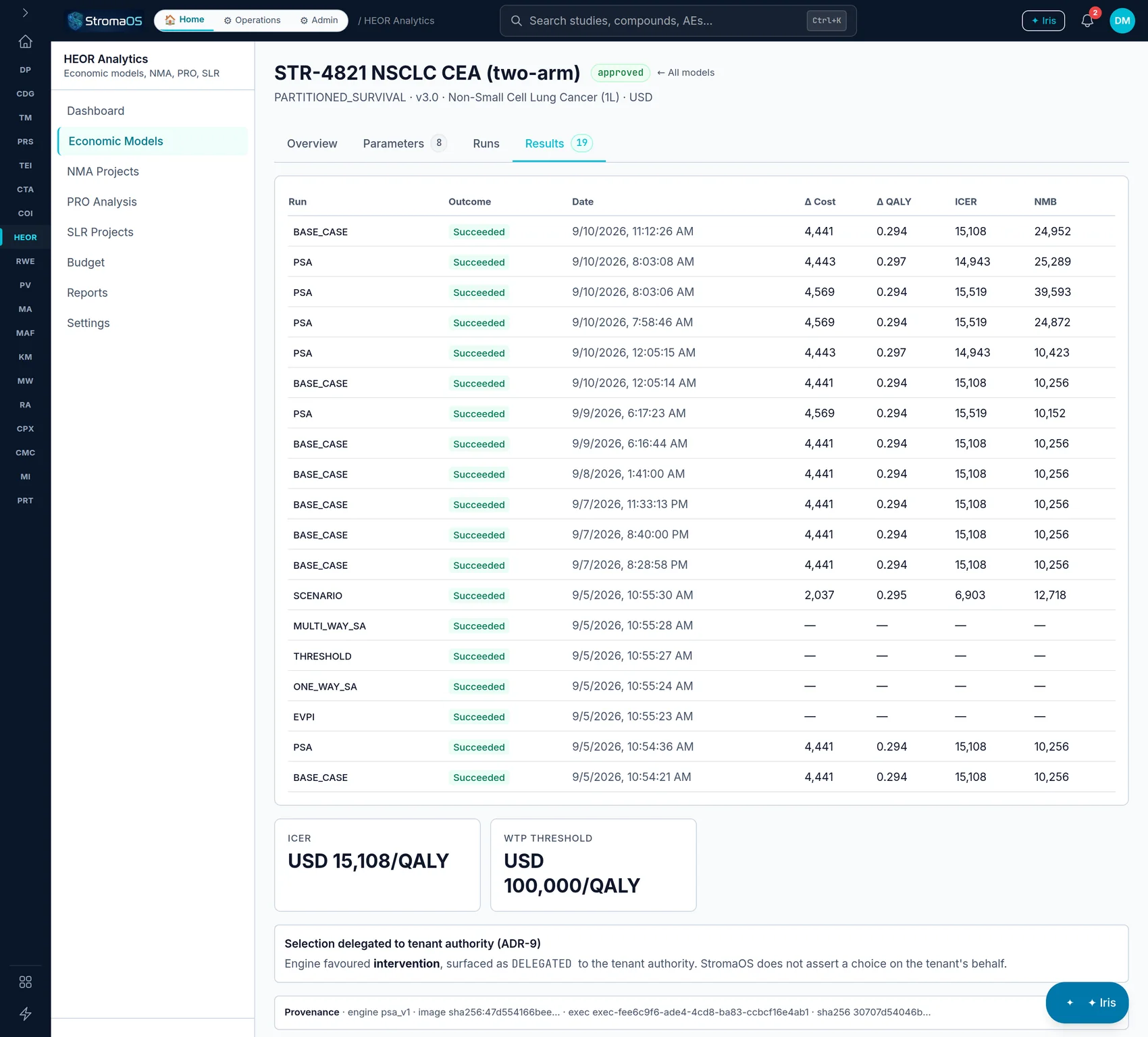
Nineteen executions of the same model, each dated, each carrying its own numbers, under a provenance line that pins the engine by digest. Read the line above it too: the engine favoured one arm, recorded that as DELEGATED, and left the choice with the tenant's own authority. Producing the number and asserting the decision are two different jobs.
Captured from a running instance. Demo tenant on synthetic and public test data.
Qualification and validation
Reproducibility is treated as an execution requirement, not a documentation exercise.
Methods can be qualified against reference datasets, golden outputs, known operating characteristics, and independent implementations. Critical analyses can invoke blinded double programming with reconciliation and adjudication before release.
The result is a scientific execution record that shows not only the answer, but why the method was eligible, how it was run, what diagnostics passed, who reviewed it, and whether it is approved for the intended use.
Model a qualifiable analysis workflowDeclared, and refused
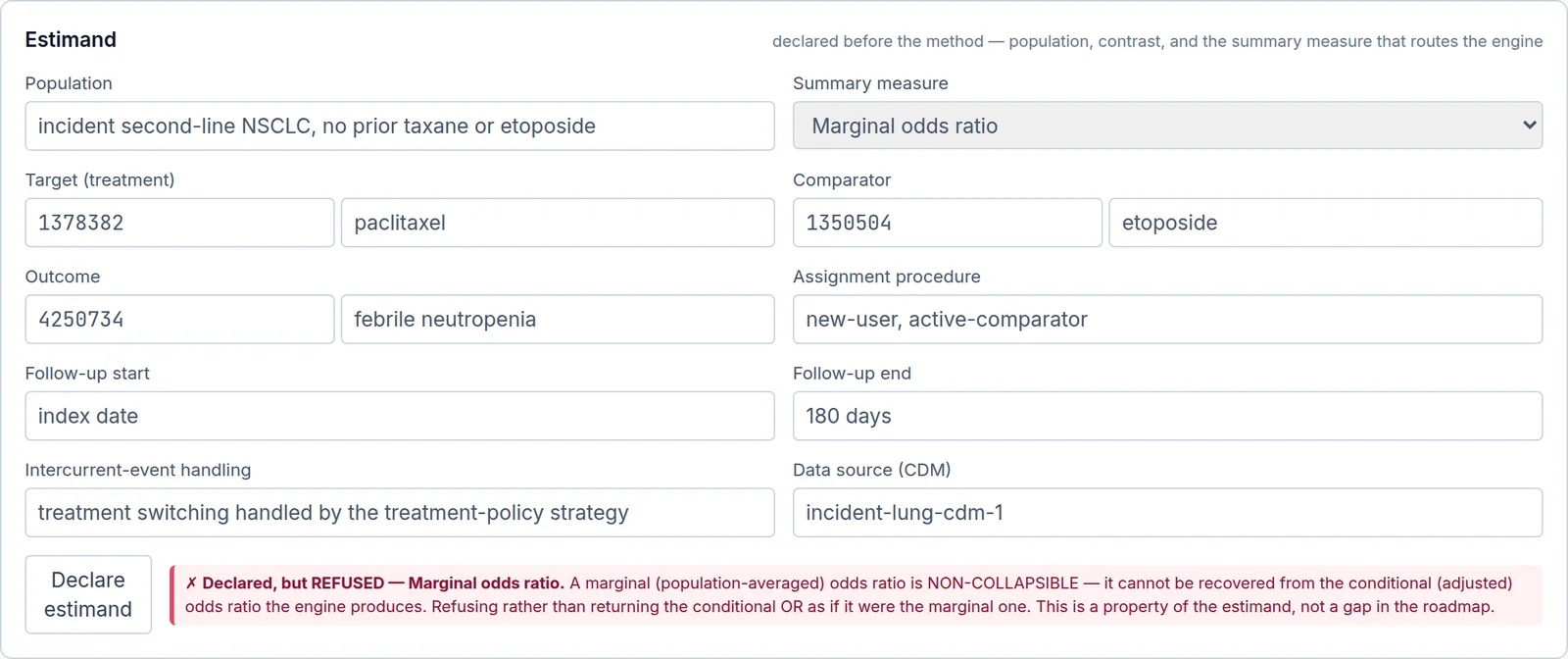
The estimand is declared before the method is chosen, and this one was refused. A marginal odds ratio is non-collapsible, so it cannot be recovered from the conditional estimate the engine computes. Returning the conditional one labeled as the marginal one would have been the easy answer, and nobody downstream would have seen the difference.
Captured from a running instance. Demo tenant on synthetic and public test data.
Governance inside the Fleet
The Sentry Agent encapsulates scientific and statistical controls.
Governance controls are not a separate peer outside the Fleet. The Sentry Agent enforces method eligibility, input quality, execution policy, validation state, review requirements, output release, and Evidence Data Trace before Lead and Worker Agents can advance the work.
Only eligible methods can execute.
The Sentry verifies method qualification, intended use, assumptions, package status, regulatory posture, and required diagnostics.
- Method allowlists and version control
- Qualification and validation status
- Regulatory-profile compatibility
- Alternative-method escalation
Scientific data must be fit for the task.
Source provenance, data cuts, coding, units, completeness, temporal alignment, permissions, and quality thresholds are checked before computation.
- ALCOA+ and lineage checks
- Schema and semantic validation
- Missingness and consistency gates
- Purpose-based data access
The environment remains deterministic and reproducible.
Runtime versions, packages, parameters, random seeds, compute targets, retries, logs, and artifacts are governed as part of the analysis.
- Environment and dependency locking
- Parameter and seed capture
- Compute-resource policy
- Exception and retry governance
Outputs do not become evidence automatically.
Diagnostics, independent verification, statistical review, human authority, limitations, and intended-use status determine whether a result can be released or reused.
- Quality-agent review
- Double-programming gates
- Human approval routing
- Output status and permitted use
Method routing
Scientific compute is routed to the lowest capable, most defensible tier.
Deterministic calculations and version-controlled statistics remain primary. Machine learning and AI are invoked only when the task requires them, and human authority remains explicit for regulated interpretation and release.
TIER 01Analytical
SQL, rules, deterministic calculations, data checks, mappings, and workflow logic.
TIER 02Statistical
R methods, simulation, survival, causal inference, bioequivalence, PK/PD, and uncertainty.
TIER 03Machine Learning
Prediction, classification, clustering, anomaly detection, ranking, and model evaluation.
TIER 04Local Scientific AI
Private domain models such as MedGemma and Boltz operating inside governed infrastructure.
TIER 05Hosted AI
Approved external models invoked with controlled context, logging, purpose, and output handling.
TIER 06Human
Statistical, clinical, scientific, safety, quality, regulatory, and executive review and authorization.
TIER 07Panel of Experts
Structured adjudication for conflicting methods, uncertain interpretation, or high-consequence decisions.
Platform outcomes
Scientific computing becomes reusable because methods, environments, controls, and decisions remain connected.
The engine reduces repeated coding, fragmented validation, inconsistent methods, and untraceable outputs while preserving the scientific authority of statisticians and domain experts.
Re-run the same analysis with the same governed context.
Preserve inputs, code, environment, packages, seeds, parameters, diagnostics, versions, and outputs.
Promote qualified methods into shared execution services.
Reuse qualified statistical and scientific workflows without rebuilding custom scripts for every program.
Give reviewers the complete scientific record.
Connect assumptions, diagnostics, verification, limitations, decisions, approvals, and downstream use.
Increase computational throughput without weakening scientific authority.
Allow Lead and Worker Agents to execute at scale while the Sentry Agent enforces controls and humans retain approval.
Start with one critical analysis that is repeatedly rebuilt, manually checked, or difficult to defend.
Register the method, environment, input contract, validation corpus, diagnostics, Sentry controls, review authority, and output status. Then run the analysis as a governed scientific execution service.