Teams know what was decided, but not why.
Evidence considered, assumptions, alternatives, dissent, authority, uncertainty, and expected consequences are rarely preserved as reusable operational context.
StromaOS captures scientific rationale, evidence, methods, decisions, approvals, commitments, exceptions, outcomes, and lessons across every product, program, study, market, and lifecycle stage.
Scientific and operational work generates decisions, assumptions, exceptions, rejected alternatives, commitments, approvals, and lessons. Most of that context is dispersed across systems, presentations, meeting notes, email, code, and the memory of experienced employees.
Evidence considered, assumptions, alternatives, dissent, authority, uncertainty, and expected consequences are rarely preserved as reusable operational context.
Teams repeatedly search prior analyses, regulatory interactions, study decisions, safety assessments, quality events, market assumptions, and approved content.
How experts interpret evidence, recognize patterns, challenge assumptions, and navigate exceptions is not captured in executable form.
Without source, version, approval, permitted use, confidence, and expiry controls, more retrieval produces more ambiguity rather than better decisions.
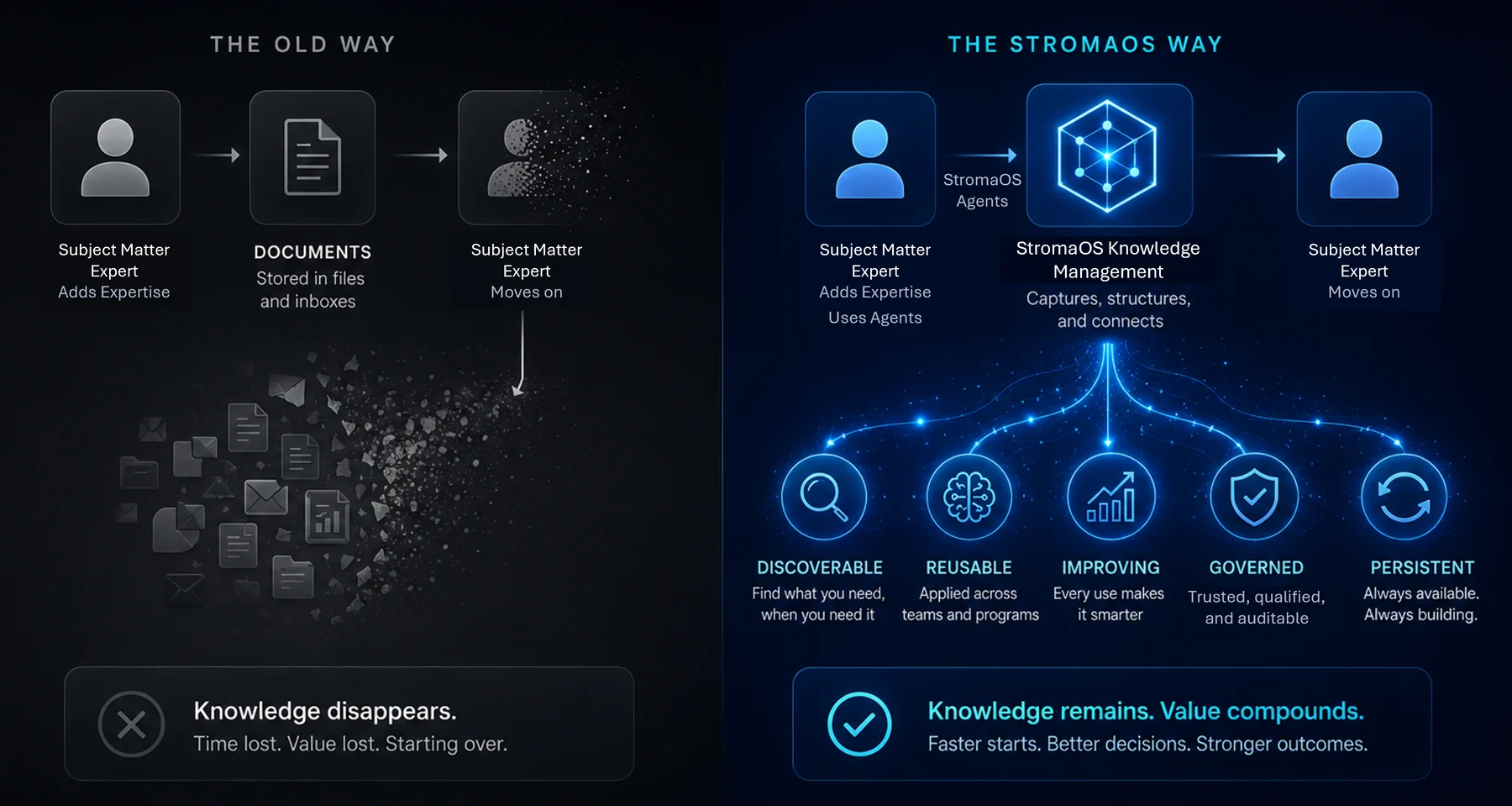
The expert moves on either way. What changes is whether the reasoning goes with them - which is why the third study costs less than the first.
Knowledge Management converts sources, evidence, decisions, rationale, commitments, and outcomes into reusable, permission-aware knowledge objects.
Connect hypotheses, analyses, methods, results, interpretations, limitations, decisions, and subsequent outcomes.
Preserve how work was performed, where it failed, what exceptions occurred, how teams intervened, and whether actions worked.
Connect assets, indications, studies, populations, endpoints, evidence, claims, risks, commitments, markets, and decisions across source systems.
Retain the question, evidence, options, rationale, dissent, authority, decision, action, expected effect, and actual outcome.
Retrieve only eligible knowledge based on role, product, geography, sensitivity, approval state, purpose, and allowed use.
Promote proven patterns, methods, decisions, content, and interventions into governed reusable knowledge without turning every past action into precedent.
Every step retains the source, context, version, reviewer, confidence, authority, permitted use, and downstream application.
Data, document, analysis, interaction, meeting, workflow, decision, action, outcome, or expert contribution.
Product, program, indication, study, market, stakeholder, method, question, claim, risk, and time.
Source status, evidence strength, version, confidence, reviewer, limitations, sensitivity, and authority.
Claims, decisions, commitments, actions, outcomes, dependencies, contradictions, successors, and superseded items.
Permitted purpose, audience, module, geography, lifecycle stage, expiry, and revalidation conditions.
Retrieve, compare, execute, draft, simulate, decide, monitor outcomes, and update institutional memory.
StromaOS does not treat every document or model output as equally trustworthy. Knowledge is qualified by source, version, evidence strength, review, approval, confidence, sensitivity, applicability, expiry, and purpose.
Retrieval becomes safer because the system distinguishes current approved knowledge from draft, exploratory, superseded, disputed, restricted, or expired material.
Model a governed knowledge layerStromaOS separates source capture, semantic interpretation, evidence qualification, approval, permitted use, retrieval, execution, and promotion into reusable knowledge.
Explore the Governance SpineEvery knowledge object retains its source, owner, system, version, timestamp, transformation history, reviewer, and downstream use.
Draft, exploratory, validated, approved, disputed, superseded, restricted, expired, and withdrawn remain distinct governed states.
Access depends on role, product, market, sensitivity, intended purpose, decision type, external-use status, and policy.
AI may extract, connect, compare, and recommend. Qualified domain owners retain validation, approval, applicability, and reuse authority.
Sources, transformations, prompts, models, versions, reviews, approvals, retrievals, decisions, actions, and outcomes remain reconstructable.
Knowledge Management routes work through deterministic retrieval, version-controlled analytics, machine learning, local scientific models, governed hosted models, human review, or expert adjudication.
Search, filters, rules, lineage, status checks, version comparison, relationship traversal, and deterministic retrieval.
Trend, recurrence, similarity, confidence, evidence weighting, performance, outcome analysis, and qualified workflows.
Classification, clustering, entity resolution, semantic matching, anomaly detection, and model evaluation.
Private local models for synthesis, contextual retrieval, controlled summarization, and internal scientific memory.
Approved external models invoked with controlled knowledge, purpose, logging, cost, and output handling.
Scientific, clinical, regulatory, safety, quality, legal, operational, and governance review and authorization.
Structured adjudication for disputed knowledge, conflicting evidence, or high-consequence precedent and reuse decisions.
Each agent receives a defined knowledge scope, permitted sources, status filters, purpose, intelligence tiers, review requirements, and authority ceiling.
Frames the knowledge question, assembles relevant context, reconciles contradictions, tracks gaps, and prepares the governed knowledge package.
Perform bounded source retrieval, entity resolution, semantic linking, version comparison, evidence synthesis, and knowledge-update tasks.
Checks source eligibility, approval status, permitted use, sensitivity, expiry, contradiction, reviewer requirements, authority, and traceability.
The value is not a larger document repository. The value is governed memory that remains usable inside research, development, regulatory, safety, quality, access, and medical workflows.
Carry forward evidence, assumptions, alternatives, dissent, authority, commitments, expected consequences, and actual outcomes.
Preserve qualified patterns, methods, heuristics, exceptions, interventions, and reasoning without removing human ownership.
Connect discovery, clinical, regulatory, safety, quality, HEOR, access, and medical work through shared entities and decisions.
Control retrieval by source, status, role, purpose, product, geography, sensitivity, approval, and allowed use.
Connect the existing systems and repositories. Define the shared entities, knowledge states, authority model, permitted uses, expiry rules, and outcome links. Then turn institutional memory into a governed operational asset.