Value questions surface after development choices are fixed.
Payer, HTA, comparator, endpoint, population, outcomes, and economic evidence needs are often discovered after the relevant studies and analyses have already been designed.
StromaOS connects evidence generation planning, health economics, outcomes research, real-world evidence, value dossiers, payer questions, HTA response, local adaptation, and market learning in one governed execution environment.
Market access and HEOR teams must combine clinical, epidemiological, economic, real-world, patient, utilization, and competitive evidence across markets. That work is frequently initiated late, adapted repeatedly, and managed through disconnected models, documents, vendors, and local processes.
Payer, HTA, comparator, endpoint, population, outcomes, and economic evidence needs are often discovered after the relevant studies and analyses have already been designed.
Inputs, assumptions, scenarios, utility values, resource use, comparators, validation, review, and market adaptations are spread across files and vendor workflows.
Global evidence is adapted repeatedly without clear boundaries around what is approved, what may change locally, what requires review, and what evidence supports each claim.
Questions, objections, evidence gaps, analyses, responses, commitments, outcomes, and market learning are often retained in local documents rather than reused globally.
StromaOS coordinates evidence needs, methods, models, real-world analyses, claims, dossiers, local adaptation, payer and HTA response, commitments, and learning in one execution model.
Population, comparator, outcome, value claim, evidence gap, market requirement, payer objection, or HTA need.
Clinical, economic, epidemiological, real-world, patient, utilization, and market-specific evidence requirements.
Models, analyses, cohorts, assumptions, scenarios, uncertainty, validation, review, and quality gates.
Claims, evidence, model outputs, limitations, approved content, dossiers, and local adaptation boundaries.
Payer and HTA questions, objections, analyses, commitments, negotiations, approvals, and follow-up.
Inputs, methods, versions, assumptions, decisions, responses, outcomes, commitments, and market learning.
StromaOS preserves the full chain behind economic and access evidence: data inputs, cohort definitions, comparators, model structure, assumptions, utilities, resource use, scenarios, uncertainty, validation, reviewer decisions, and local adaptations.
Real-world analyses start from an approved cohort package, so the population a payer questions is the population your evidence team reviewed and approved.
Global teams can enable local execution without losing control of the evidence or approved argument.
Model a value evidence workflow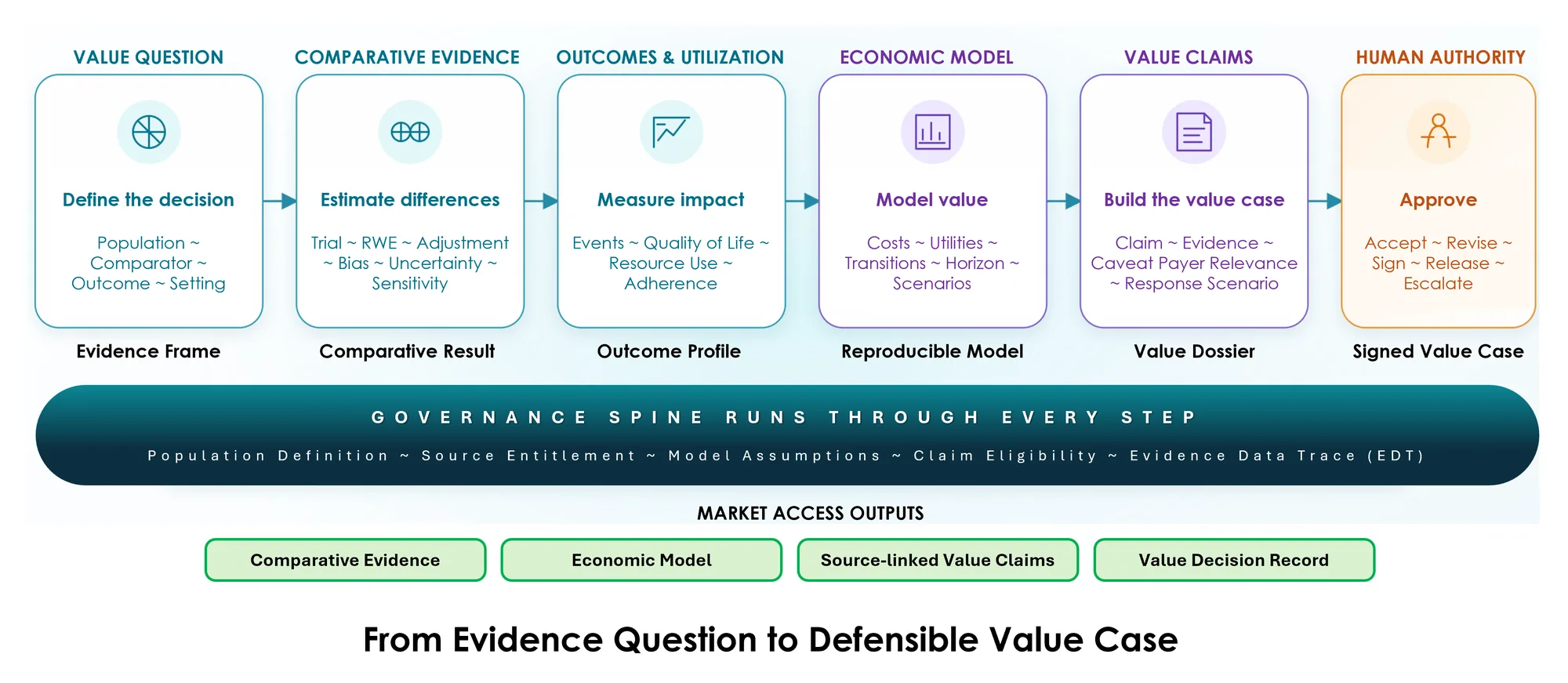
Model assumptions, sensitivity and the approval that accepted them travel together. A payer challenge lands against a record, not a rebuild.
StromaOS separates data preparation, analysis, modeling, interpretation, claim formation, local adaptation, drafting, review, approval, negotiation, and release.
Explore the Governance SpineModels, assumptions, cohorts, comparators, utilities, resource use, scenarios, validation, uncertainty, and reviewer acceptance remain part of the record.
Every value statement remains linked to approved evidence, model outputs, limitations, confidence, audience, jurisdiction, permitted use, owner, and review state.
Policy defines which global evidence elements may change locally, which require re-analysis, which require review, and which remain fixed.
Drafting, scientific review, economic review, market review, approval, submission, negotiation, and commitment remain separate permissions.
Data, methods, models, prompts, assumptions, versions, reviews, decisions, claims, responses, commitments, and outcomes remain reconstructable.
Connect the evidence sources and specialist systems already in use. Define the method, assumptions, review, local adaptation boundaries, claim standard, and approval authority. Then run the work as one governed value evidence operation.