CMC quality intelligence

Connect quality evidence to controlled action.

StromaOS connects deviations, investigations, CAPA, complaints, process knowledge, suppliers, stability, specifications, change control, regulatory impact, and lifecycle quality operations in one governed execution environment.

Connected quality evidence Governed investigation execution Traceable change impact Preserved quality memory
The CMC quality operating problem

Quality events are investigated locally, but their impact is rarely local.

CMC and quality decisions can affect product, process, batch, method, site, supplier, specification, validation, stability, filing, market, supply, and patient risk. The relevant evidence is usually distributed across validated systems, documents, spreadsheets, meetings, and specialist teams.

01 · Fragmentation

The investigation context is split across systems.

Quality events, manufacturing data, laboratory records, equipment history, materials, suppliers, complaints, stability, prior CAPA, and change records are rarely reviewed as one connected evidence set.
02 · Repeated investigation

Prior causes and lessons are difficult to reuse.

Similar events recur because prior hypotheses, eliminated causes, supporting evidence, remediation, effectiveness, and decision rationale are trapped in static records.

03 · Change uncertainty

Impact is assessed after functions have already diverged.

A proposed process, method, specification, supplier, equipment, or site change can affect validation, stability, supply, filings, commitments, and markets in different ways.

04 · AI without quality authority

Automation can support investigation without making the decision.

AI can retrieve, compare, cluster, summarize, and draft, but it cannot be allowed to determine root cause, approve CAPA, release product, authorize change, or close an event without accountable quality authority.

How the solution works

Quality work becomes one governed evidence-to-effectiveness chain.

StromaOS coordinates quality evidence, investigation, trends, risk, root-cause hypotheses, CAPA, change control, regulatory impact, validation, accountable review, and closure in one execution model.

STEP 01

Capture the quality event

Deviation, OOS/OOT, complaint, trend, supplier issue, process signal, change, or regulatory commitment.

STEP 02

Assemble the context

Batches, methods, equipment, materials, sites, suppliers, process history, prior events, CAPA, stability, and filings.

STEP 03

Investigate and assess

Hypotheses, evidence, eliminated causes, recurrence, impact, risk, product, patient, supply, and market context.

STEP 04

Exercise quality authority

Root cause, disposition, CAPA, change, validation, release, escalation, filing, and approval decisions.

STEP 05

Execute controlled action

Containment, correction, prevention, training, implementation, verification, monitoring, and regulatory action.

STEP 06

Verify and preserve

Effectiveness, residual risk, evidence, decisions, approvals, closure, recurrence, and reusable quality memory.

Change impact control

A change should be approved only after its full operating impact is visible.

StromaOS connects a proposed process, method, specification, supplier, site, equipment, material, packaging, or analytical change to affected products, batches, validation, stability, supply, markets, filings, commitments, risks, actions, and decision authority.

Change becomes a governed multi-functional execution record rather than a routing form.

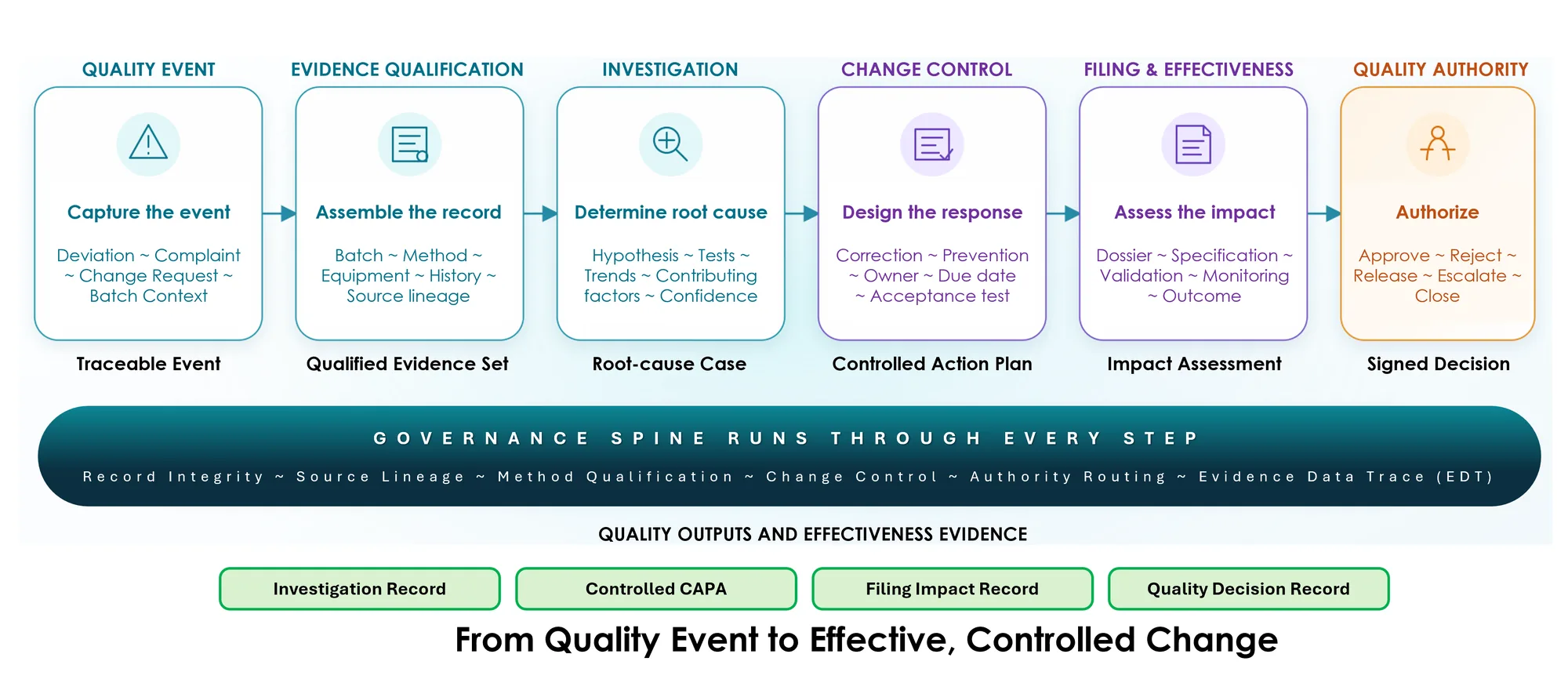
Model a change-control workflow
CMC and quality work routed from process and analytical data through deviation and change assessment to an authorized disposition, under the Governance Spine.

Change impact, closure and filing consequence stay connected. The chain from a deviation to its regulatory impact is traversable rather than reconstructed under inspection.

Governance throughout CMC quality

AI can accelerate investigation without inheriting quality authority.

StromaOS separates retrieval, trend detection, hypothesis generation, evidence synthesis, recommendation, root-cause decision, disposition, CAPA approval, change approval, release, filing, implementation, and closure.

Explore the Governance Spine
01

Source-system preservation

Authoritative quality, laboratory, manufacturing, validation, supplier, and regulatory records remain in their validated systems while StromaOS governs cross-system execution.

02

Investigation governance

Hypotheses, evidence, eliminated causes, related events, risk, impact, required methods, reviewers, and decision authority are explicit and versioned.

03

Quality authority separation

AI may retrieve, compare, detect patterns, and draft without receiving authority to determine root cause, approve disposition, authorize change, release product, or close an event.

04

Evidence gates and effectiveness

Progression and closure depend on required evidence, validation, review, approval, implementation verification, residual risk, and effectiveness criteria.

05

Evidence Data Trace

Inputs, methods, models, prompts, versions, hypotheses, decisions, approvals, CAPA, changes, filings, implementation, effectiveness, and closure remain reconstructable.

Start with one investigation, change-control process, or recurring quality bottleneck.

Connect the quality sources and validated systems already in use. Define the evidence standard, authority, quality gates, impact dimensions, regulatory obligations, and closure criteria. Then run the work as one governed quality operation.