The safety picture is distributed across evidence types.
Individual cases, literature, clinical trial findings, real-world evidence, class effects, toxicology, complaints, and external intelligence are reviewed in separate operating systems.
StromaOS connects case evidence, literature, trial data, real-world evidence, class effects, signal detection, aggregate analysis, medical assessment, regulatory obligations, and lifecycle follow-up in one governed execution environment.
Pharmacovigilance depends on a chain of evidence, medical judgment, regulatory obligation, operational execution, and lifecycle follow-up. That chain is frequently split across case systems, signal tools, literature workflows, aggregate reports, spreadsheets, committees, documents, and local processes.
Individual cases, literature, clinical trial findings, real-world evidence, class effects, toxicology, complaints, and external intelligence are reviewed in separate operating systems.
Signal history, prior rationale, dissent, threshold changes, dismissed hypotheses, outstanding evidence, and follow-up actions are difficult to carry across committees and reporting cycles.
Monitoring, mitigation, label, communication, study, submission, training, or market actions may be managed outside the signal record that triggered them.
Models can classify, summarize, extract, trend, and draft, but they cannot be allowed to collapse evidence assembly, medical evaluation, regulatory judgment, and release into one uncontrolled action.
StromaOS coordinates incoming evidence, detection methods, medical assessment, quality gates, regulatory obligations, accountable review, action management, and closure in one execution chain.
Cases, literature, trial findings, RWE, complaints, class effects, and external safety intelligence.
Trends, disproportionality, clusters, severity, expectedness, exposure, novelty, and rule-based triggers.
Case series, mechanism, class context, trial evidence, RWE, alternative explanations, uncertainty, and gaps.
Signal validation, benefit-risk interpretation, escalation, committee review, decision, and rationale.
Investigate, monitor, communicate, mitigate, amend, report, update label, or close with evidence.
Methods, versions, evidence, rationale, approvals, obligations, follow-up, effectiveness, and lifecycle memory.
A signal management process should show more than status. StromaOS preserves why a signal was opened, which evidence changed the assessment, which uncertainties remain, who had authority, what action was approved, and what evidence is required for closure.
Exposure and comparator populations for safety studies come from approved cohort packages, so the people behind an assessment are defined once and traceable to the individual.
The result is a continuous safety record rather than a sequence of disconnected committee artifacts.
Model a signal workflow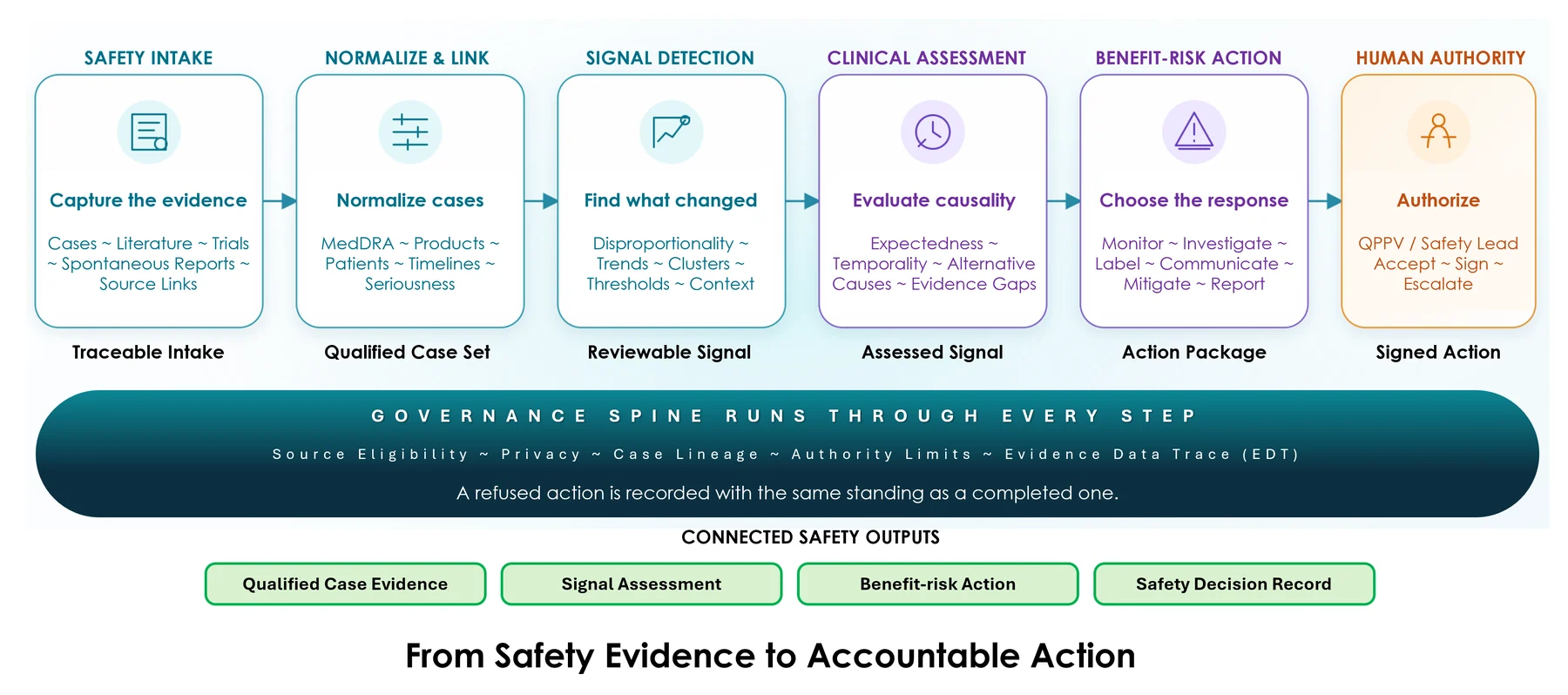
Six stages, each producing a named artifact the next stage can use. A refused action is recorded with the same standing as a completed one.
StromaOS separates classification, extraction, detection, synthesis, recommendation, evaluation, approval, reporting, release, and closure. Named medical, safety, regulatory, quality, and governance authorities retain accountable decisions.
Explore the Governance SpineEvery signal assertion remains linked to the cases, analyses, literature, trial findings, real-world evidence, class context, extraction, interpretation, date, and confidence that support it.
Disproportionality, trend, seriousness, expectedness, exposure, novelty, frequency, mechanism, and escalation criteria are explicit and versioned.
AI may assemble and analyze evidence. Accountable medical and safety authorities retain signal validation, causality, benefit-risk, action, and closure decisions.
Drafting, medical review, regulatory review, approval, submission, communication, and label release remain separate governed permissions.
Inputs, methods, models, prompts, versions, thresholds, dissent, decisions, approvals, obligations, actions, effectiveness, and closure remain reconstructable.
Connect the safety sources and specialist systems already in use. Define the evidence standard, thresholds, medical authority, quality gates, regulatory obligations, and closure criteria. Then run the work as one governed safety operation.