Mapped in place, not bought back
Semantic transformation maps your sources to a common model where they already sit. Nothing is migrated, which targets the premium you pay for the shape of information you already generated.
Before any analysis runs, someone has to normalize the data, map it to a common model, strip the identifiers and prove the licenses allow the use. Today each of those is a separate invoice from a separate supplier - and the work is thrown away at the end of the study.
Three parts. None of them is the product on its own - a workforce without governed execution is a generic agent platform, and governed execution without your data and your authority is somebody else’s system.
Biostatistics, medical writing, regulatory, safety and HEOR executed end to end by governed specialists you scale without hiring, built for pharmaceutical work rather than adapted to it.
Policy is evaluated before a task is dispatched, not reviewed after it lands, and every result arrives with the evidence record that defends it.
Your data and your models, deployed where you choose - managed, in your VPC, embedded, or air-gapped - with every decision right resolved to a named person in your organization, never to the platform.
Data preparation is part of the work, so StromaOS performs it rather than requiring you to buy it first. The distinction matters to a CFO: this is spend that moves, not capability that is added.
Semantic transformation maps your sources to a common model where they already sit. Nothing is migrated, which targets the premium you pay for the shape of information you already generated.
De-identification and anonymization run as governed steps at the point of preparation, with the record of what was protected, and how, attached to the run.
MedDRA, WHODrug and the rest. Entitlement is checked before a licensed asset resolves, and a run that loses entitlement withholds its result rather than destroying the work.
Once your data is mapped, it stays mapped. Reusable preparation can reduce what each subsequent study must repurchase, which is what bends the cost curve after the first.
Systems of record hold what you did. StromaOS performs the work those systems govern and writes results back where your organization already looks.
Content, quality and safety platforms stay exactly where they are. We do the work and hand the record back with the evidence attached.
Heavy analytical work is pushed down to run where the data already sits, rather than extracting it to us.
Terminologies and external datasets resolve under your entitlement, not a resold one. Your license, your relationship.
Preparation is where most governance failures originate, because it happens before anyone is watching. Every step here is a governed action with a Sentry check in front of it and a record behind it.
A mapping decision is a scientific decision. Which fields are equivalent, which units convert, which codes are synonyms, what counts as missing rather than zero - these determine what an analysis can conclude.
Treating that as invisible plumbing is how a study becomes unreproducible two years later. Treating it as governed work is how it stays defensible.
Every transformation carries its rationale, its version and the person or policy that authorized it.
A worker cleared for de-identified data cannot reach identified data, at any step, including preparation.
Not audited afterwards. A licensed asset does not resolve without a valid entitlement.
A source that could not be reached says so. A check that did not run is never recorded as passed.
Most of what a scientific question needs is not in a warehouse table. It is in protocols, study reports, literature, labels and correspondence. The catalog carries the ingestion, retrieval and extraction capability to reach it, so a Fleet doing real evidence work is not waiting on a data engineering project first.
Governed ETL, tabular cleaning and transformation, and API orchestration across the systems you already run - plus the domain ingestion that scientific work needs, including bring-your-own-licence source data and vocabulary ingestion with its own quality checks.
Retrieval against your documents rather than a general model’s memory. Entitlement is verified before a passage is retrieved, and provenance is retained at the passage level, so every assertion traces back to the source it came from and a use your licence does not cover is refused rather than answered.
Structured extraction from PDFs, forms, tables, audio and video - the formats regulated evidence actually arrives in. Extracted values carry their source location, so a reviewer can go from a number in a report back to the page it was read from.
Data profiling, anomaly investigation and quality checking run as governed capabilities in the same catalog, so the checks on a dataset are part of its record rather than a script someone ran once.
A source graded, not assumed
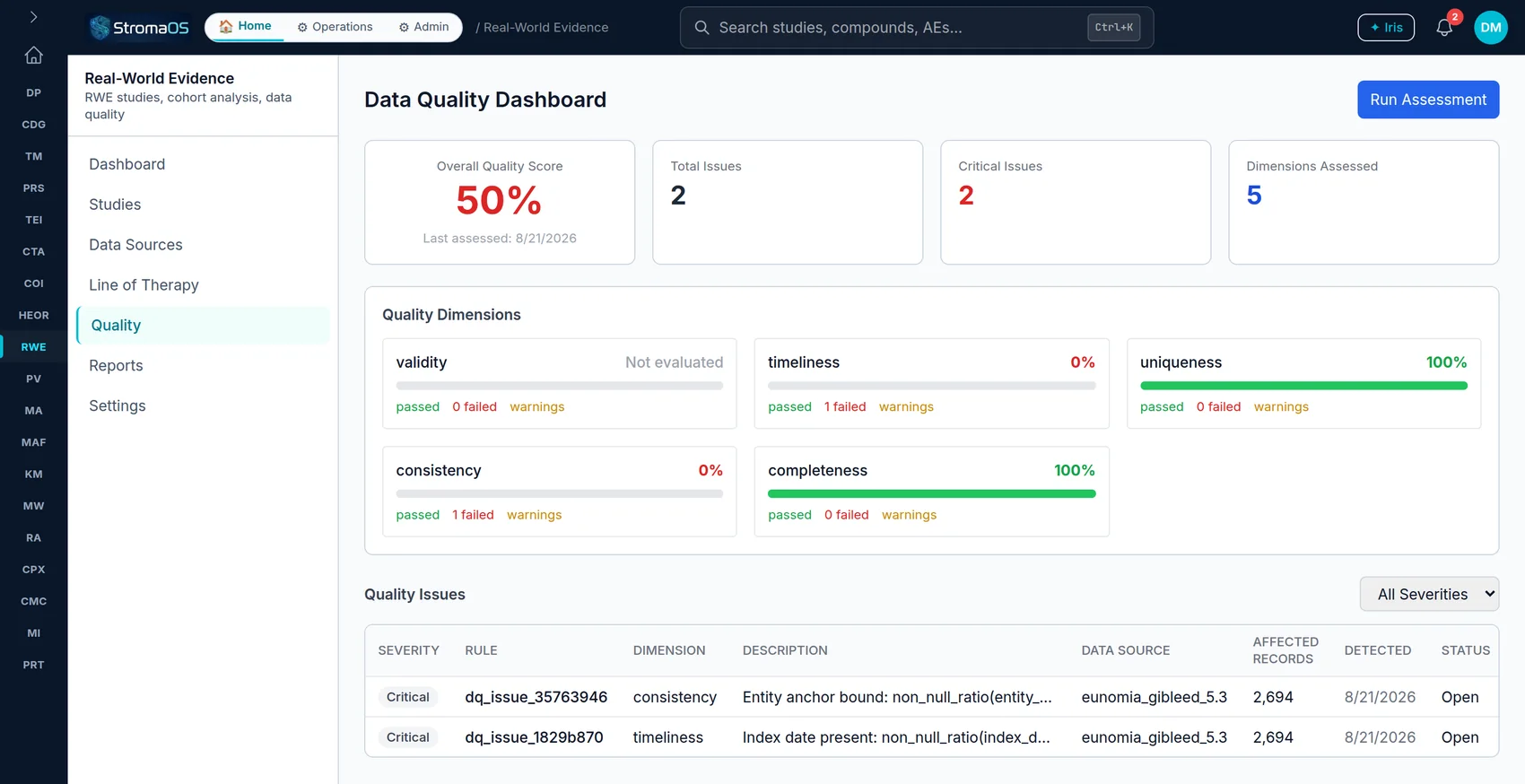
Fifty percent, shown rather than smoothed. Look at the first tile: validity reads “Not evaluated”, not zero. A system that records unknown as none will eventually tell you your evidence is strong when nobody checked. Every open issue names the rule that failed, the dimension it belongs to, and how many records it reaches.
Captured from a running instance. Demo tenant on synthetic and public test data.
A governed semantic runtime, not another golden record. No data moves - only meaning flows. The alternative is the migration project that consumes the budget before anything is produced.
Terminology reconciled across programs so early evidence is comparable rather than merely adjacent.
Study definitions mapped to a common model so analyses can span programs without hand-reconciliation.
MedDRA and WHODrug resolved under your entitlement, consistently, wherever they are referenced.
Manufacturing and quality vocabulary connected to the clinical and regulatory record that depends on it.
Economic models built on the same definitions the clinical evidence used, so a payer challenge does not require a rebuild.
Field and scientific communication connected to the approved evidence base rather than a parallel copy of it.
Connected meaning is what makes multi-hop reasoning possible - following evidence across domains rather than running isolated searches and stitching the answers together by hand.
A search index over your old documents is a filing cabinet with a search box. It can find a document. It cannot tell you which analysis produced the number inside it, or which decision that number went on to support.
Connected knowledge accumulates as a durable asset scoped to your boundary - not a model somebody else improves using your work.
Targets, mechanisms, endpoints and populations, connected across programs.
Obligations, commitments, precedent and the evidence that satisfied them.
Which methods were used, which were refused, and what a reviewer flagged last time.
Your SOPs, house standards and reviewer expectations - the part that usually leaves with people.
Sources harmonized, identifiers removed, entitlements verified - performed as part of the work rather than purchased ahead of it.
The same sources are already harmonized. What changes is the question, not the plumbing underneath it.
Retained preparation is what bends the cost curve after the first study - unlike project-based services that commonly reset the preparation effort.
Bring the invoice lines for normalization, de-identification and license administration to a working session, and we will model what moves and what does not.