Method routing
Each task is routed to the lowest capable, most defensible method - deterministic analytics and version-controlled statistics stay primary, and AI is invoked only where the task requires it.
For architects, platform owners and the people who have to sign off on where the data goes. Everything below runs in the deployment posture you choose - in your VPC, embedded in the data platform you already run, fully air-gapped, or managed by us.
Three parts. None of them is the product on its own - a workforce without governed execution is a generic agent platform, and governed execution without your data and your authority is somebody else’s system.
Biostatistics, medical writing, regulatory, safety and HEOR executed end to end by governed specialists you scale without hiring, built for pharmaceutical work rather than adapted to it.
Policy is evaluated before a task is dispatched, not reviewed after it lands, and every result arrives with the evidence record that defends it.
Your data and your models, deployed where you choose - managed, in your VPC, embedded, or air-gapped - with every decision right resolved to a named person in your organization, never to the platform.
The integration points are the product. A Worker Agent that can pick up a qualified, version-controlled instrument, with the policy envelope covering the instrument rather than stopping at the model call, is a different construction from either a pharma platform with AI added or an agent framework with pharma prompts.
Where a biostatistician, safety reviewer or medical writer actually works. Assignments, results, lineage and the evidence trail in one place - with the human authority steps where they belong in the flow rather than in a separate console.
The layer that makes a worker a specialist rather than a generalist: pharma processes, governance profiles carrying a named regulatory posture, scientific ontologies and terminologies, and the domain rulesets a function is held to.
What a general-purpose agent runtime does not provide. Statistical execution under a pinned, reproducible engine; machine learning with evaluation and explainability; a medical model that runs on patient-level data in place rather than calling out to a third-party API; and the submission-dataset pipeline.
Agents, Fleets and sovereign federation; policy evaluated before dispatch by the Sentry Agent; Evidence Data Trace; and human authority resolution. Agent behavior is integrated with the instruments above rather than sitting beside them - which is what lets the policy envelope cover the method a worker runs, not only the call it makes.
Your sources are connected rather than migrated. Semantic transformation maps them to a common model in place; de-identification runs as a governed step at the point of preparation; and your data licenses are verified and enforced before a licensed asset resolves. In Your VPC, Embedded and Air-gapped deployments, patient-level data and execution remain inside your boundary.
One envelope runs vertically through all five. Policy is not a layer between them - it is evaluated at every boundary, from the data a worker may read, through the instrument it may pick up, to the human who must sign the result.
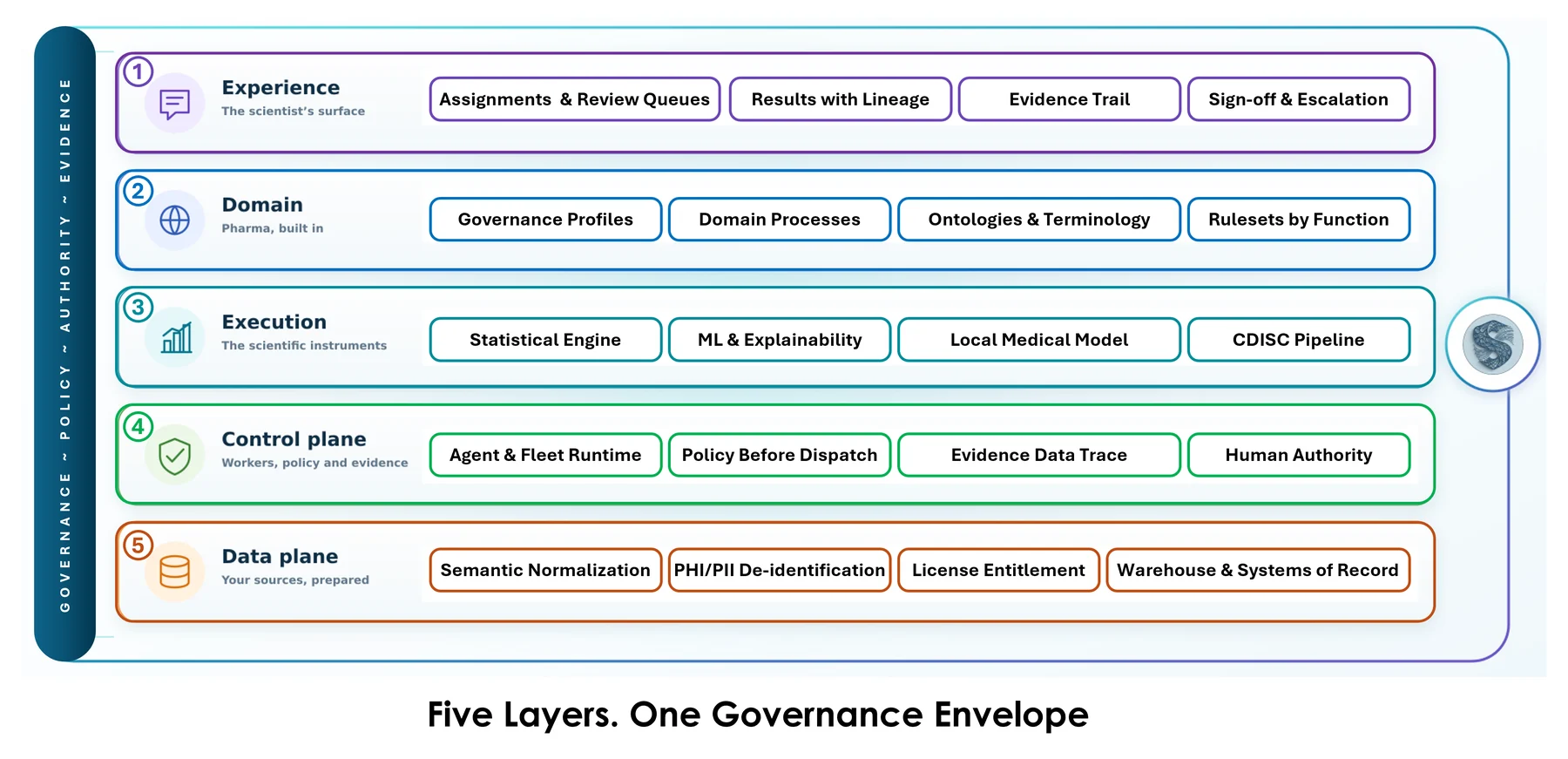
The envelope runs vertically through all five. Policy is not a layer between them; it is evaluated at every boundary - from the data a worker may read, through the instrument it picks up, to the human who signs the result.
The runtime decides how work runs. The Sentry Agent decides whether it may. Keeping those separate is what stops an efficiency decision from quietly becoming a governance decision.
Each task is routed to the lowest capable, most defensible method - deterministic analytics and version-controlled statistics stay primary, and AI is invoked only where the task requires it.
Work is scheduled against real constraints: filing deadlines, review windows, and the capacity a program actually has.
A failed step recovers to a known state. It does not resume from a half-written record or leave orphaned compensating actions behind.
Heavy analytical work is pushed down to run where the data already sits, rather than moving the data to the compute.
Recurring obligations - aggregate reviews, conformance runs, periodic reports - execute on their schedule with the same controls as ad-hoc work.
Behavior is observed while work runs, not summarized afterwards. Drift and exceptions surface as they happen.
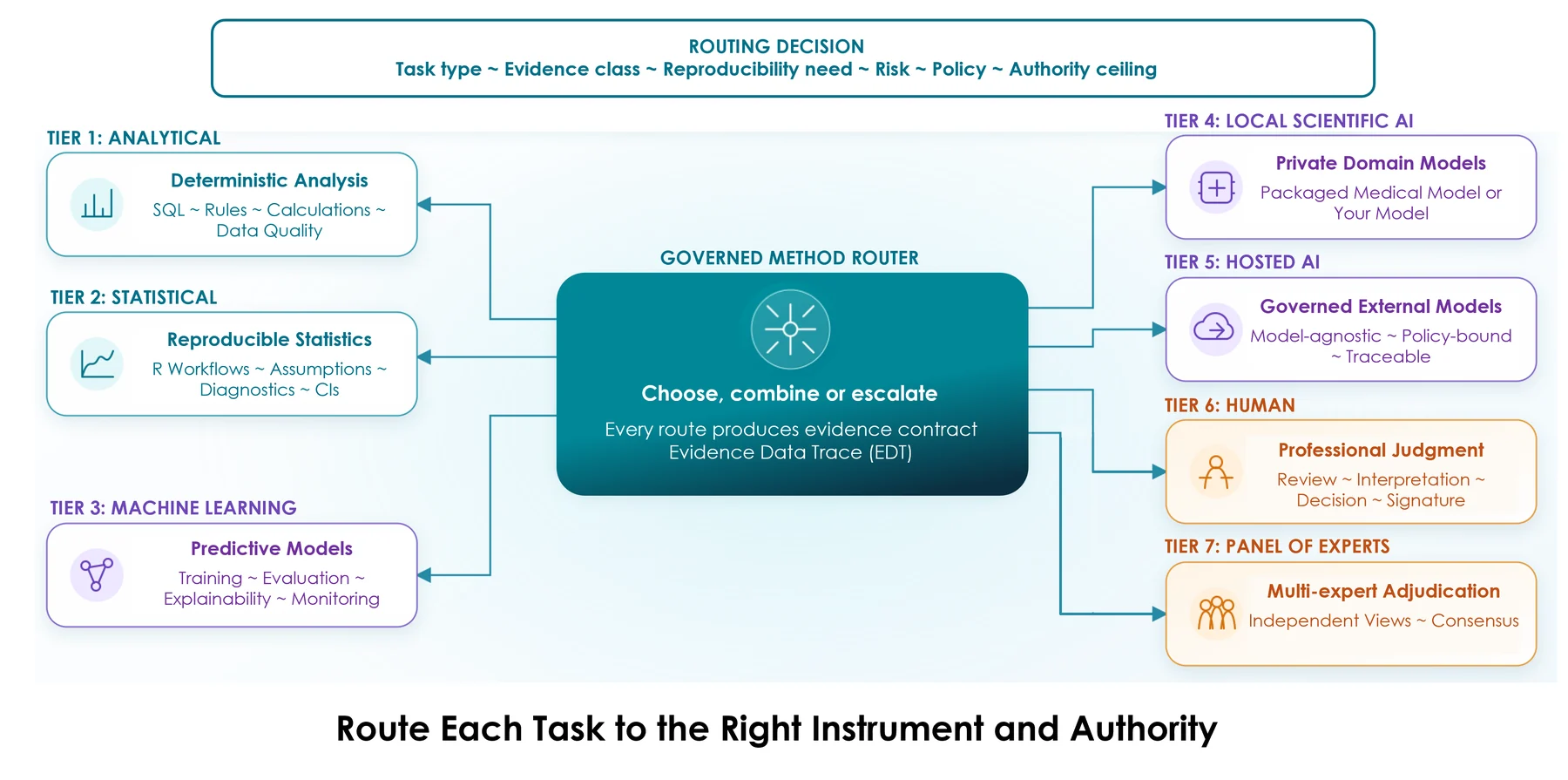
The router picks the least powerful method that will do the job, and escalates only when it will not. The route taken, and why, becomes part of the Evidence Data Trace - so a reviewer can see that a hosted model was used, or that it was not.
Keep the system of record. Keep the safety database. Keep the warehouse. StromaOS performs the work those systems govern and writes the results back where your organization already looks.
Content, quality and document platforms hold what you did. StromaOS does it, and hands the record back with the evidence attached.
Analytical work executes where the data already sits. In Your VPC, Embedded and Air-gapped deployments, nothing is extracted to a vendor environment to be worked on.
Case intake and regulatory reporting stay where they are. The Fleet performs the assessment on top of them.
Nothing is required, resold or metered, and we do not compete with the model providers you have standardized on.
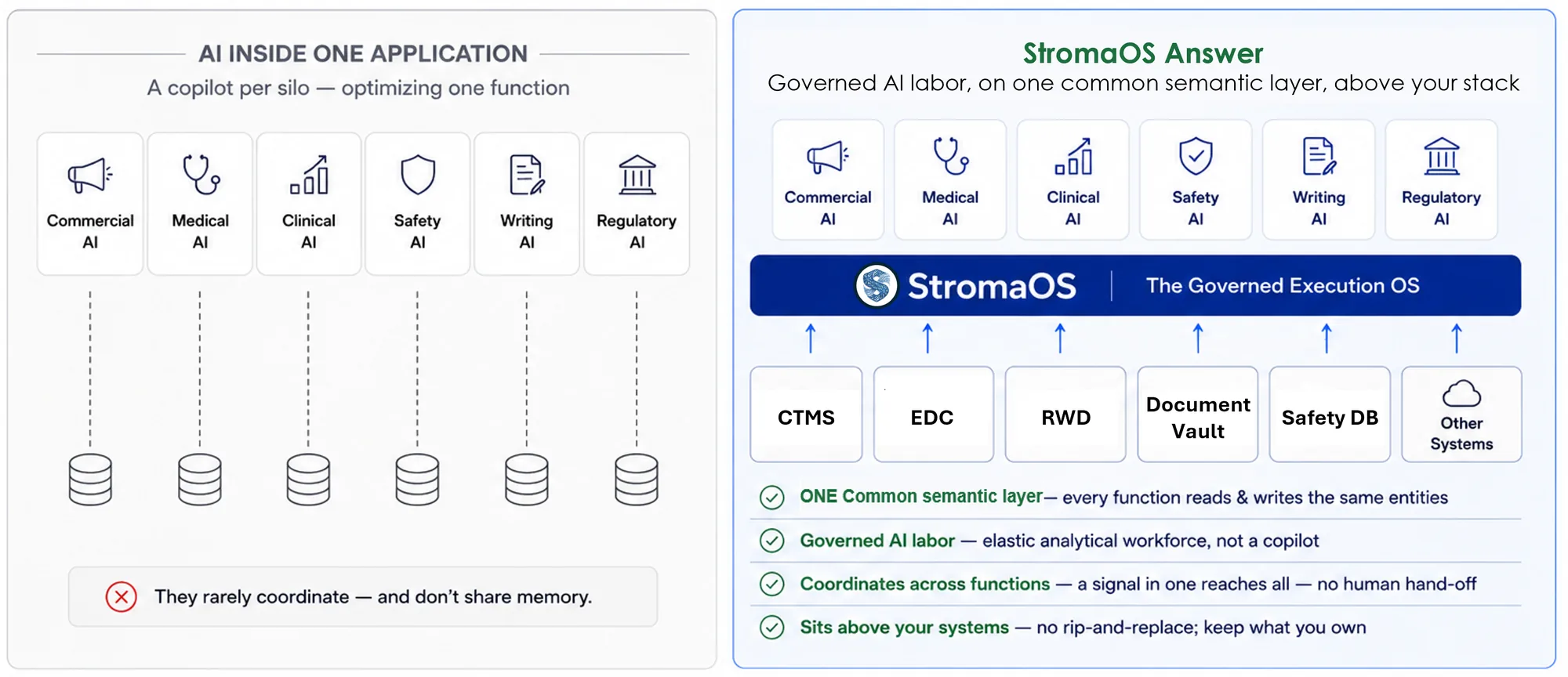
The systems of record stay exactly where they are. What changes is where the work happens - one governed layer above them rather than a copilot inside each one, unable to see the others.
Three of the four postures put the entire request path inside your boundary. Managed is the exception, and it is an operating choice rather than an architectural one - the controls, the evidence record and the human authority model do not change.
We operate it. Fastest route to a first deployment, suitable where the data classification allows it.
Runs in your cloud account, inside your network boundary, under your identity provider and your controls.
Deployed natively into the data platform you already run, so work executes where the data already lives.
Fully sovereign, no egress, your own models. For classified programs and jurisdictions that require it.
Three of the four postures put execution on your compute inside your own boundary, where your existing controls apply rather than being duplicated. Managed exists for speed where the data classification allows it.
Bring your own. Nothing is required, resold or metered.
Open schema, queryable, exportable. The retention obligation on regulated evidence outlives any vendor relationship, so the record has to be readable without us.
Placement relative to what you already run, the read and write surface, how policy executes at runtime, the four deployment postures and the boundaries the platform does not cross. No address required.
A ninety-minute working session - a tailored sketch of how StromaOS composes with your platform mix, and an honest read on where it does not.