The study exists in multiple incompatible versions.
Protocol, operations, analytics, MIDD, safety, data management, and vendor systems each maintain a partial view of the same study and often reconcile only at formal milestones.
StromaOS connects trial analytics, clinical operations, model-informed drug development, real-world evidence, and safety in one execution environment. Protocol, study, site, patient, endpoint, operational, exposure-response, and safety decisions retain the evidence and authority that produced them.
Clinical development depends on the interaction between scientific evidence, protocol design, quantitative modeling, study operations, patient data, site performance, safety, and external evidence. Those functions frequently operate with separate tools, definitions, timelines, and decision records.
Protocol, operations, analytics, MIDD, safety, data management, and vendor systems each maintain a partial view of the same study and often reconcile only at formal milestones.
Site, enrollment, quality, safety, endpoint, and exposure-response signals may be visible in one function while the context required for action remains elsewhere.
Teams spend time rebuilding context for governance meetings, protocol amendments, dose decisions, interim reviews, regulatory interactions, and cross-functional actions.
Analytical copilots and agents can accelerate review, monitoring, and drafting, but without explicit data boundaries, method validation, escalation rules, human authority, and traceability they create new operating risk.
StromaOS coordinates study context, analytical methods, operational signals, domain agents, quality gates, and accountable human review from planning through execution and evidence handoff.
Protocol, endpoint, population, dose, site, enrollment, risk, amendment, analysis, or evidence gap.
Protocol, study data, operations, sites, safety, models, prior studies, RWE, regulatory commitments, and decisions.
Analytics, statistical methods, MIDD, operational intelligence, safety review, RWE, and approved AI agents.
Data sufficiency, method validity, reproducibility, confidence, deviation, exception, and review requirements.
Clinical, statistical, medical, operational, safety, pharmacology, and governance decisions.
Inputs, analyses, versions, assumptions, approvals, actions, outcomes, and cross-study learning.
Clinical leaders need a coordinated view of scientific, analytical, operational, safety, and regulatory readiness without replacing the specialist systems used by each function.
StromaOS connects those systems through common entities, definitions, workflow states, decisions, risks, evidence gaps, milestones, and authority.
Feasibility starts from a governed cohort definition, with counts, attrition and source coverage at every criterion before money is committed to a design.
Model a clinical program workflow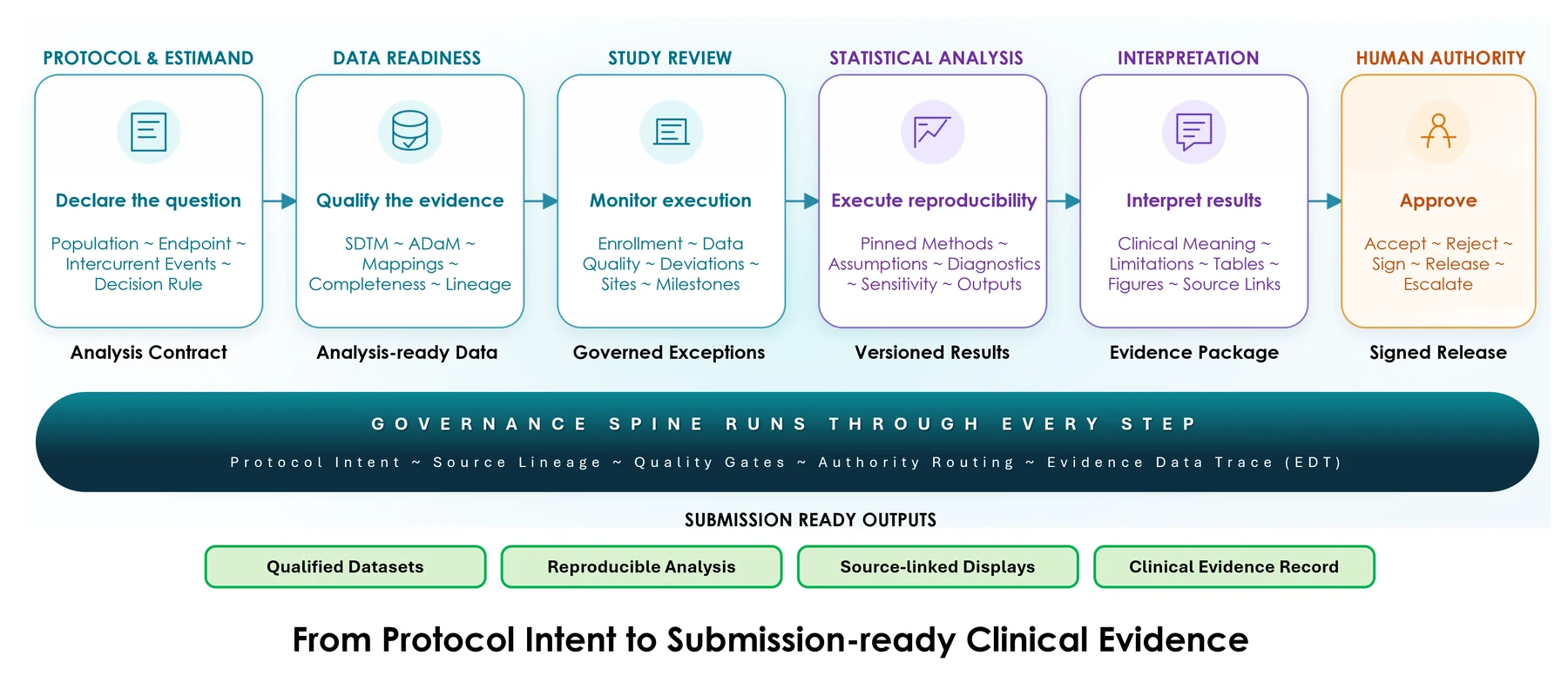
The analysis, the assumptions and the authority that accepted them stay joined. A result you cannot reconstruct is not a result you can file.
StromaOS separates retrieval, analysis, recommendation, action, approval, amendment, release, and submission. Clinical, statistical, safety, pharmacology, operational, and regulatory authorities retain accountable decisions while AI operates inside explicit policy and quality boundaries.
Explore the Governance SpineStudy, patient, site, country, vendor, and external data are accessed only for approved users, purposes, workflows, jurisdictions, and operating contexts.
Methods, estimands, code, statistical assumptions, diagnostics, model versions, quality criteria, and reviewer acceptance remain part of the execution record.
An agent may detect a signal or prepare an amendment package without receiving authority to alter a protocol, change a dose, close a site, or submit a response.
Thresholds, confidence, risk severity, exceptions, unresolved uncertainty, and policy determine which clinical and governance authorities must decide.
Inputs, transformations, code, models, prompts, methods, versions, decisions, approvals, actions, and downstream consequences remain reconstructable.
Connect the study sources and specialist systems already in use. Define the decision, authority, methods, quality gates, and required human review. Then run the work as a governed clinical operation.