Selectable domain modules across discovery, development, safety, regulatory, access, medical, and quality.
The StromaOS product architecture
Intelligence Modules on one governed operating system.
Sixteen domain Intelligence Modules. Two cross-cutting evidence capabilities. One governed execution system underneath - the Shared Semantic Data Layer, the Governance Spine, Evidence Data Trace, human authority, and four deployment postures across the pharmaceutical lifecycle.
What we have to offer
Three parts. None of them is the product on its own - a workforce without governed execution is a generic agent platform, and governed execution without your data and your authority is somebody else’s system.
One - the work
Performed, not tooled.
Biostatistics, medical writing, regulatory, safety and HEOR executed end to end by governed specialists you scale without hiring, built for pharmaceutical work rather than adapted to it.
Two - the proof
Proven while it runs.
Policy is evaluated before a task is dispatched, not reviewed after it lands, and every result arrives with the evidence record that defends it.
Three - the authority
Under your authority.
Your data and your models, deployed where you choose - managed, in your VPC, embedded, or air-gapped - with every decision right resolved to a named person in your organization, never to the platform.
Product model
Buy the domain capability you need. Inherit the same operating system underneath.
Each intelligence module can be activated independently. As modules are added, the organization gains more value from the Shared Semantic Data Layer, Knowledge Management, the Governance Spine, reusable skills, agents, evidence objects, and lifecycle context.
Knowledge Management and Evidence Generation Planning span the full lifecycle.
Analytical, statistical, machine learning, local AI, hosted AI, human review, and panel of experts - the right method for each task.
Every task runs inside explicit evidence, policy, quality, human authority, and traceability controls.
Intelligence Modules
Sixteen Intelligence Modules across the pharmaceutical lifecycle.
Each module has its own operating model, evidence context, domain workflows, agents, methods, quality controls, decision authorities, and measurable outcomes. They are described here in one place rather than across sixteen pages.
Discovery & portfolio
Scientific, translational, safety, quantitative, and strategic decision support.
01
Discovery
Target Mechanism Intelligence
Connect disease biology, genetics, tractability, biomarkers, competitive activity, safety liabilities, and target confidence in one governed Intelligence Module.
Explore module →02
Discovery
Portfolio & R&D Strategy Intelligence
Compare assets, indications, scenarios, risk, evidence strength, capital, timing, strategic fit, and opportunity cost without flattening the science.
Explore module →03
Preclinical
Preclinical Risk & Safety Intelligence
Integrate toxicology, off-target findings, class effects, exposure margins, species relevance, mechanistic risk, and mitigation into development decisions.
Explore module →04
Preclinical
Translational Evidence Intelligence
Connect preclinical findings to human biology, biomarkers, endpoints, populations, exposure, and clinical hypotheses while preserving uncertainty.
Explore module →05
Quantitative development
Clinical Pharmacology & MIDD
Govern exposure-response, dose selection, simulation, model assumptions, diagnostics, uncertainty, and quantitative decisions from discovery through submission.
Explore module →Clinical development
Study analytics, trial operations, quantitative evidence, external evidence, and safety context.
06
Clinical
Clinical Trial Analytics
Coordinate study-level and cross-study analytics, endpoint support, trends, anomalies, missingness, subgroups, and decision packages with method traceability.
Explore module →07
Clinical
Clinical Operations Intelligence
Connect study startup, sites, enrollment, milestones, vendors, deviations, risks, actions, escalation, and operational decision history.
Explore module →08
Cross-lifecycle
Real-World Evidence
Define, compare and approve governed cohorts, then build epidemiology, comparative effectiveness, treatment-pattern, utilization, burden, outcomes, and longitudinal evidence on populations other functions reuse.
Explore module →09
Safety
Pharmacovigilance
Connect case evidence, signal detection, aggregate review, benefit-risk, medical assessment, regulatory action, and lifecycle follow-up.
Explore module →Regulatory, quality & submission
Strategy, claims, evidence, regulated content, quality impact, approval, and release.
10
Regulatory
Regulatory Affairs
Coordinate strategy, regulatory intelligence, requirements, health authority interactions, commitments, market obligations, evidence readiness, and submission decisions.
Explore module →11
Submission
Medical Writing
Generate regulated content from approved evidence objects, reusable content components, source-linked claims, controlled review, and explicit approval authority.
Explore module →12
Quality
CMC Quality Intelligence
Connect deviations, investigations, CAPA, complaints, process knowledge, stability, suppliers, change control, filing impact, and effectiveness.
Explore module →HEOR, access & medical
Value evidence, payer execution, scientific intelligence, medical response, and communication.
13
Value evidence
HEOR
Govern economic models, outcomes analyses, comparators, utilities, resource use, assumptions, scenarios, uncertainty, validation, and reviewer acceptance.
Explore module →14
Access
Market Access
Coordinate access strategy, evidence needs, value claims, dossiers, payer and HTA response, commitments, local adaptation, and market learning.
Explore module →15
Medical affairs
Medical Affairs Intelligence
Monitor the scientific landscape, structure field insights, identify evidence gaps, detect patterns, support scientific planning, and connect insight to action.
Explore module →16
Medical information
Medical Information & Scientific Communications
Classify questions, retrieve approved evidence, prepare source-linked responses, manage citations, route review, control release, and reuse approved knowledge.
Explore module →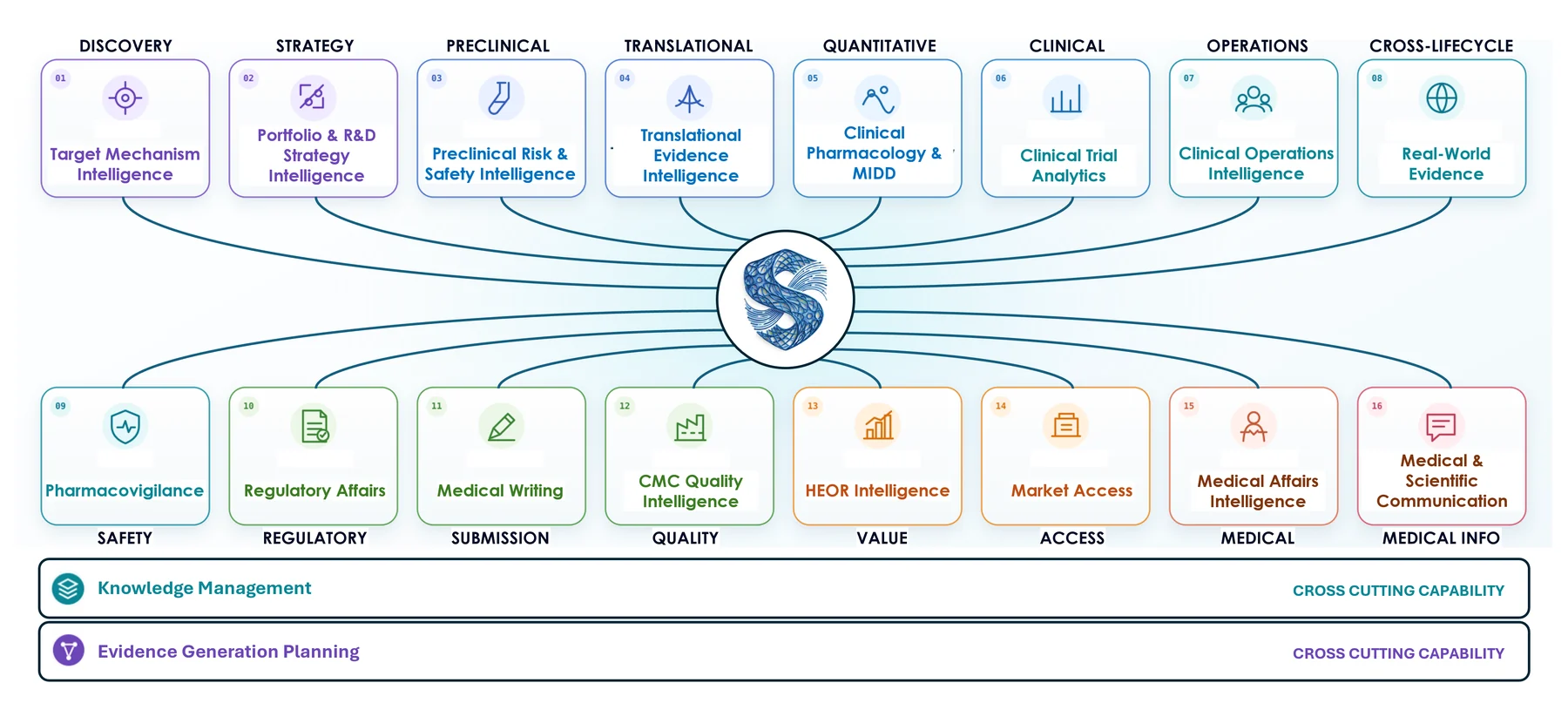
Modules are bought and activated one at a time. What they share underneath - the Shared Semantic Data Layer, the Governance Spine, Scientific Compute and the Evidence Data Trace - is the same in every one.
Cross-cutting products
Two capabilities span every module and every lifecycle stage.
These are not generic repositories or project trackers. They are evidence operating capabilities that inherit the same semantics, governance, human authority, and traceability as the domain modules.
17
Always-on capability
Knowledge Management
Retain evidence context, definitions, assumptions, decisions, qualified outputs, lessons, reusable skills, and organizational memory as the work occurs.
Explore module →18
Cross-functional capability
Evidence Generation Planning
Connect evidence questions and gaps to studies, analyses, experiments, commitments, markets, milestones, owners, dependencies, and decision readiness.
Explore module →
StromaOS
The shared product layer underneath every module.
Every Intelligence Module runs on the same governed execution system. That means new modules inherit the same execution, governance, evidence, data, and deployment controls rather than creating another application silo.
Agents, fleets, workflows, and decision packages
Compose domain work from governed agents, workflows, skills, reports, forms, methods, quality gates, and human review.
- Agents organized into Fleets
- Lead, worker, and sentry roles
- Reusable governed skills
- Decision-ready outputs
Method routing
Route each task to the appropriate method rather than using an LLM by default.
- Analytical and statistical
- Machine learning
- Local scientific AI
- Hosted AI, human, expert panels
Shared Semantic Data Layer
Connect domain systems through common entities, ontologies, definitions, temporal context, and semantic mappings.
- 43+ ontologies
- Knowledge graph + vector retrieval
- Common data model
- Mapped in place, not migrated
Version-controlled and reproducible methods with validation evidence
Use governed statistical and machine-learning methods with preserved assumptions, diagnostics, reproducibility, and review - qualifiable for your intended use rather than declared validated for it.
- 140+ statistical methods
- 12 ML libraries
- R harness and confidence rules
- Golden datasets and quality checks
Tools, models, platforms, and data remain open
StromaOS is model-, tool-, platform-, and data-agnostic. Existing scientific tools and external models can be invoked as governed capabilities.
- 360+ services and connectors
- Hosted and local models
- MCP servers and external tools
- Customer-controlled data
Evidence and decisions survive every handoff
Every execution creates reusable organizational memory rather than another static output.
- Evidence Data Trace
- Versioned decision history
- Approved content and analysis reuse
- Lifecycle continuity
What ships in the catalog
850+ governed, executable definitions - before you write one.
Every module above is assembled from the same catalog. A definition is not documentation: it is the executable object the platform runs, carrying its own approval gates, decision rights and evidence contract. You inherit the catalog on day one and extend it, rather than starting from an empty system.
Governed definitions
The executable objects a Fleet runs
| 350+ Skills | One callable capability an agent step can invoke | 50+ Reports | Sources and layout for a reviewable output |
| 175+ Processes | An end-to-end governed process with its approval gates | 40+ Rulesets | Deterministic policy evaluated during execution |
| 90+ Agents | What an AI agent does - its skills, trigger and steps | 16+ Packaged Fleets | A deployable unit - agents configured to run together |
| 70+ Quality definitions | Gates a run must satisfy to be complete | 15+ Forms | The SME extension path, without a release |
| 60+ Agent identities | Role, values and boundaries - what an agent will not decide |
43+ ontologies
Clinical, safety, regulatory, genomic and laboratory vocabularies. Version-aware, license-checked, and mapped in place rather than migrated.
140+ methods
Version-controlled and qualifiable for your intended use, executed against a pinned engine image so a result can be reproduced years later.
12 ML libraries
Pinned to exact versions and air-gap checkable, declared per skill rather than assumed present in the environment.
Ontologies, methods and libraries are what the definitions run on. They are counted separately and deliberately not added into the figure above - an ontology is an asset, not a governed definition.
The catalog is a starting position, not a boundary. Definitions are yours to fork, extend and author against on day one, and the count grows with each release without a migration on your side.
The Governance Spine
Every product inherits the same control architecture.
Governance is not a separate dashboard added after deployment. It is the execution layer that determines what can run, which evidence can be used, which models and tools are eligible, which quality conditions must be met, and who retains authority.
Review the governance architecture01
Policy-as-code
Role, purpose, data class, jurisdiction, workflow state, model, tool, action, cost, and authority are evaluated before execution.
02
Human Authority Framework
Analyze, recommend, act, approve, publish, release, and submit remain separate permissions assigned to accountable roles.
03
Quality gates
Evidence completeness, method validity, reproducibility, confidence, unresolved uncertainty, exceptions, and review govern progression.
04
Evidence Data Trace
Inputs, methods, prompts, models, versions, policies, transformations, decisions, approvals, outputs, and actions remain reconstructable.
05
Governed external capability
Customer-built agents, internal applications, external models, scientific tools, and third-party services can operate inside the same control model.
Deployment
Deploy where the data, models, and operating constraints require.
Four postures. The product experience, the controls, the evidence record and the human authority model are the same in all of them - what changes is infrastructure, isolation, hosting, and who operates it.
Managed
We operate it. The fastest route to a first deployment, suitable where the data classification allows it.
- Managed operations
- Rapid deployment
- Governed model and tool access
- Boundary defined by your agreement
Your VPC
Runs in your cloud account, inside your network boundary, under your identity provider and your controls.
- Dedicated tenant
- Your network boundary
- Enterprise identity and security
- Patient-level data stays inside
Embedded
Deployed natively into the data platform you already run, so work executes where the data already sits.
- Execution goes to the data
- No parallel data estate
- Your platform’s compute and controls
- Highest-fidelity integration
Air-gapped
No egress, local models, controlled update path. For classified programs and jurisdictions that require it.
- No external data movement
- Local scientific models
- Offline governed execution
- Controlled release channel
Start with the module closest to a visible operating bottleneck.
Activate one Intelligence Module, connect the systems and evidence already in use, define the authority and quality model, and expand from the shared product foundation.