An Audit Trail Assembled After the Fact Is an Argument, Not a Record
Why Reconstruction Fails Exactly When It Is Needed
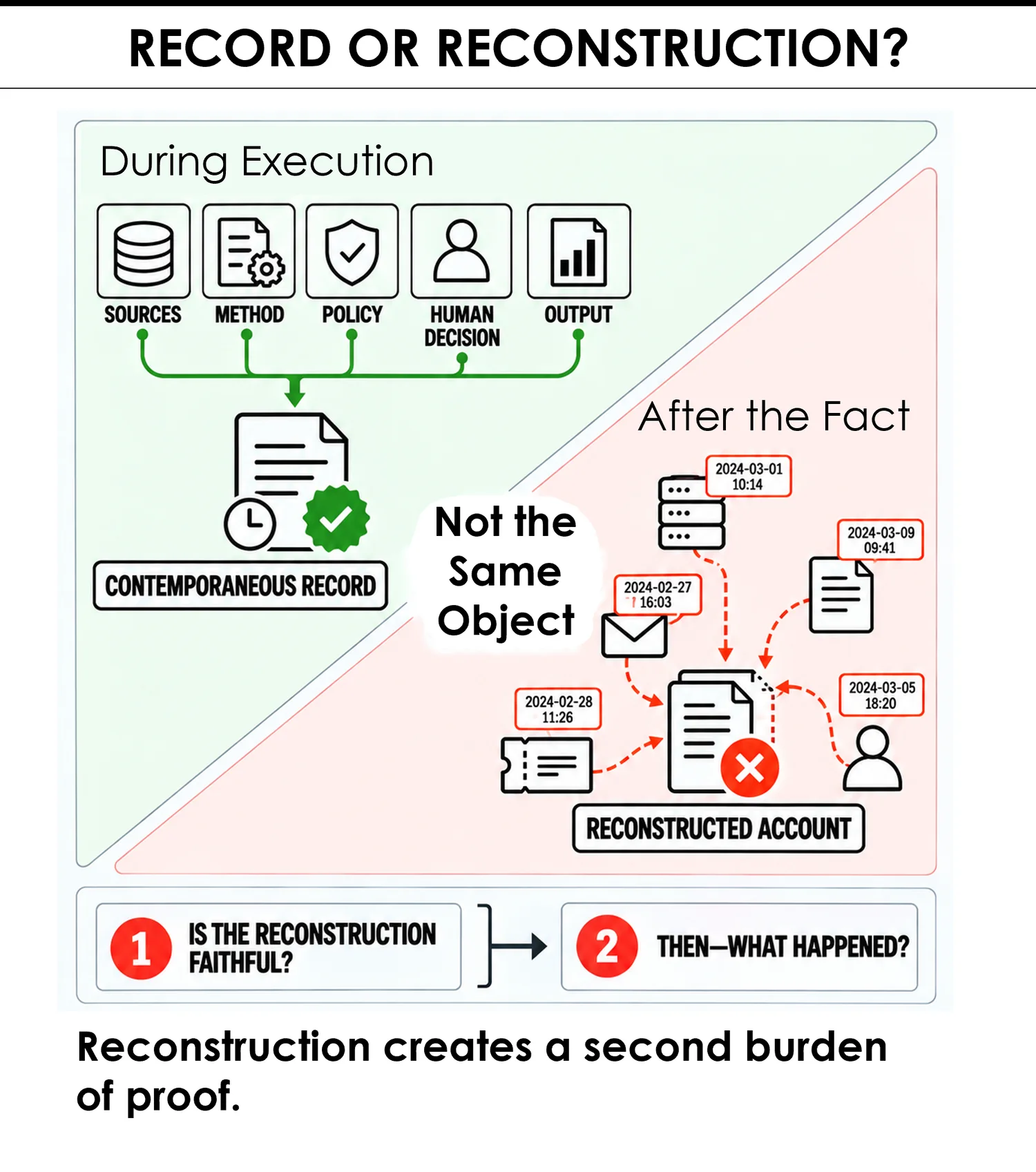
The reconstruction has to answer a question the record never faces. Before anyone can ask what happened, they have to establish that the reconstruction is faithful - a second burden of proof that did not previously exist.
Every regulated organization can and must produce an audit trail. The harder question is when that trail came into existence.
In many organizations, the record presented during an inspection or audit is not the record produced when the work occurred. It is assembled later from system logs, documents, email, meeting notes, ticket histories and the recollections of the people involved. The result may be careful. It may even be accurate. But it is not the same kind of object as a contemporaneous record.
A record states what occurred. A reconstruction argues that something probably occurred. That distinction matters most when the work is difficult to reconstruct and the consequences of getting it wrong are highest.
The Audit Trail That Appears on Demand
Most regulated work crosses several systems.
A source dataset arrives in one environment. Transformations occur in another. Analysis code is stored somewhere else. Decisions move through email, meetings and workflow tools. Approval may be captured in a document-management system that contains the final artifact but not the path that produced it. When a reviewer later asks how an output was created, the organization begins an investigation of its own history.
Teams search for:
- the source version that was available at the time,
- the code or method that was actually executed, If the code evolved, then the versioned code needs to be found.
- the parameters supplied to it,
- the policies then in force,
- the exceptions that were raised,
- and the person who accepted the result.
These fragments are then ordered into a narrative. The narrative is usually called the audit trail. More precisely, it is a reconstruction of one.
A Reconstruction Has a Second Burden of Proof
A contemporaneous record can still be incomplete or wrong. Recording something at the moment of execution does not make it true.
But a reconstruction introduces an additional evidentiary problem. Before it can be used to prove what occurred, the organization must first prove that the reconstruction itself is faithful.
That means establishing that:
- the collected fragments belong to the same execution,
- no relevant event is missing,
- timestamps are comparable across systems,
- later versions were not mistaken for earlier ones,
- retrospective explanations did not replace contemporaneous reasoning,
- and the people reconstructing the history did not unknowingly fill gaps with what usually happened.
The organization is no longer answering one question. It is answering two:
- What happened?
- Why should anyone trust the account assembled afterward?
The second question exists only because the system failed to create the first answer while the work was happening.
Time Does Not Treat Every Fragment Equally
Reconstruction becomes less reliable with age.
People leave. Vendors change. Systems are migrated. Logs expire. File stores are reorganized. A model is updated under the same product name. A script is corrected without preserving the exact version it replaced. A policy page shows its current text but not the text in force six months earlier.
None of these events is unusual. Together, they change what the organization can prove.
The degradation is not linear. One missing file may be recoverable. One missing file combined with a departed analyst, a replaced system and an undocumented exception may make the execution impossible to reconstruct at all.
This is why the moment of inspection is often the worst possible moment to begin building the record. The people with the most knowledge are also managing the response, the systems have moved on, and the organization is working backward from an output whose provenance is now in question.
Logs Are Necessary, but They Are Not the Record
Technical logs are often offered as the answer.
Logs can show that a service ran, a user authenticated, a file changed or an API returned a response. They are essential operational evidence.
But a regulated execution record has to connect more than events. It has to connect meaning.
It should establish:
- which evidence was used,
- which transformation produced each derived input,
- which method and version were selected,
- which assumptions and parameters governed the run,
- which policy permitted or restricted the action,
- which exceptions occurred,
- what a human reviewer was shown,
- and who held authority to accept, reject or escalate the result.
Those facts may exist in separate logs but their relationship usually does not. A pile of timestamps is not lineage and a collection of artifacts is not yet an execution record.
Documentation Cannot Repair Missing Execution Structure
The common response is to improve documentation. Teams add templates, standard operating procedures, required fields and post-run checklists. These measures can improve discipline. They cannot manufacture relationships the execution environment never captured. If the system did not bind an output to the exact inputs, method, policy and authority that produced it, a later document can only describe that relationship. It cannot establish it technically.
The result is the same as the difference between a receipt generated by a transaction and a memo written later explaining what was probably purchased. Both may be useful. Only one is native to the event.
The Record Has to Be a Product of Execution
A defensible audit trail cannot be an export assembled at the end of the process. It has to be one of the outputs of the process itself which changes the architectural requirement.
The system must preserve, as work occurs:
- the identity and version of every relevant input,
- the transformations between source and output,
- the method and execution environment,
- the policy decision that allowed the work to proceed,
- the human authority applied at controlled boundaries,
- and the final disposition of the result.
The record must be created whether the work succeeds, fails, is rejected or is abandoned. Otherwise, the system captures only the history it finds convenient to retain. This is not more detailed logging; it is execution designed to leave evidence behind.
Why This Matters More With AI
AI-assisted work increases the reconstruction and compounds the problem.
A single output may depend on retrieved evidence, prompt and model versions, tool calls, statistical routines, generated intermediate artifacts, policy checks and human review. Some steps are probabilistic and others are deterministic. Their authority is not interchangeable. If those relationships are not bound during execution, a later reviewer may be able to reproduce a plausible answer without reproducing the answer that was actually produced. That is a dangerous form of apparent reproducibility.
The question is not whether the system can generate the result again. It is whether the organization can establish why this result existed, under these conditions, at that moment.
The Question Buyers Should Ask
When a platform claims to provide an audit trail, the useful question is not: “Can you export the logs?”
It is: “When does the audit record come into existence?”
If the answer is after the work, after an exception, after a challenge or after an inspection begins, the organization does not yet have a record. It has the ingredients from which someone may be able to construct an argument. Sometimes that argument will succeed and sometimes it will not.
Regulated infrastructure should not make that uncertainty a normal operating condition. The takeaway is simple: An audit trail assembled after the fact is evidence of the reconstruction effort. It is not necessarily evidence of the original execution.
Ray Diwakar writes on provenance, decision infrastructure and governed execution in regulated life sciences. StromaOS is the system these arguments led to.