A System That Can Prove What It Refused to Do
The Negative Nobody Can Demonstrate
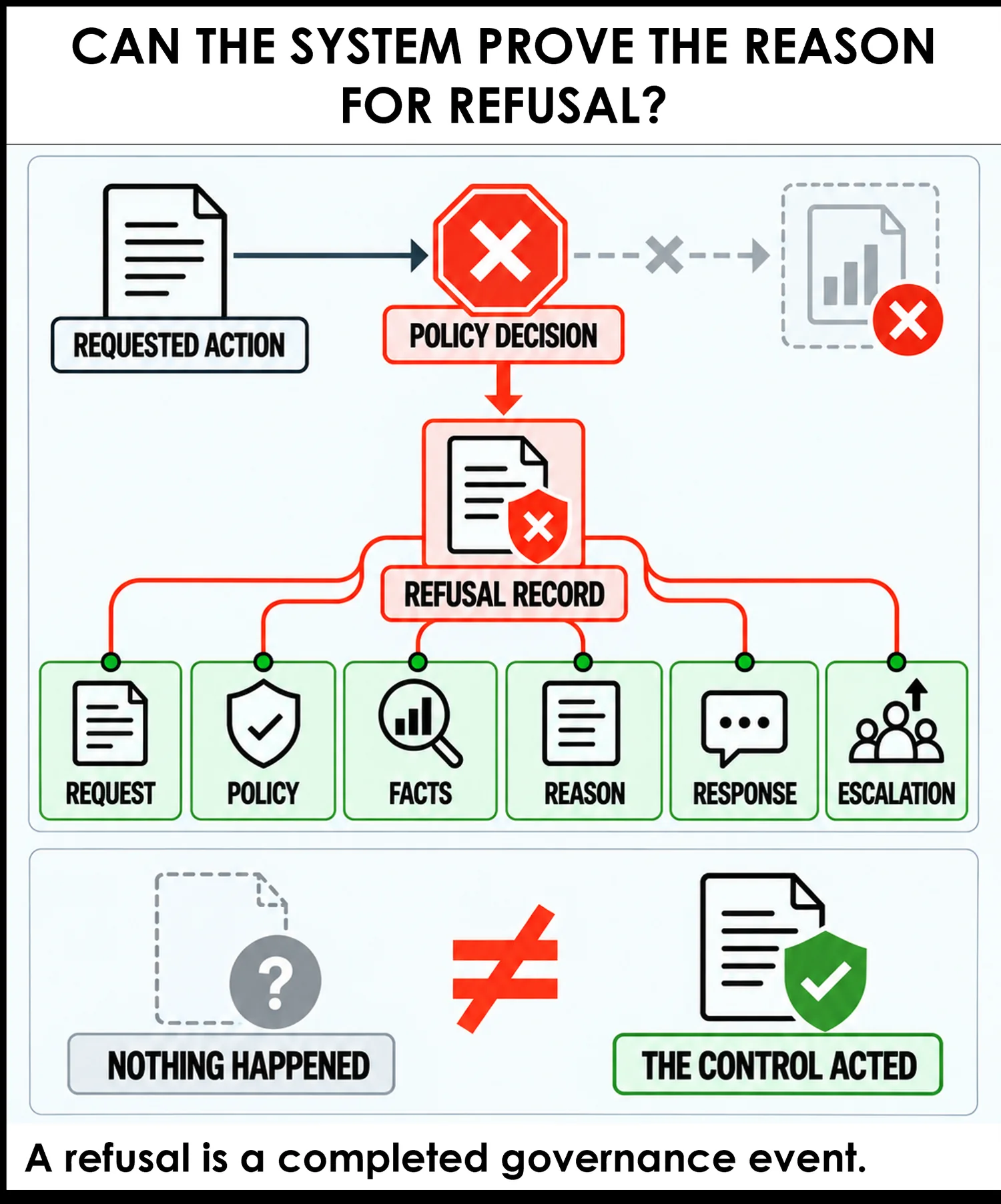
A refusal is a completed governance event, not an absence. Without a record, a control that worked and a request that was never made look identical.
Regulated systems are very good at recording completed activity. A user submitted a request, a process ran, a document was generated, an approval was entered and an output was released. But governance is not demonstrated only by the actions a system completed; it is also demonstrated by the actions it correctly prevented. That history is much harder to produce.
When a control works, the visible result is often nothing. The analysis did not run and the document was not released, the recommendation did not reach the next stage or the prohibited data was not used. No incident occurred, so the organization treats the control as successful. But a refusal that leaves no artifact is indistinguishable from a request nobody made.
The Question Behind the Audit Question
A reviewer asking for evidence of control is rarely satisfied by seeing only compliant outputs.
The deeper question is: “What would have happened if the conditions had not been met?”
Could an analyst have used a dataset outside its permitted purpose? Could an agent have released an unsupported claim? Could a method have run without required qualification? Could a workflow have bypassed the person who held decision authority?
Organizations often answer these questions with policy documents, access-control diagrams and descriptions of expected behavior. Those materials show what the system was intended to prevent. They do not show that the system actually prevented it. The strongest evidence is not a statement that the control exists. It is a record of the control being asked to decide-and declining.
Failed Events Are Not the Same as Governed Refusals
Many systems do record failures. Authentication logs capture denied access. Applications capture validation errors, workflow tools record rejected approvals and security systems generate alerts when a rule is violated. These are important records, but they are usually fragments. A governed refusal needs to preserve the decision, not merely the error.
That means recording:
- what action was requested,
- who or what requested it,
- the evidence and context available at the time,
- the policy or constraint that applied,
- the facts evaluated against that constraint,
- the reason the action was refused,
- what the requester was told,
- whether escalation or override was available,
- and what happened next.
“Permission denied” proves that a technical boundary responded. It does not necessarily prove that the correct policy was applied to the correct facts for the correct reason.
Absence Is Not Evidence of Control
Organizations routinely infer governance success from the absence of a bad outcome. No unapproved document was found or no prohibited analysis appeared in the submission or no unauthorized dataset was identified in the final evidence package.
But absence supports several possible explanations:
- the control stopped the action,
- a person noticed the problem and intervened outside the system,
- the request failed for an unrelated technical reason,
- the action occurred but was not detected,
- or nobody attempted it.
Only one of these demonstrates that governance worked as designed since without a refusal record, they can look identical.
Why Policy Documents Are Not Enough
A policy describes the rule. A refusal record shows the rule in operation. The distinction matters because policies are rarely self-executing as they depend on facts, classifications, thresholds, timing and authority. A policy may prohibit release when evidence quality falls below an approved threshold. To prove the control operated, the organization must show more than the policy text. It must show which evidence was assessed, which threshold applied, what result was calculated and why release was prevented.
Otherwise, the organization can prove that it had a rule but not that the rule governed the action in question. This is the difference between governance as documentation and governance as execution.
AI Makes Invisible Refusal More Dangerous
In conventional software, permitted behavior is usually enumerated in advance. AI-assisted systems introduce a much larger space of possible requests and generated actions.
An agent may be asked to:
- use evidence beyond its permitted purpose,
- infer a conclusion unsupported by the source,
- invoke a method outside its qualified context,
- disclose restricted information,
- skip a required human decision,
- or complete an action beyond its delegated authority.
The important safety behavior is often the agent’s decision not to comply. If that decision disappears into an application message or ephemeral conversation, the organization loses evidence of its most important governance successes. Worse, it cannot distinguish a system that reliably refused from one that simply happened not to cause visible harm.
Refusal Must Be a First-Class Event
Treating refusal as a first-class event changes the control layer. The system cannot represent outcomes only as success or technical failure. It needs a governed disposition that states:
- the requested action was understood,
- execution was evaluated,
- a specific constraint prevented it,
- no prohibited downstream action occurred,
- and any authorized path forward was communicated.
That disposition should be bound to the same evidence chain as completed work. A reviewer should be able to move from the request to the applicable control, from the control to the evaluated facts, and from those facts to the refusal. The refusal is then not missing work, it is a completed governance action.
Overrides Must Be Visible Too
Some refusals can be escalated and some policies permit a named authority to override a control under specified conditions. That does not weaken the refusal model, it makes it more important.
The record should distinguish:
- a control that allowed an action,
- a control that refused an action,
- a refusal that was escalated,
- and an authorized override with its stated basis.
Without those distinctions, an override can look like the control never fired. The organization then loses the very evidence that would show the exception was recognized and deliberately governed.
The Control Question Organizations Should Test
Organizations testing governance often begin with a permitted case and confirm that it completes. However, they should also submit a case that must not complete.
Then ask:
- Can the system show the exact action it declined?
- Can it identify the control that stopped it?
- Can it show the facts on which that decision rested?
- Can it prove that nothing downstream occurred?
- Can it show what escalation, if any, followed?
If the answer exists only in scattered logs or the memory of the person who tested the control, the governance success cannot be audited reliably.
The Evidence of Restraint
Regulated systems are usually judged by the quality of what they produce. As automated systems gain more authority, they will also be judged by the quality of what they decline to produce.
That requires a different evidentiary assumption:
The absence of an action is not the record, the decision not to act is the record. And unless that decision is captured when it occurs, a system cannot prove that its controls worked when they mattered.
Ray Diwakar writes on provenance, decision infrastructure and governed execution in regulated life sciences. StromaOS is the system these arguments led to.