“Validated” Is Not a Permanent Property
Why Every Method Has Standing Only for an Intended Use
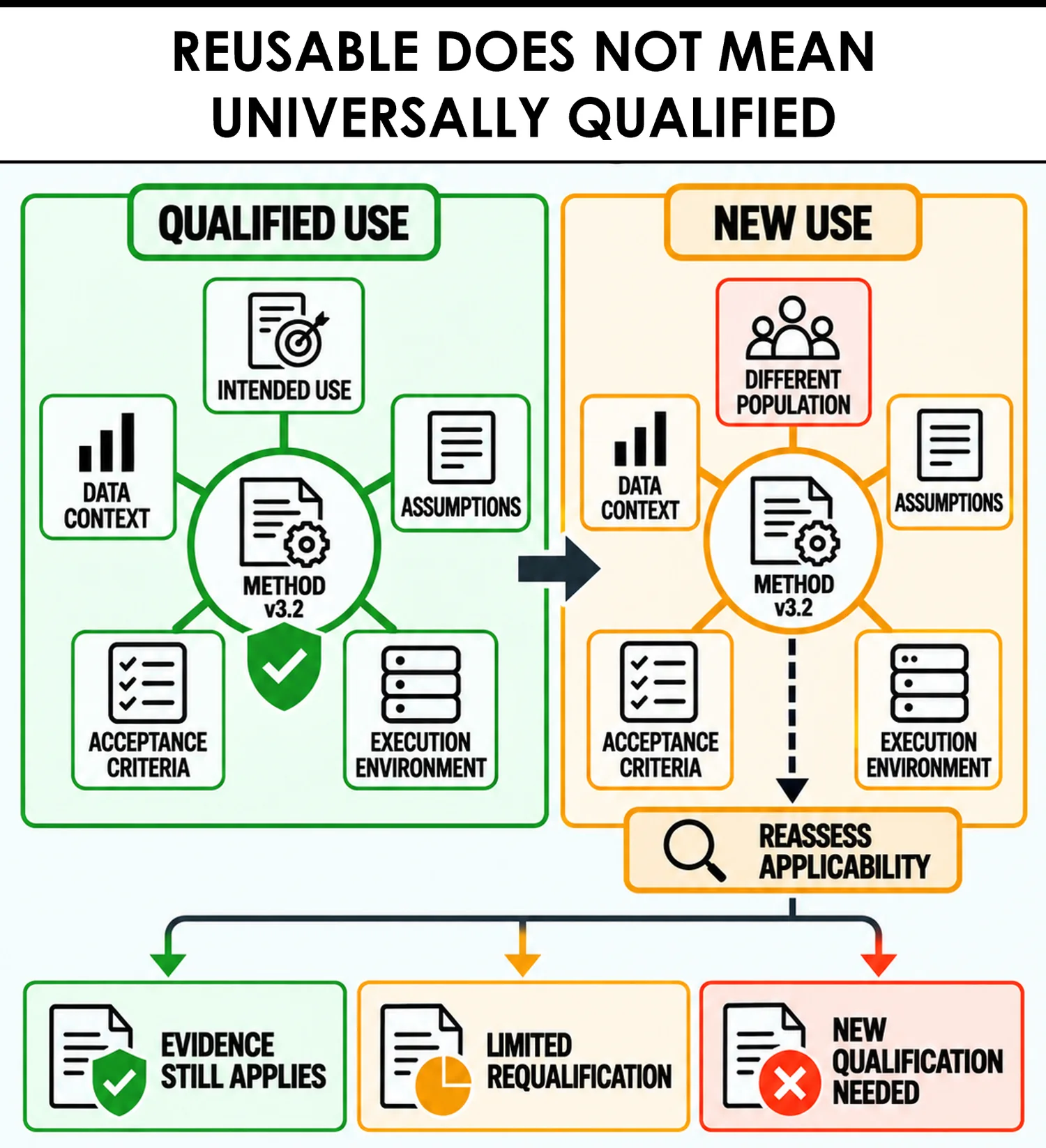
The method did not change. Its standing did. Reusable and universally qualified are not the same claim, and only one of them is safe to make.
In regulated work, few words create more comfort than “validated.” A validated method sounds settled, it has passed the necessary tests, earned standing and can now be trusted. But the word is often used as though validation were a permanent property of the method itself - like a version number or a manufacturer’s specification.
It is not. Validation and qualification always answer a more specific question: Fit for what intended use, in what context, under which assumptions? When those conditions change, the earlier evidence does not disappear. But neither does it automatically establish suitability for the new use.
A Method Does Not Act in the Abstract
Consider a statistical procedure that has been tested on a defined class of data, with specified preprocessing, sample characteristics, missing-data rules and acceptance criteria. Calling that procedure “validated” compresses all of those conditions into one word.
The compression becomes dangerous when the method is reused for:
- a different endpoint,
- a different population,
- a different data-generating process,
- a different decision consequence,
- a different implementation,
- or a different regulatory purpose.
The method may still be appropriate. But its prior standing does not answer the new question by itself.
A method qualified for exploratory signal detection does not automatically have standing for confirmatory inference. A model calibrated for one population does not become reliable in another because its code is unchanged. A workflow tested for internal review does not become submission-ready merely because the same steps were followed. Intended use is not a footnote to validation. It is the boundary of the claim.
The Word Hides a Relationship
“Validated” sounds like a property attached to an object. In practice, the defensible object is a relationship among:
- the method,
- its implementation and version,
- the data and operating environment,
- the intended use,
- the governing assumptions,
- the acceptance criteria,
- and the evidence demonstrating fitness.
Change one part of that relationship and the organization must determine whether the earlier evidence still applies. Sometimes the change is immaterial, sometimes a limited assessment is sufficient and sometimes requalification is necessary. The important point is that the answer must be made explicitly. The label cannot make that decision on the organization’s behalf.
Why Reuse Creates False Confidence
Modern analytical environments encourage reuse. Methods are packaged as libraries, templates, services and reusable agents. That is generally beneficial as reuse can reduce error, improve consistency and prevent teams from rebuilding common capabilities. But technical reusability and evidentiary standing are different things.
Software asks: “Can this method run here?”
Regulated practice asks: “What establishes that this method should be relied upon here?”
A reusable component may execute perfectly while being used beyond the context for which it was assessed. The problem is not necessarily the method. It is the unexamined transfer of confidence from one use to another.
AI Expands the Intended-Use Problem
AI systems make this distinction more important because their capabilities are broad and their interfaces encourage generalization. A model may summarize, classify, extract, recommend and generate using the same underlying service. Teams can therefore mistake capability breadth for qualification breadth. But performance in one task says little about another unless the relationship has been established.
A model shown to extract adverse-event terms accurately has not thereby been qualified to assess causality. A language model that retrieves relevant evidence has not been qualified to determine whether a claim is supported, likewise a system that drafts text acceptably has not earned authority to release it.
The model may participate in each workflow, but its permitted role, required controls and acceptance criteria should change with the intended use.
“Human in the Loop” Does Not Settle the Question
Human review is often offered as a universal response. It is an important control, but it does not eliminate the need to define intended use. Human reviewers need to know what they are being asked to rely on, what the system was assessed to do and where its known limitations begin. A reviewer presented with a fluent output may be less able-not more able-to detect that the method was used outside its qualified context.
Human authority is meaningful only when the system makes the boundary visible.
What the Record Should Carry
If intended use determines standing, the execution record should not say only that a “validated method” ran.
It should preserve:
- the exact method and implementation version,
- the intended use for which it was selected,
- the qualification evidence relied upon,
- the assumptions required for that evidence to remain applicable,
- the checks performed against the current context,
- any deviations or limitations,
- and the authority that accepted its use.
This converts validation from a label into an inspectable decision, it also makes change manageable. When the data, method or purpose changes, the organization can identify which part of the qualification relationship must be reassessed instead of treating every change as either harmless or catastrophic.
The Cost of Loose Vocabulary
This may sound like a dispute over terminology. It is not - Vocabulary shapes operating behavior. If teams believe a method is validated in the abstract, reuse feels presumptively safe and reassessment feels exceptional. If they understand that a method is qualified for a defined use, every new application begins with the correct question: does the existing evidence cover this context?
That difference affects method selection, change control, review effort and regulatory defensibility. It also prevents a common failure in technology procurement: accepting a platform-level claim of validation without asking which capabilities, configurations and intended uses the claim actually covers.
The Question Behind the Label
When someone says a method, model or system is validated, the next question should be immediate:
“For which intended use?”
Then:
- Under what assumptions?
- In which environment?
- Against what acceptance criteria?
- Using which version?
- What changed since that evidence was produced?
These are not objections to validation. They are what give the validation claim meaning.
The takeaway is simple:
“Validated” is not a permanent attribute that follows a method everywhere it goes. It is a bounded conclusion supported for an intended use. The boundary is not administrative detail, it is the claim.
Ray Diwakar writes on provenance, decision infrastructure and governed execution in regulated life sciences. StromaOS is the system these arguments led to.