What a Signature Means
Why Decision Rights Have to Resolve to a Named Human
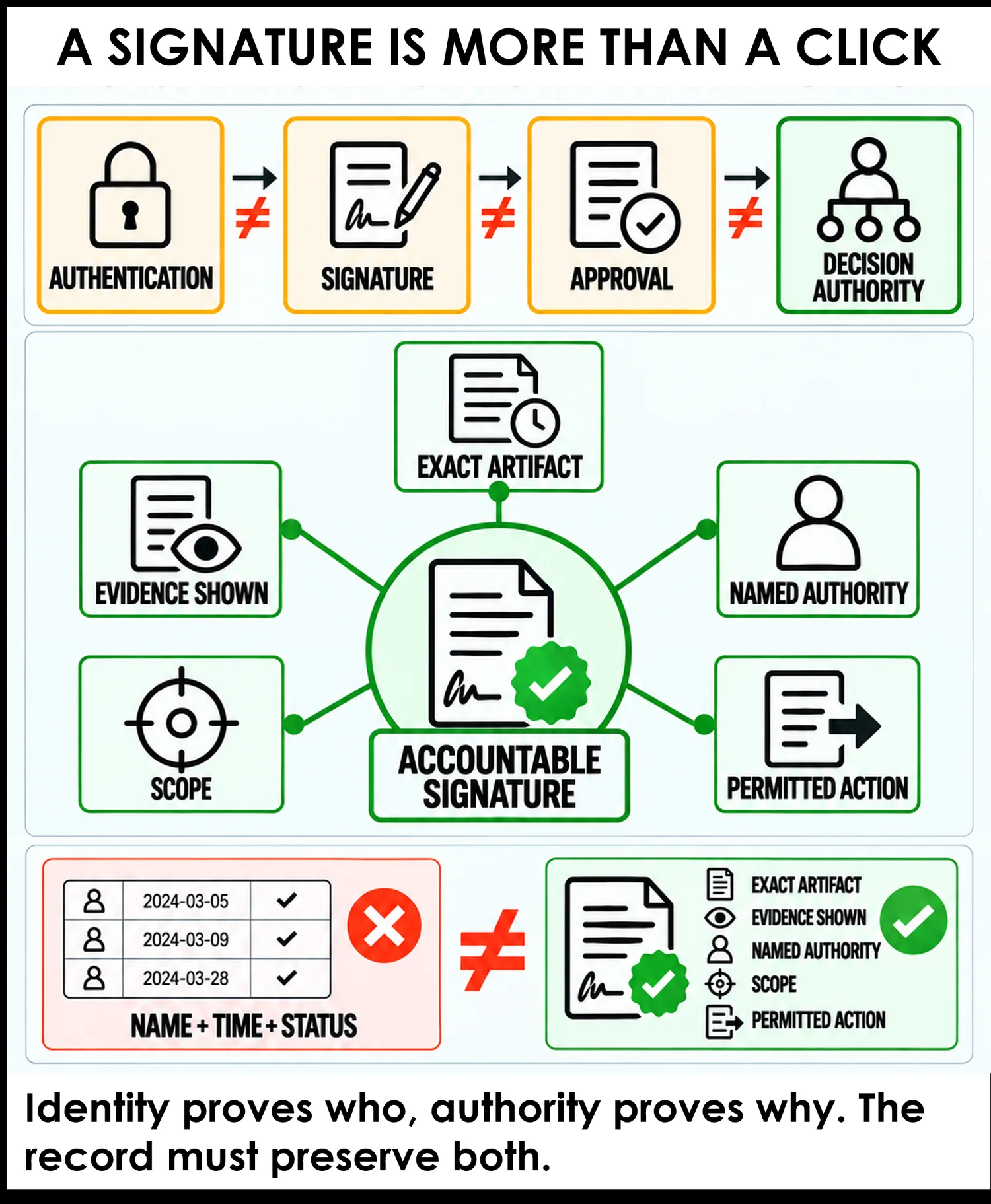
A name, a timestamp and a status is not a decision right. Identity proves who; only the surrounding record proves why they were entitled to decide it.
Regulated systems capture signatures everywhere. A user approves a document, accepts a result, releases an output or advances a workflow. The system records a name, a timestamp and a changed status. That may establish who clicked the button, but it does not necessarily establish what the signature meant.
To carry accountability, a signature has to answer more difficult questions:
- What was the person approving?
- What information was placed in front of them?
- Which decision right did they hold?
- What remained outside the scope of their approval?
- What were they accountable for if the decision proved wrong?
Without those facts, an approval is a workflow event and it is not yet a defensible exercise of authority.
Identity Is Not Authority
Systems frequently collapse four different events:
- authentication,
- electronic signature,
- approval,
- and decision authority.
Authentication establishes that a credentialed identity accessed the system. An electronic signature binds that identity to an action. Approval changes the state of a workflow. Decision authority establishes why that person had the right and responsibility to make the decision. These events may occur together and they are not interchangeable.
A person can be authenticated without being authorized. They can be authorized to review one aspect of an output without being authorized to release the whole. They can sign after being shown only a summary, while the decision actually depends on evidence they never saw. The name in the audit log does not resolve these distinctions.
What Was in Front of the Person?
A signature is often preserved more carefully than the decision context that preceded it. The final document and the approval remains.
But the system cannot reproduce:
- the evidence available at the time,
- the warnings or exceptions displayed,
- the version the person actually reviewed,
- the alternatives considered,
- the unresolved uncertainty,
- or the recommendations generated by automated systems.
This creates an evidentiary asymmetry. The organization can prove that a person approved something, but not precisely what they were asked to judge. If the underlying artifact later changes, the signature can appear to authorize information that was never in front of the signer. A meaningful signature must be bound to an immutable decision view: the relevant evidence, output, exceptions and governing context as they existed at the moment of decision.
Approval Does Not Transfer Every Responsibility
Complex regulated work contains several decision rights. One person may own scientific interpretation and another may own patient safety. Another may own statistical acceptability, regulatory strategy, data privacy or release authority.
A single approval state can flatten those distinctions. When it does, accountability tends to migrate. If a problem emerges later, responsibility is assigned to whoever signed last, whoever remains employed or whoever is available to explain the record. That is not governed accountability. It is retrospective allocation.
The system should state which right each person exercised and which rights remained elsewhere. Otherwise, “approved” becomes a broad word covering a narrow and possibly misunderstood act.
AI Creates an Authority Gap
AI-assisted workflows make this problem more apparent. An agent may assemble evidence, select tools, propose an analysis, generate interpretations and draft a final artifact. A human may then approve the result but what did that approval represent?
Did the person verify the source evidence? Review the method choice? Accept the model’s uncertainty? Confirm policy compliance? Approve the language? Authorize release?
If the interface presents only a polished final output, the signature may imply a depth of review the person could not reasonably perform. The presence of a human does not automatically create human control. Control exists only when the person has the authority, information, time and explicit decision boundary necessary to exercise judgment.
Named Human Authority Is Not a Click at Every Step
Resolving decision rights to a named human does not mean requiring manual approval for every automated action. That would make scalable execution impossible and would often produce ceremonial review rather than meaningful oversight.
A named human can delegate execution within defined limits. The important requirements are that:
- the delegated authority is explicit,
- its scope and duration are known,
- the system operates within those boundaries,
- exceptions return to the appropriate person,
- and consequential decisions cannot silently migrate to an automated component.
The human remains accountable for the decision boundary even when the system performs the work inside it. This is different from placing a generic “human in the loop” after the output has already been formed.
What a Defensible Signature Record Contains
A meaningful signature record should preserve more than identity and time.
It should contain or bind to:
- the exact artifact or decision presented,
- the evidence and material assumptions visible to the signer,
- the exceptions, refusals and unresolved uncertainties,
- the specific authority being exercised,
- the scope of the approval,
- the policy or procedure under which that authority existed,
- the signer’s disposition and any stated rationale,
- and the downstream action the signature permitted.
If the decision is later challenged, the organization should be able to reconstruct not merely who approved it but the decision that person actually made.
The Problem With Available Accountability
When systems do not preserve authority explicitly, accountability tends to follow availability.
The person still at the company explains the work. The current process owner inherits an earlier decision. A senior executive becomes responsible because the original specialist has left. In an AI-assisted workflow, the chain may end with no person able to say which judgment was theirs and which was supplied by the system. This is exactly when an audit trail assembled after the fact becomes an argument. The organization has the signature but must reconstruct its meaning. The signature should have carried that meaning from the beginning.
The Question to Ask About Approval
When evaluating a regulated workflow, do not ask only:
“Does it support electronic signatures?”
Ask:
“Can the system show what this person had the authority to decide, what they were shown, and what their signature permitted?”
If the answer is only a username, timestamp and status change, the system has recorded an interaction. It has not fully recorded accountability. A signature is meaningful when it binds evidence, authority and consequence to a named human. Anything less proves that someone clicked approve. It does not prove what approval meant.
Ray Diwakar writes on provenance, decision infrastructure and governed execution in regulated life sciences. StromaOS is the system these arguments led to.