Execution Goes to the Data
Why Where Work Runs Is a Process Question, Not an IT Preference
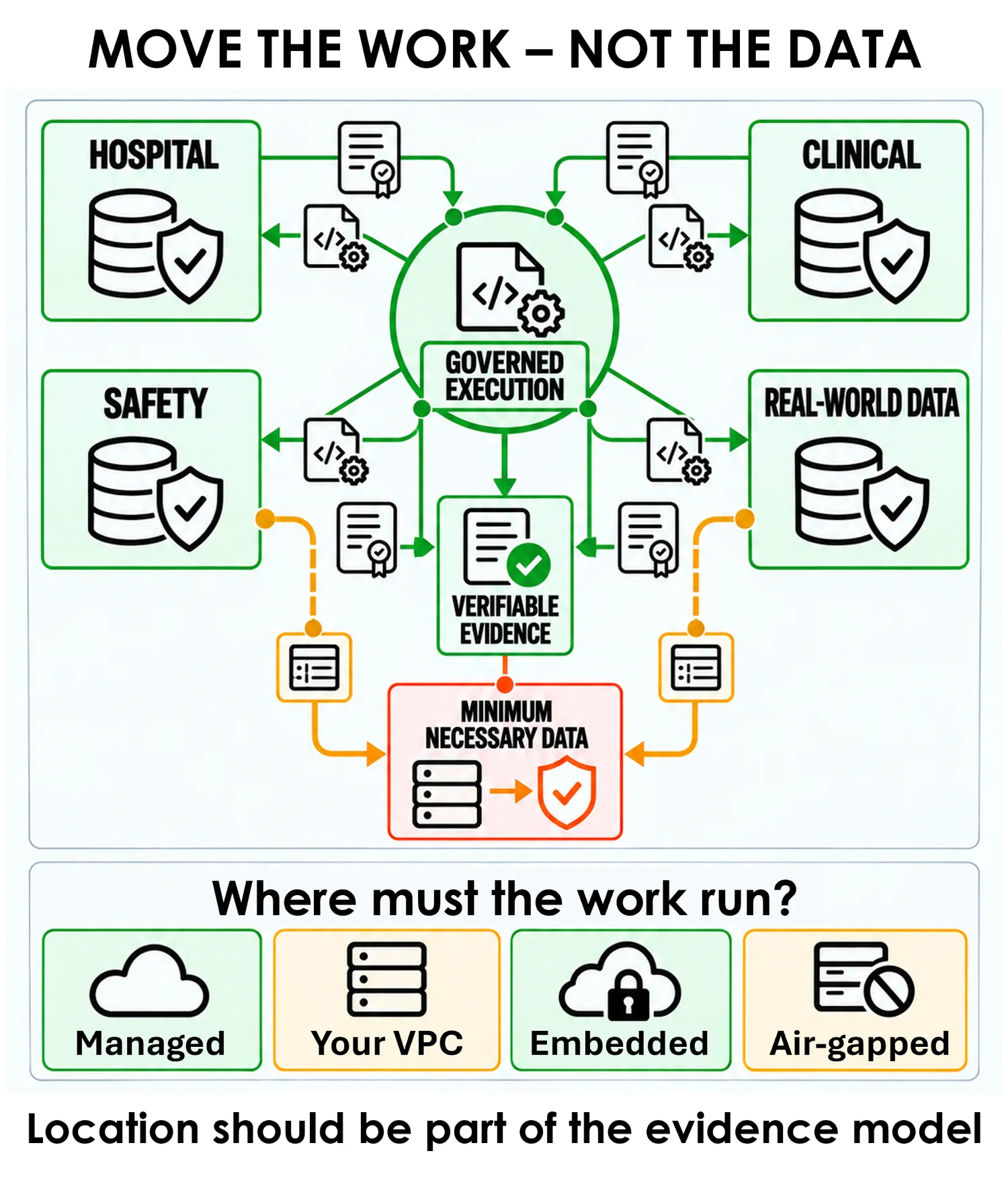
Send the work, not the data. Location stops being an IT preference and becomes part of the evidence model - which is why the deployment posture is the first question worth settling.
Most analytical systems begin with the same assumption: To work with data, first assemble the data somewhere.
Sources are extracted, copied, normalized and loaded into a new environment. Controls are then added around the copy, entitlements are recreated, residency is documented, Consent and purpose restrictions are translated into the rules of the receiving system.
This architecture is familiar because centralization makes analysis convenient. It also creates many of the governance problems organizations later try to solve. Once data leaves its source boundary, the system must reproduce context that was native to the source: who controls it, where it may reside, which purposes are permitted and what must happen when those conditions change. The alternative is not to prohibit data movement. It is to stop treating movement as the default requirement for execution. Where appropriate, execution can go to the data.
Copies Inherit Data but Not Automatically Its Context
A copied row may be identical to its source, its governance context is not. At the source, the data sits inside an existing environment of ownership, access, retention, consent and operational meaning. After extraction, those conditions have to be represented again. That representation may be technically and legally sound, but it is now another control surface that must remain aligned with the source.
- If an entitlement changes, both environments must respond.
- If consent is withdrawn, the organization must identify every relevant copy and derivative.
- If a residency rule changes, the location of the copy becomes consequential.
- If a source value is corrected, downstream versions may no longer match.
Centralization does not remove governance complexity. It relocates and multiplies it.
The Minimum Necessary Movement
Some work genuinely requires data to move. Cross-source linkage, pooled analysis, model training and certain forms of statistical computation may require records or derived datasets to be brought together.
The better design question is: What is the minimum movement necessary to complete this task defensibly?
Sometimes the answer is row-level data. Sometimes it is a governed subset, an aggregate, a parameter update, a signed result or an evidence record describing what was executed at the source. Sometimes data has to be normalized to the destination system. The architecture should be capable of distinguishing among these cases instead of applying one centralization pattern to all of them.
Sending Work Instead of Rows
When execution goes to the data, the analytical instruction, method and governing policy are delivered into the approved environment. The work runs there, subject to the controls of that boundary.
What returns may include:
- an approved aggregate,
- a derived artifact,
- a statistical result,
- a model contribution,
- or a signed evidence record describing the inputs, method, policy and authority involved.
The purpose is not merely to reduce data transfer. It is to preserve the relationship between execution and the environment that has standing to govern the source. This changes the unit of exchange. Instead of assuming that rows must travel before knowledge can be produced, the system can exchange governed evidence generated where the data already resides.
Deployment Posture Determines the Evidence Boundary
Deployment is often treated as an infrastructure preference to be settled late in procurement. Cloud or customer environment. Shared or single tenant. Connected or air-gapped. These choices are usually compared through cost, security and operational convenience. They also determine the boundary inside which evidence is created.
A shared environment may simplify integration and elastic operation but requires explicit tenant isolation and controlled movement. A single-tenant environment creates a more dedicated boundary but still requires agreed interfaces. Customer-VPC deployment places execution closer to the customer’s controls and data. Air-gapped deployment preserves the most restrictive boundary but materially changes integration, updates, model operations and support.
These are not four packaging options for the same evidentiary posture. They create different relationships among data custody, execution authority and the record produced by the work. That is why deployment should be one of the first architectural decisions, not the last commercial checkbox.
The Integration Cost Is Real
Bringing execution to the data is not free. The execution environment must be deployable, observable and governable across boundaries. Methods and dependencies must be versioned, updates must be controlled, evidence records must be verifiable outside the environment that created them and failures must be diagnosable without casually exporting restricted information.
In more isolated postures, integration effort increases materially. Air-gapped environments require deliberate release processes, local model and dependency management, and operating procedures that do not assume continuous access to an external control plane. These costs should be stated plainly. The architectural advantage is not that distributed execution eliminates complexity. It is that complexity is accepted where it preserves a boundary the organization considers important.
Evidence Must Travel Better Than Data
Distributed execution creates its own risk: each environment can become a black box that returns a result without enough information to assess it. That is not a governed alternative to centralization, it is merely distributed opacity.
For execution to travel safely, the returned evidence must establish:
- which data or approved representation was used,
- where the work ran,
- which method and version executed,
- which policies were applied,
- what restrictions governed the output,
- who or what held execution authority,
- and whether a named human decision was required.
The result should be independently verifiable without requiring the recipient to possess every source row. This is what makes signed evidence more than a report. It carries the execution context needed to evaluate the claim.
AI Makes Location More Consequential
AI systems increase pressure to centralize because models improve when more context is available in one place. They also increase the consequences of doing so indiscriminately. Prompts, retrieved context, embeddings, model inputs and generated artifacts can all create new representations of restricted information. A hosted model call may move data beyond the boundary even when the application itself remains inside it.
A governed architecture must therefore route not only the task but the method. Some work may use deterministic local computation. Some may use a local model. Some may permit a hosted model after approved transformation. Some may require human judgment without model access at all. Execution locality and method selection become part of the same control decision.
The First Question
Organizations often begin platform discussions by asking what the system can connect to.
A more consequential question is: “Where must this work be allowed to run?”
That question exposes data residency, entitlement, consent, model access, integration effort and evidentiary requirements before they are buried inside implementation. It also prevents a common mistake: designing the analytical workflow first and discovering later that its assumed data movement cannot be defended.
The takeaway is not that data should never move. It is that movement should be justified by the work, not assumed by the architecture. Move the minimum necessary data. Where movement is unnecessary, move governed execution instead.
Ray Diwakar writes on provenance, decision infrastructure and governed execution in regulated life sciences. StromaOS is the system these arguments led to.