Why the Third Study Costs Less Than the First
Retained Structure, and Why Most Organizations Never Get It
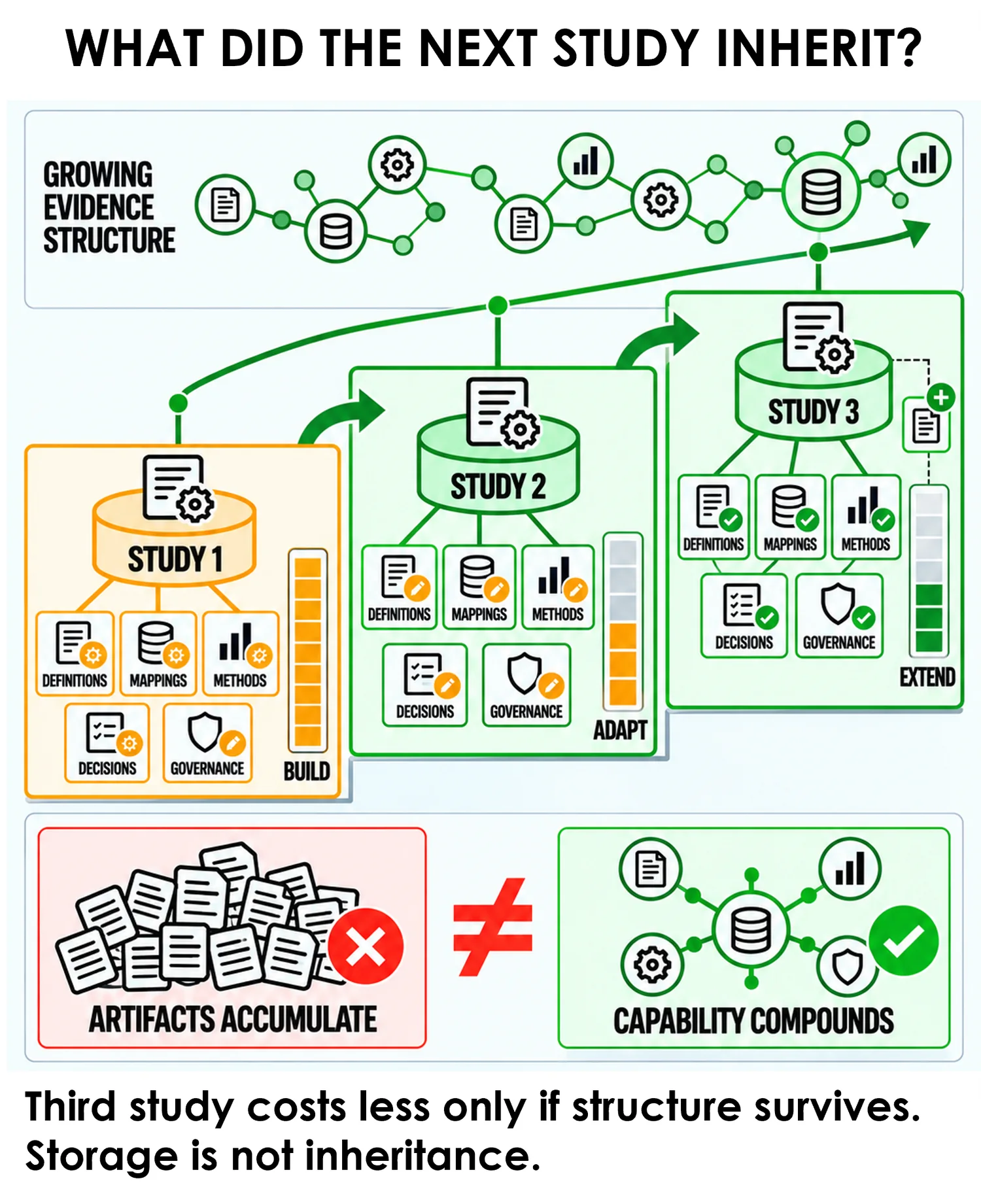
Storage is not inheritance. Artifacts accumulate; capability compounds - and only one of those makes the third study cheaper than the first.
The second study is rarely treated as a continuation of the first. It receives a new plan, a new team, a new workspace and often a new group of consultants. Cohort definitions are rewritten, source mappings are rebuilt, methods are reconfigured, earlier decisions are rediscovered through documents and meetings.
The organization may reuse templates and copy prior code, but much of the understanding that made the first study work has already disappeared. This loss is usually treated as a staffing or documentation problem. It is neither.
The deeper problem is that most systems preserve artifacts but not the structure that produced them and the structure is the part that would have made the next study cheaper.
What the First Study Actually Builds
A study produces more than its stated deliverables. While generating evidence, the team also develops:
- operational definitions,
- source-to-concept mappings,
- cohort and endpoint logic,
- terminology resolutions,
- method configurations,
- quality thresholds,
- exception-handling rules,
- review pathways,
- and reasoning about why one approach was accepted while another was rejected.
This is real organizational knowledge. It often costs more to establish than the final document suggests.
Yet much of it remains distributed across code, tickets, spreadsheets, slide decks, email and the memories of specialists. The final artifact survives, however the executable understanding behind it does not.
Why Documentation Does Not Solve the Problem
Organizations respond rationally by creating documentation standards, handover templates, knowledge bases and lessons-learned repositories. These can improve continuity, but they rarely create compounding. The reason is that documentation captures descriptions of work. The next study needs reusable structure.
A paragraph explaining how a cohort was defined is not the definition itself. A slide describing a mapping decision is not a governed mapping that can be applied again. A report naming the selected method does not preserve its configuration, assumptions, qualification basis and acceptance criteria.
The document tells the next team that knowledge once existed. It does not make that knowledge operational.
Consultants Are Not the Problem
Complex regulated work requires specialized expertise. Consultants often provide it well.
They are brought in because the customer’s systems, data and processes are difficult to understand and because the work must be completed under time pressure. During the engagement, the consultants build valuable context. They learn how definitions differ across teams, which source fields are trustworthy, which exceptions matter and how decisions are actually made.
When the engagement ends, that understanding often leaves with them. This is not necessarily a failure of handover or good faith. The environment gave the consultants no durable place to leave the structure they created. The next engagement therefore begins with rediscovery. The customer pays again to rebuild understanding of its own operation. Each rebuild can deepen the dependency that made the consultant necessary in the first place.
The Difference Between Memory and Structure
Organizational memory is often imagined as searchable content. If every document can be found, the organization assumes the knowledge has been retained.
Search helps people locate prior artifacts. It does not reliably answer:
- Which definition is currently authoritative?
- Where was it used?
- Which source concepts did it depend on?
- Under what assumptions was the method accepted?
- Which policy governed the decision?
- What changed after the study?
- Which rejected alternatives should not be repeated?
These are relationship questions. Retained structure preserves the relationships among evidence, definitions, methods, policies, decisions and outcomes. It allows the next study to inherit something it can inspect, adapt and execute-not merely something it can read.
What the Second Study Should Inherit
The simplest test of institutional knowledge is not how many documents the organization retained. It is what the second study inherited from the first.
Did it inherit:
- only final reports,
- searchable supporting artifacts,
- reusable cohort and endpoint definitions,
- governed semantic mappings,
- executable method configurations,
- qualification evidence and known limitations,
- prior decisions with their rationale,
- quality gates and escalation rules,
- and a traceable record of approaches that were refused or abandoned?
Each step represents a deeper form of retention. Only the later steps materially reduce the amount of understanding that must be rebuilt.
Plans for Compounding Require Deliberate Forethought
Teams are often told to reuse more, but reuse cannot depend on personal discipline alone. If the system stores outputs separately from the definitions, mappings, methods and decisions that produced them, reuse will remain manual and fragile. Compounding requires the execution environment to preserve structure as work occurs.
That means a definition created for one study becomes a governed object with lineage. A mapping records its source, meaning and accepted use. A method configuration remains attached to its assumptions and qualification evidence. A human decision retains what was presented and why it was accepted. A refusal records the path that should not be repeated. The next study can then begin from an inspectable prior state instead of an empty workspace and a folder of documents. This is not a knowledge-management feature added after execution. It is a consequence of how execution was recorded.
Reuse Does Not Mean Blind Repetition
Inherited structure should not be mistaken for automatic reuse. A definition appropriate for one protocol may not fit another. A mapping may become stale, a method may require requalification for a different intended use and more importantly, policies change.
The benefit is not that the next study avoids judgment. It is that the next team can see what already exists, why it existed and what must be reconsidered. It can compare the new context with the old one rather than reconstructing the old context first.
Good institutional memory accelerates change because it makes prior assumptions visible. Bad institutional memory accelerates copying because it hides them.
Why the Third Study, Not Merely the Second
The second study tests whether structure was retained, the third reveals whether the organization compounds. By then, reusable definitions have either become governed assets or fragmented into another generation of local copies. Semantic mappings have either accumulated with lineage or multiplied without authority. Method configurations have either become easier to qualify or harder to distinguish. Exceptions have either improved the control system or disappeared into project history.
If the architecture retains structure, each study contributes to the operating capability of the next. The organization becomes faster without depending on the same people remembering more. If it retains only artifacts, every study adds volume to the repository while the cost of understanding remains largely unchanged.
The Economic Question Hidden Inside Knowledge Management
Organizations often measure knowledge management through repository use, search activity or document completeness. The more revealing measure is economic:
How much work did the next study avoid rebuilding?
Not because it cut corners. Because qualified definitions, mappings, methods, decisions and governance structures were already available to be evaluated and reused. If the answer is “very little,” the organization has storage, not compounding. The takeaway is simple: The third study costs less than the first only when the first two left behind more than artifacts.
They must leave behind structure the organization can still inspect, govern and execute after the original people are gone.
Ray Diwakar writes on provenance, decision infrastructure and governed execution in regulated life sciences. StromaOS is the system these arguments led to.