How Many Times Has Your Data Changed Hands?
Why Data Exchange Depth Matters More Than Coverage in the AI Era
The Question No One Asks (But Everyone Should)
When organizations evaluate data-driven AI platforms, the conversation usually starts with scale:
- How many patients?
- How many households?
- How much geographic coverage?
But there is a more important question that is almost never asked:
How many times has this data already changed hands before it reaches your system?
In modern healthcare data markets, data rarely travels directly from its source to its final use. Instead, it is licensed, aggregated, transformed, re-licensed, and re-packaged - often multiple times.
This matters far more than most buyers realize.
Data Exchange Is Not Binary - It’s Layered
We often speak about data as if it were either:
- first-party or
- third-party
In reality, data exists on a continuum of exchange depth.
A dataset may originate in a hospital, but by the time it powers an AI model, it may have passed through:
- one aggregator,
- then a specialty data vendor,
- then an analytics platform,
- and only then into a decision system.
Each exchange adds distance from the source - and with it, complexity, opacity, and risk.
Introducing Data Exchange Depth (DED)
Data Exchange Depth (DED) is a simple concept:
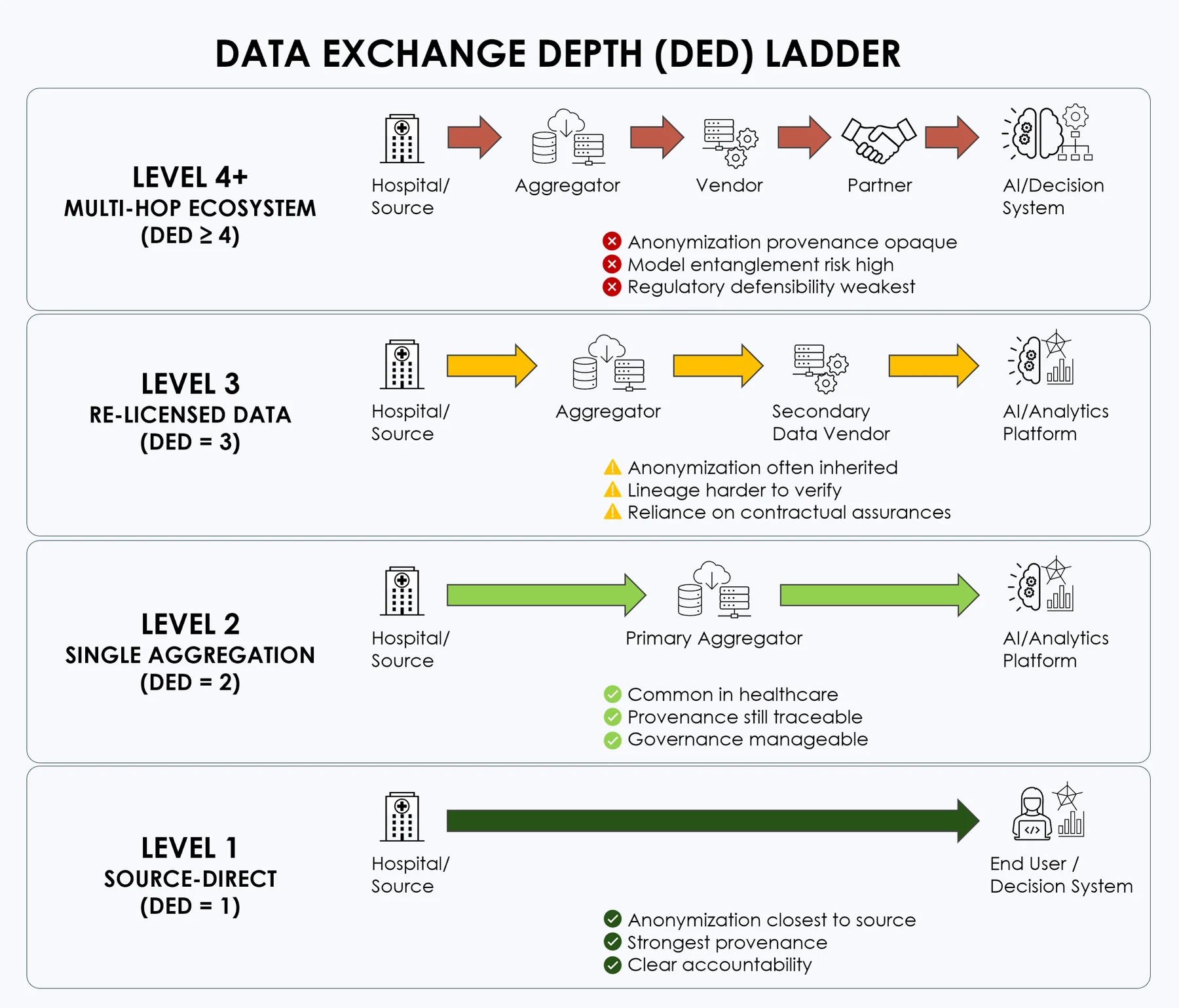
Each rung adds a hand the data passed through. The label on the dataset does not change as you climb, but what you can prove about it does - and the change is not linear.
DED is the number of distinct entities that have controlled, transformed, licensed, or re-issued a dataset before it is used for analytics or AI.
It is about lineage clarity and not about finding fault.
Examples
- DED = 1 Data moves directly from source to user.
- DED = 2 Data flows through a single intermediary before use.
- DED = 3+ Data is re-licensed or aggregated multiple times before consumption.
As DED increases, provenance clarity decreases - non-linearly.
Why Exchange Depth Changes the Risk Profile
At each exchange point, three things tend to happen:
- Anonymization moves further from the source
- Technical guarantees are replaced by contractual assurances
- Context is lost
By the third or fourth exchange, downstream consumers often rely on:
- representations in contracts,
- inherited policies,
- and summary documentation
- not on verifiable artifacts from the original anonymization process.
This is not unusual. It is how modern data markets function. But it has consequences.
The Anonymization Question That Actually Matters
Most platforms correctly state that they use “de-identified data.”
The harder question is: At which point in the exchange chain did anonymization actually occur?
Was it:
- at the source system?
- after aggregation?
- after linkage?
- only at output time?
And just as important:
Can that anonymization step be traced back to a specific system, policy, and moment in time - or is it inferred downstream?
As exchange depth increases, answering this question precisely becomes difficult - sometimes impossible.
Coverage Amplifies Risk When Provenance Is Weak
Large datasets are often framed as safer because they are “statistical” or “population-level.”
But scale cuts both ways.
When anonymization provenance is unclear:
- more volume increases re-identification surface area,
- more linkage increases model entanglement,
- more layers of aggregation can compromise regulatory submissions.
In other words:
Coverage without lineage clarity does not reduce risk - it compounds it.
Why This Matters More in AI Systems Than in Analytics
Traditional analytics can often tolerate provenance ambiguity. AI systems cannot.
Because models:
- encode relationships learned during training,
- internalize linkages that may no longer be permissible (permissions were pulled or license no longer valid), and
- are difficult to selectively unwind if an upstream dataset is challenged or removed.
When AI decisions are later scrutinized, the question is no longer just:
- “Was this data de-identified?”
It becomes:
- “Under what assumptions was this model trained - and do those assumptions still hold?”
Exchange depth makes that question harder to answer.
This Is a Structural Issue, Not a Vendor Issue
It’s important to be clear:
This is not a critique of any specific data provider, hospital, aggregator, or analytics company.
Multi-hop data licensing exists because:
- healthcare data is fragmented,
- aggregation creates value,
- and reuse enables innovation.
But as AI systems move closer to decision-making, the industry must acknowledge a simple reality:
Every additional exchange introduces uncertainty that cannot be fully abstracted away.
A Different Design Assumption
If data exchange depth is inevitable, then AI systems should be designed with that assumption in mind.
That means:
- treating data as replaceable,
- separating decision logic from data availability,
- minimizing dependence on opaque linkages,
- and ensuring human judgment remains part of the loop.
In future articles, we’ll explore what this means for system architecture, governance, and regulatory readiness.
For now, the takeaway is simple:
Before asking how much data a system has, ask how far that data has traveled.
Ray Diwakar writes on provenance, decision infrastructure and governed execution in regulated life sciences. StromaOS is the system these arguments led to.