Where Did Anonymization Actually Happen?
Why Timing Matters More Than Technique in AI-Driven Systems
“De-Identified” Is an Outcome - Not a Location
In discussions about healthcare data and AI, the term de-identified is often treated as a binary property:
- Either data is de-identified
- Or it is not
But this framing misses a critical dimension.
De-identification is not just what was done - it is where and when it was done.
And in modern data pipelines, that distinction matters far more than most architectures assume.
Anonymization Has a Point of Origin
Every anonymization process happens at a specific place in a pipeline, under:
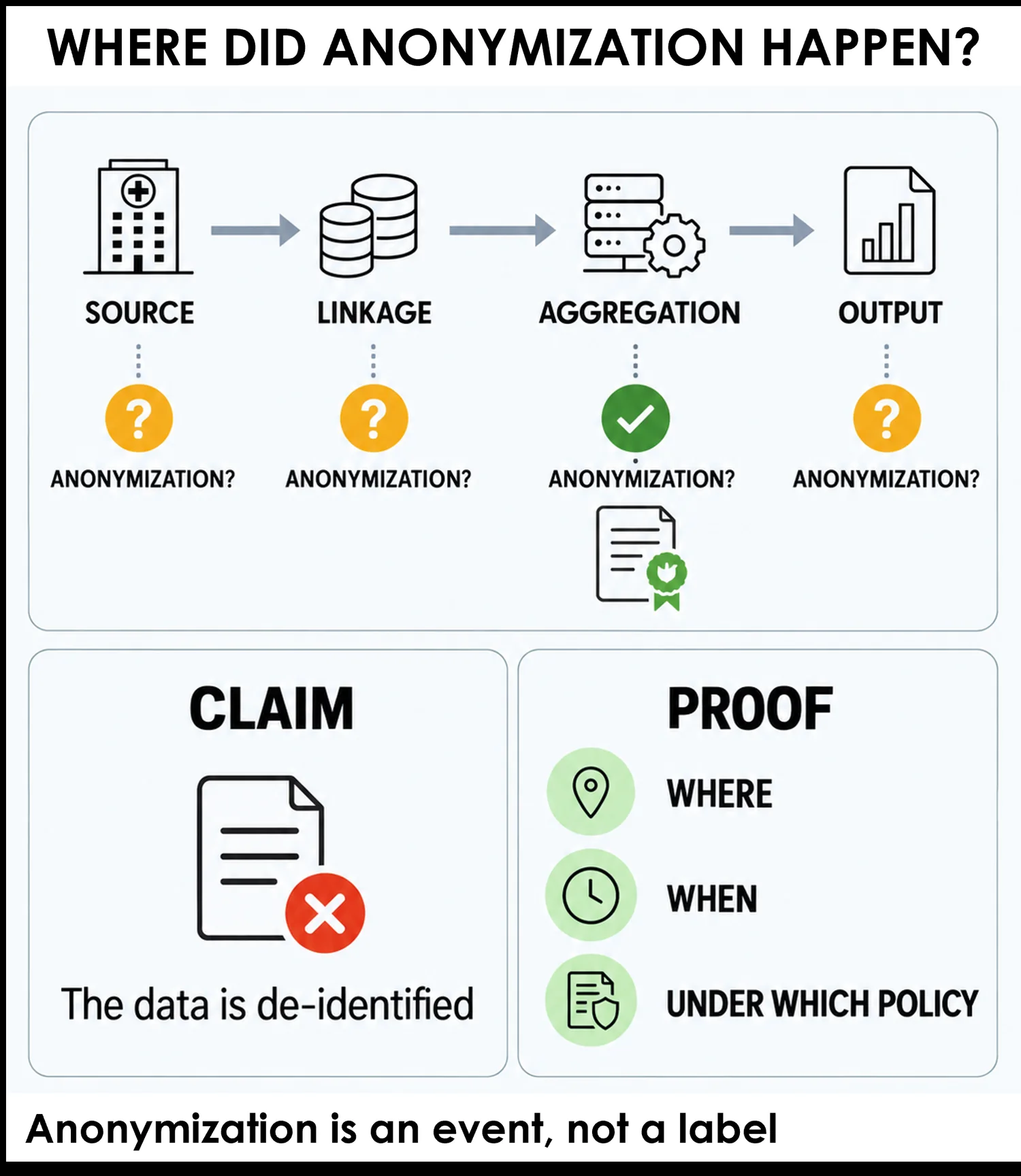
De-identified is an outcome, not a location. The claim is the same at every rung; what you can prove about it is not.
- a specific system,
- a specific policy,
- and a specific set of assumptions.
Yet downstream users are often several steps removed from that moment.
The further data travels, the harder it becomes to answer a deceptively simple question:
At which point did anonymization actually occur?
Four Places Anonymization Commonly Happens
Across healthcare data ecosystems, anonymization typically occurs in one of four locations. These are not equivalent.
1. At the Source System
What this looks like
- A hospital, lab, or registry anonymizes data before it leaves
- Identifiers are removed or irreversibly transformed
- Only de-identified data is ever shared downstream
Strengths
- Strong provenance
- Clear accountability
- Lowest re-identification risk
Limitations
- Rare at scale
- Requires mature governance and tooling at every source
- Results in heterogeneous anonymization standards
This is the strongest form of anonymization - and the least common.
2. At a Primary Aggregation Layer
What this looks like
- Identifiable or lightly tokenized data flows into an aggregator
- Aggregator performs anonymization
- Data is then licensed onward
Strengths
- Operationally efficient
- Common in healthcare data markets
- Often well-documented at the aggregator level
Risks
- Aggregator temporarily processes identifiable data
- Downstream users rely on assurances, not direct artifacts
- Anonymization assumptions become inherited, not verified
This model works - but it introduces distance between the buyer and the anonymization event.
3. After Multi-Source Integration
What this looks like
- Data from multiple providers is combined
- Identity resolution or linkage occurs
- Anonymization is applied after integration
Why this matters At this point, anonymization is no longer protecting raw records - it is protecting constructed relationships.
Even if identifiers are removed later:
- linkage logic has already been applied
- models may already reflect cross-source associations
Downstream consumers rarely have visibility into this step - only contractual confirmation that it occurred.
4. At the Output or Presentation Layer
What this looks like
- Raw or linked data feeds models
- Outputs are masked, summarized, or aggregated
- Anonymization applies to results, not inputs
This is the weakest form of anonymization.
Why?
- Models may encode identity-derived structure
- Outputs are safe only as long as assumptions hold
- Reproducing or auditing decisions becomes difficult
This approach is increasingly scrutinized - not because it is malicious, but because it is fragile.
Why Timing Changes the Risk Profile
The same anonymization technique can have very different implications depending on when it is applied.
Consider two systems that both claim “de-identified data”:
- One anonymizes at ingestion
- The other anonymizes after aggregation and modeling
Legally, they may appear similar. Architecturally, they are not.
As anonymization moves later in the pipeline:
- provenance clarity declines
- audit complexity increases
- downstream systems inherit assumptions they cannot verify
The Provenance Gap
Most downstream consumers do not receive:
- the original anonymization code,
- the exact transformation rules,
- or the full policy context under which anonymization occurred.
Instead, they receive:
- summaries,
- attestations,
- and contractual representations.
This creates what we can call a provenance gap:
A point beyond which anonymization is assumed, not demonstrated.
The gap widens with every additional data exchange.
Why AI Makes This Harder - Not Easier
In traditional analytics, provenance gaps are often tolerable.
In AI systems, they are not.
Why?
Because AI models:
- internalize structure learned during training
- retain influence from data relationships even after masking
- cannot easily be “partially unwound” if an upstream assumption is challenged
If a dataset is later restricted, reinterpreted, or withdrawn, the question becomes:
Can this model still be defended - or even retrained - without it?
That question is unanswerable without knowing where anonymization actually happened.
This Is Not About Fault - It’s About Design Assumptions
It’s important to be explicit:
- This is not an accusation
- This is not a claim of non-compliance
- This is not a critique of any one sourcing model
It is an observation about system design under uncertainty.
Healthcare data ecosystems are complex by necessity. But complexity does not eliminate responsibility - it changes where responsibility must live.
A Design Implication (Not a Verdict)
If anonymization timing cannot always be proven downstream, then systems must be designed to:
- tolerate incomplete provenance
- minimize reliance on opaque linkages
- isolate decision logic from data fragility
- allow graceful degradation when assumptions change
- preserve human judgment in high-stakes paths
In other words:
Decision systems should assume that anonymization provenance will sometimes be contested - and still function responsibly.
Looking Ahead
In the next article, we’ll explore what happens when AI decisions depend on post-hoc anonymization, and why some architectures degrade gracefully while others do not.
For now, the takeaway is straightforward:
“De-identified” tells you what. “Where anonymization happened” tells you whether you can defend it later.
And in the age of AI-driven decisions, that difference matters.
Ray Diwakar writes on provenance, decision infrastructure and governed execution in regulated life sciences. StromaOS is the system these arguments led to.