What Happens When AI Decisions Depend on Post-Hoc Anonymization?
Why Masking Outputs Cannot Repair Upstream Assumptions
When Anonymization Comes After the Fact
In many AI systems, anonymization is treated as a final step:
- data is collected,
- integrated and modeled,
- decisions are produced,
- and only then identifiers are removed or masked.
This approach is often described as safe because:
- outputs are aggregated,
- individual identities are hidden,
- compliance checklists are satisfied.
But this logic assumes something that is rarely examined:
That anonymization applied at the end of a pipeline can neutralize assumptions made earlier in the system.
In AI-driven decision systems, that assumption does not hold.
Post-Hoc Anonymization Defined
Post-hoc anonymization refers to anonymization that occurs:
- after multi-source integration,
- after identity resolution or linkage,
- after model training,
- or only at the output or reporting layer.
The data looks anonymous at the end. But the system has already learned from data that was not.
Why AI Systems Are Different From Reports
In traditional analytics:
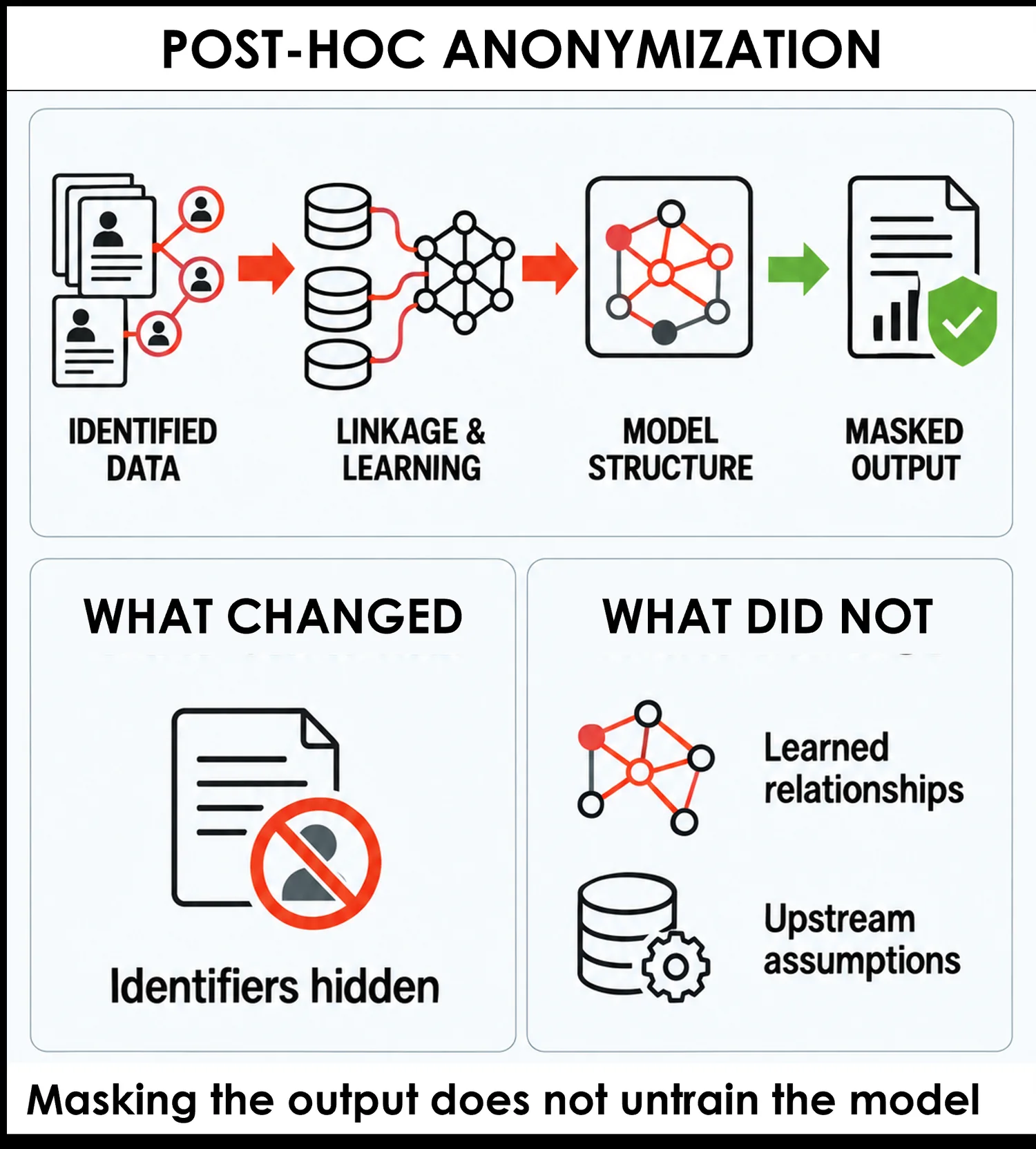
Identifiers are hidden in the output. The relationships they created inside the model are untouched, along with every upstream assumption that shaped them.
- anonymization at output time may be sufficient,
- calculations can often be rerun with different filters,
- assumptions are visible and reversible.
AI systems behave differently.
Models:
- internalize relationships,
- encode structure learned during training,
- propagate assumptions across predictions.
Once learned, these structures cannot be selectively masked away.
If identity-derived relationships shaped the model, anonymizing the output does not remove their influence.
The Irreversibility Problem
Consider an AI system trained on data that was:
- linked across institutions,
- correlated at the household or patient level,
- anonymized only after linkage.
Even if:
- identifiers are removed,
- outputs are aggregated,
the model still reflects:
- who was linked to whom,
- how often,
- and under what inferred patterns.
If a downstream user later asks:
“Can we defend this decision without relying on that linkage?”
The answer is often unclear - or no.
Why This Matters in Real Decisions
As AI moves into:
- eligibility determination,
- cohort selection,
- intervention prioritization,
- regulatory or evidentiary workflows,
the cost of being wrong changes.
At that point, the question is no longer:
- “Is this data anonymous?”
It becomes:
- “Are the assumptions that shaped this decision still permissible today?”
Post-hoc anonymization offers no protection against that challenge.
The Audit Gap
When decisions are reviewed - internally or externally - auditors often ask:
- Which datasets influenced this outcome?
- When were those datasets anonymized?
- Could the decision be reproduced if one dataset were removed?
- Which assumptions are baked into the model itself?
Systems built around post-hoc anonymization struggle to answer these questions because:
- lineage is implicit,
- training data is entangled,
- and decision logic is inseparable from learned structure.
What looks compliant at the surface becomes fragile under inspection.
Model Entanglement Is the Hidden Risk
One of the least discussed consequences of post-hoc anonymization is model entanglement.
When a model is trained on:
- multi-hop data,
- post-integration anonymized datasets,
its parameters reflect relationships that may no longer be defensible.
If an upstream dataset is:
- restricted,
- reinterpreted,
- or withdrawn,
the model cannot easily be “partially untrained.”
Remediation often means:
- full retraining,
- loss of historical comparability,
- or acceptance of residual risk.
At scale, this is not just costly - it is destabilizing.
Why Output Masking Is Not a Safety Net
It is tempting to believe that:
- aggregated results,
- masked identifiers,
- population-level summaries
are sufficient safeguards.
But safety in AI systems is not about what is visible - it is about what influenced the decision.
If sensitive or weakly governed relationships shaped the outcome:
- masking the result does not change that fact,
- and does not strengthen its defensibility.
This Is a Design Issue, Not a Compliance Failure
To be clear:
- post-hoc anonymization is not inherently negligent,
- many systems evolved this way for practical reasons,
- and legal compliance may still be satisfied.
The issue is architectural.
Systems that depend on post-hoc anonymization implicitly assume:
- stable permissions,
- static interpretations,
- and uncontested lineage.
Those assumptions are increasingly unsafe.
Designing for Assumption Failure
A more resilient approach starts from a different premise:
Assumptions about data use will change over time. Systems must survive that change.
This means:
- minimizing reliance on opaque linkage,
- isolating deterministic logic from learned inference,
- preserving human oversight in high-impact decisions,
- and ensuring decisions can degrade gracefully when data constraints tighten.
In such systems, anonymization is not a patch - it is one part of a broader governance strategy.
The Question That Matters Most
As AI systems are evaluated, the most important question is no longer:
“Are the outputs anonymized?”
It is:
“If anonymization assumptions were challenged tomorrow, what decisions could we still defend?”
Systems built on post-hoc anonymization struggle to answer that.
Systems designed around provenance, replaceability, and tiered decision-making do not.
Looking Ahead
In the next article, we’ll explore how decision infrastructure can be designed to remain stable even when data assumptions shift - and why separating analytics, inference, and judgment is becoming essential.
For now, the takeaway is simple:
Anonymization applied at the end of a pipeline cannot correct assumptions made at the beginning.
And in AI-driven decision systems, assumptions are everything.
Ray Diwakar writes on provenance, decision infrastructure and governed execution in regulated life sciences. StromaOS is the system these arguments led to.