Why Provenance Matters More Than Volume
When More Data Increases Risk Instead of Reducing It
The Seductive Comfort of Big Numbers
In healthcare AI, volume has become a proxy for credibility.
Platforms advertise:
- millions of patients,
- national coverage,
- near-complete household penetration.
The implicit promise is simple:
More data means more accuracy - and therefore less risk. Right? That assumption is understandable and is also increasingly wrong.
Volume Solves Statistical Problems - Not Governance Problems
Large datasets are excellent at addressing:
- sampling bias,
- sparsity,
- variance.
They are much less effective at addressing:
- lineage ambiguity,
- consent uncertainty,
- anonymization provenance,
- regulatory defensibility.
In fact, when provenance is unclear, volume amplifies risk rather than mitigating it. This is the paradox modern AI systems are running into.
Provenance Is About How, Not How Much
Data provenance answers questions like:
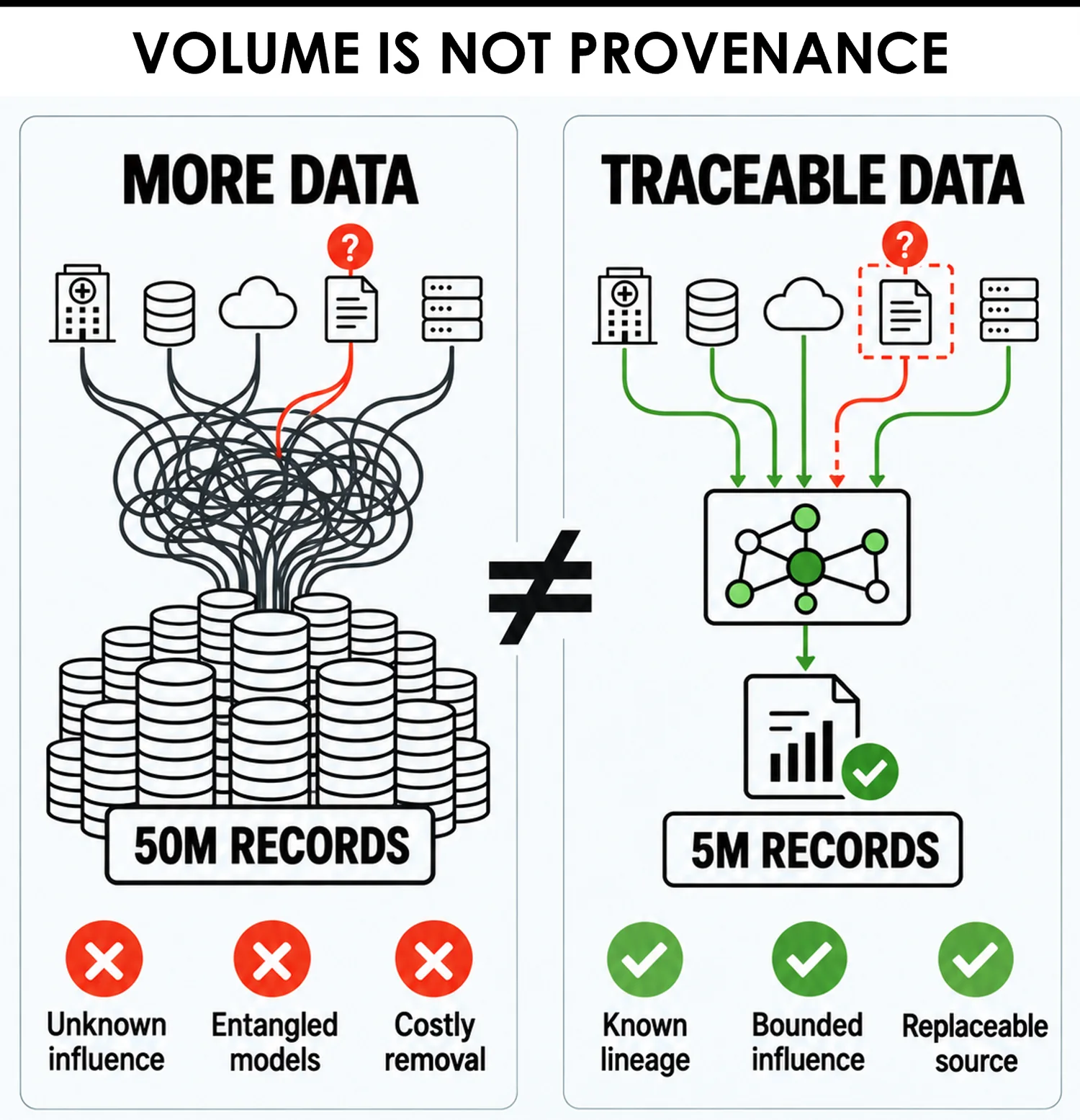
The larger dataset is the harder one to defend. When a source is challenged, scale decides how expensive the answer is, not how convincing.
- Where did this data originate?
- Under what policy was it collected?
- When and where was it anonymized?
- Who had control at each step?
Volume answers none of these.
A dataset with:
- 5 million records
- weak provenance
is often riskier than:
- 500,000 records
- strong, traceable lineage
Yet the market continues to reward scale over clarity.
The Compounding Effect of Exchange Depth
As discussed in earlier articles, most datasets used in AI systems have passed through multiple hands.
Each exchange:
- replaces technical guarantees with contractual ones,
- abstracts away original context,
- inherits assumptions that downstream users cannot fully verify.
When volume is layered on top of this:
Every additional record multiplies the consequences of a flawed assumption.
A single ambiguous anonymization step becomes embedded across:
- more models,
- more workflows,
- more downstream decisions.
Why “Population-Level” Is Not a Safe Harbor
Large datasets are often defended as being:
- aggregate,
- statistical,
- non-individual.
But AI systems do not reason statistically - they reason structurally.
Models learn:
- relationships,
- correlations,
- latent groupings.
If those structures were learned from data with:
- unclear anonymization timing,
- multi-hop lineage,
- inherited permissions,
then the model encodes those uncertainties - regardless of output aggregation. Volume does not erase this. It entrenches it.
The Audit Problem Grows With Scale
When decisions are challenged - by regulators, auditors, or internal governance teams - the question is rarely:
“How big was the dataset?”
It is almost always:
- Which data sources influenced this outcome?
- Could this decision be reproduced without them?
- What assumptions were embedded during training?
- What would change if a source were withdrawn?
Large, entangled datasets make these questions harder to answer, not easier. At scale, even small provenance gaps become operationally expensive to resolve.
AI Turns Data Into Infrastructure - and Infrastructure Demands Defensibility
As AI systems move from:
- analytics → recommendations → decisions,
data stops being a resource and becomes infrastructure.
Infrastructure is judged not by:
- size,
- speed,
- novelty,
but by:
- reliability,
- auditability,
- failure modes,
- and behavior under stress.
In infrastructure systems: Unclear provenance is a design flaw, not a documentation issue.
When Volume Becomes a Liability
There are now real scenarios where more data creates more risk:
- A regulator questions one upstream data source
- A hospital revokes a data-sharing agreement
- A privacy standard is reinterpreted
- A linkage method is deemed too permissive
In tightly coupled systems, removing one dataset can invalidate:
- trained models,
- downstream decisions,
- historical analyses.
At high volume, remediation becomes slow, costly, and reputationally risky.
A Different Optimization Target
The emerging shift is subtle but decisive. Instead of optimizing for maximum coverage, forward-looking systems are optimizing for:
- minimum defensible data
- maximum traceability
- replaceability of inputs
- graceful degradation
This does not mean “less data.” It means data that can be explained, defended, and substituted when assumptions change.
Provenance as a First-Class Design Constraint
Systems designed for provenance treat data differently:
- Inputs are assumed to be volatile
- Lineage is explicit, not implicit
- Decision logic is separated from data availability
- Human review is preserved where stakes are high
These systems do not collapse when a dataset is questioned, they adapt and volume becomes additive - not foundational.
The New Question Buyers Should Ask
The most important question is no longer: “How much data does this system have?”
It is: “If one data source were challenged tomorrow, what would actually break?”
Systems built on opaque scale struggle to answer this; systems built on provenance can.
Looking Ahead
In the next article, we’ll explore what happens inside AI models when provenance assumptions change - and why some architectures can unwind those assumptions while others cannot.
For now, the conclusion is straightforward: In AI-driven decision systems, provenance is a safety feature, volume is not.
And as regulation, scrutiny, and accountability increase, markets will begin to price that difference in.
Ray Diwakar writes on provenance, decision infrastructure and governed execution in regulated life sciences. StromaOS is the system these arguments led to.