Why Decision Infrastructure Treats Data as Replaceable
Designing AI Systems That Survive Changing Assumptions
The Mistake We Keep Repeating
For years, data strategy has been framed around accumulation:
- more sources,
- more records,
- more coverage.
The implicit belief is that data itself is the asset - and that systems become stronger as that asset grows.
But as AI systems move from analytics into decision-making, this assumption quietly breaks down.
In decision systems, data is not the asset. The ability to act defensibly when data changes is.
Decisions Outlive Data
Data is volatile by nature.
It changes because:
- licenses expire,
- partners withdraw,
- regulations evolve,
- interpretations shift,
- errors are discovered.
Decisions, however, persist.
They must be:
- explained,
- audited,
- defended,
- and often revisited long after the data that informed them has changed.
Any system that assumes its data inputs are permanent is implicitly assuming its decisions will never be questioned.
That assumption no longer holds.
The Core Principle of Decision Infrastructure
Decision infrastructure is built around a simple premise:
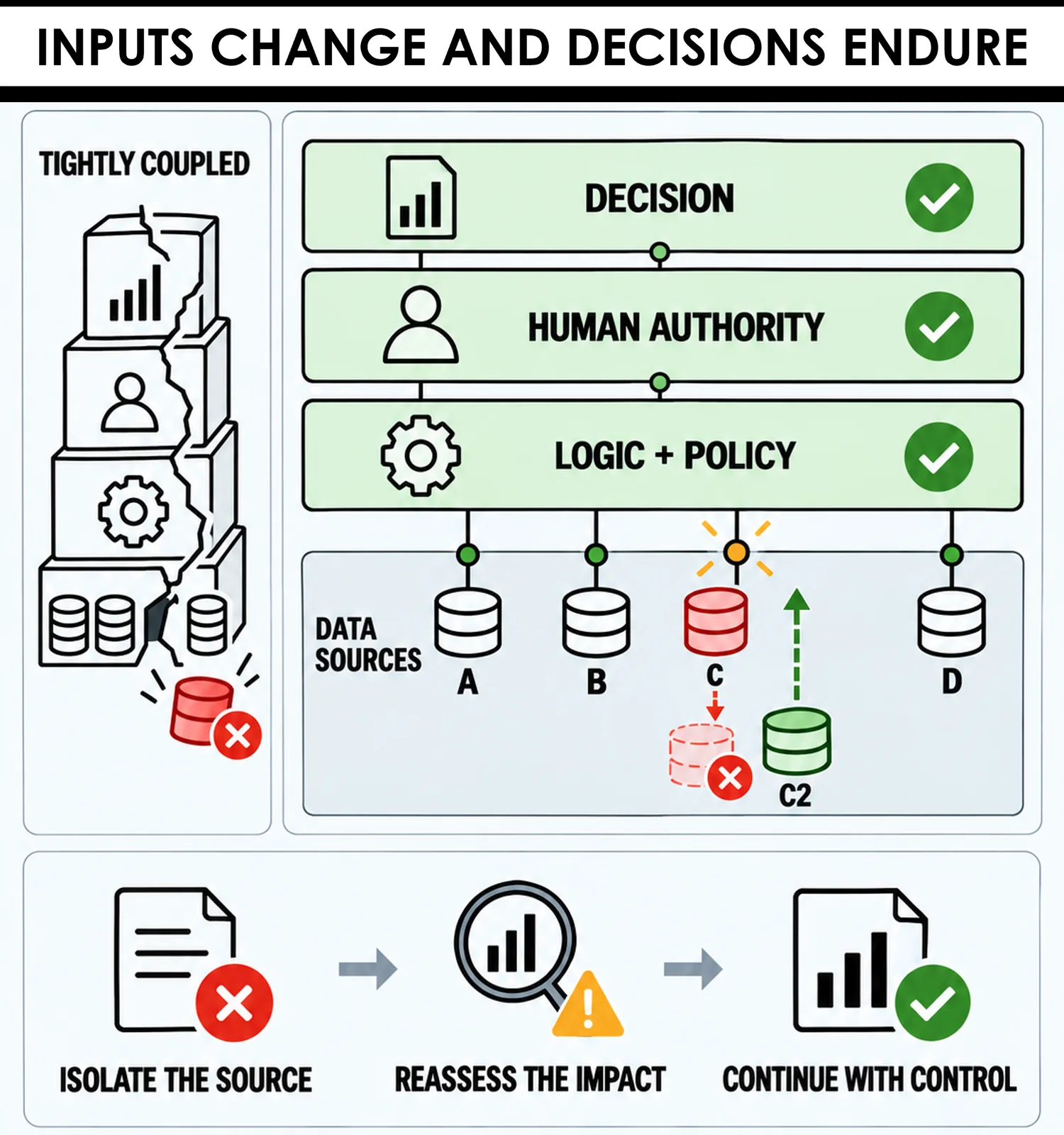
Same event, two outcomes. Coupling decides whether losing a source is a substitution or a rebuild.
Inputs are replaceable. Decisions are not.
This does not mean data is unimportant. It means data cannot be the foundation.
The foundation must be:
- logic,
- policy,
- traceability,
- and controlled escalation of uncertainty.
Why Data-Centric Architectures Become Fragile
In data-centric systems:
- data feeds are tightly coupled to models,
- models are tightly coupled to outputs,
- outputs are tightly coupled to decisions.
When one input changes, the entire system destabilizes.
Typical symptoms include:
- full model retraining to address narrow issues,
- inability to isolate which data influenced which outcome,
- difficulty reproducing historical decisions,
- increasing reliance on narrative explanations instead of technical ones.
As systems scale, these problems compound.
Replaceability as a Design Constraint
Decision infrastructure flips the optimization target.
Instead of asking:
“How do we get more data into the system?”
It asks:
“How easily can the system continue functioning if a dataset disappears?”
Replaceability becomes a first-class requirement.
That requires:
- explicit separation between data, reasoning, and action,
- deterministic layers that do not depend on probabilistic inference,
- and clear boundaries between automation and human judgment.
Layered Decisions, Not Monolithic Intelligence
One of the most effective ways to achieve replaceability is to avoid concentrating “intelligence” in a single place.
In resilient systems:
- simple, explainable logic resolves most cases,
- statistical methods handle uncertainty where appropriate,
- predictive models are used selectively,
- generative systems are constrained,
- humans remain authoritative when stakes are high.
When higher layers fail or are constrained, lower layers still function.
The system degrades - it does not collapse.
Why Provenance Still Matters - But Differently
Decision infrastructure does not ignore provenance.
It acknowledges reality:
- provenance may be incomplete,
- anonymization assumptions may change,
- upstream guarantees may weaken over time.
Instead of assuming provenance will always be perfect, the system is designed to:
- surface uncertainty,
- limit its impact,
- and prevent it from contaminating the entire decision chain.
This is a fundamentally different posture from systems that depend on pristine, stable data.
The Role of Humans in Replaceable Systems
In fragile architectures, humans are used to patch failures.
In decision infrastructure, humans are part of the design.
Human input is not a fallback. It is a deliberate control point.
This ensures that:
- novel situations are handled responsibly,
- automated reasoning can be overridden,
- and accountability remains clear even when data shifts.
Replaceability without human judgment is illusionary.
Why This Matters More as Regulation Increases
As regulatory scrutiny grows, the question will not be:
“Did you have enough data?”
It will be:
- Can you explain this decision?
- Can you reproduce it?
- Can you show what changed?
- Can you demonstrate control?
Systems that treat data as foundational struggle here. Systems that treat data as replaceable do not.
From Data Platforms to Decision Infrastructure
This is the architectural transition now underway:
This shift is subtle - but irreversible.
The New Competitive Advantage
In the next phase of AI adoption, the strongest systems will not be those with the most data.
They will be the systems that can say:
“If our data assumptions change tomorrow, we still know how to act - and why.”
That is not a feature. It is infrastructure.
Closing Thought
Data will always matter. But data will never be stable enough to anchor decisions indefinitely.
As AI systems take on more responsibility, the only durable strategy is to design for change.
Decision infrastructure treats data as replaceable - because decisions must endure.
Ray Diwakar writes on provenance, decision infrastructure and governed execution in regulated life sciences. StromaOS is the system these arguments led to.